[Preprint]. 2024 Sep 10:2024.09.10.612305.
doi: 10.1101/2024.09.10.612305.

Epidermal Growth Factor Receptor Signaling Governs the Host Inflammatory Response to Invasive Aspergillosis

Affiliations

Epidermal Growth Factor Receptor Signaling Governs the Host Inflammatory Response to Invasive Aspergillosis

Hong Liu et al. bioRxiv. .

Update in

Abstract

The epidermal growth factor receptor (EGFR) has been identified as an epithelial cell receptor for Mucorales fungi and Candida albicans. Blocking EGFR with small molecule inhibitors reduces disease severity in mouse models of mucormycosis and oropharyngeal candidiasis. In contrast, cases of invasive aspergillosis have been reported in cancer patients who were treated with EGFR inhibitors, suggesting that EGFR signaling may play a protective role in the host defense against this infection. Here, we analyzed transcriptomic data from the lungs of mice with invasive aspergillosis and found evidence that Aspergillus fumigatus infection activates multiple genes that are predicted to function in the EGFR signaling pathway. We also found that A. fumigatus infection activates EGFR in both a human small airway epithelial (HSAE) cell line and in the lungs of immunosuppressed mice. EGFR signaling in HSAE cells is required for maximal endocytosis of A. fumigatus and for fungal-induced proinflammatory cytokine and chemokine production. In a corticosteroid immunosuppressed mouse model of invasive pulmonary aspergillosis, inhibition of EGFR with gefitinib decreased whole lung chemokine levels and reduced accumulation of phagocytes in the lung, leading to a decrease in fungal killing, an increase in pulmonary fungal burden, and accelerated mortality. Thus, EGFR signaling is required for pulmonary epithelial cells to orchestrate the host innate immune defense against invasive aspergillosis in immunosuppressed hosts.

Keywords: Aspergillus fumigatus; alveolar epithelial cell; chemokine; cytokine; endocytosis; epidermal growth factor receptor; small airway epithelial cell.


Figures

FIG 1
FIG 1
A. fumigatus infection of immunosuppressed mice activates the epidermal growth factor receptor (EGFR) in the lungs. (A) Heatmap showing the results of upstream regulator analysis of the transcriptome of the lungs of mice that had been immunosuppressed with cortisone acetate and infected with A. fumigatus for 2, 4, and 6 days. Control mice were immunosuppressed but not infected. DPI, days post-infection (B) Heatmap showing the effects of A. fumigatus infection on the mRNA levels of 25 genes in the EGFR pathway (C) A. fumigatus infection of immunosuppressed mice stimulates EGFR autophosphorylation, which is reduced in mice treated with the EGFR inhibitor, gefitinib. Confocal microscopic images of thin sections of the lungs of immunosuppressed mice 12 h after intratracheal inoculation with A. fumigatus. The sections were stained for A. fumigatus (green), pulmonary epithelial cells (CD326; blue), and phosphorylated EGFR (pEGFR, red). Scale bar: 50 μm.
FIG 2
FIG 2
EGFR interacts with A. fumigatus and regulates fungal endocytosis by human small airway epithelial (HSAE) cells. (A) Confocal micrographs showing EGFR accumulation around A. fumigatus in A549 and HSAE cells after 2.5 h of infection. Hollow arrows indicate the organisms in the magnified images in the lower right of each panel. Scale bar 20 μm. (B) A. fumigatus binds to EGFR in membrane protein extracts of both A549 and HSAE cells. Representative immunoblots (right). Densitometric analysis of 3 immunoblots (left). Results are mean ± SD. (C) Western blots showing that A. fumigatus infection for 2.5 h inhibits EGFR phosphorylation in A549 cells but stimulates EGFR phosphorylation in HSAE cells. (D) Densitometric analysis of 4 phospho-EGFR Western blots such as the ones in (C). (E and F) Effects of the EGFR inhibitor, gefitinib on the endocytosis of A. fumigatus conidia (E) and germlings (F) by A549 and HSAE cells. (G and H) Effects of gefitinib on the cell-association (a measure of adherence) of A. fumigatus conidia (G) and germlings (H) with A549 and HSAE cells. (I) Endocytosis and cell-association of A. fumigatus by wild-type NIH/3T3 cells or NIH/3T3 cells that expressed human EGFR. Results in (E-I) are mean ± SD of 3 independent experiments, each performed in triplicate. A. fum, A. fumigatus; cell-assoc, cell-associated; orgs/HPF, organisms per high powered field; ns, not significant; *P < 0.05; ***P < 0.001; ****P < 0.0001 by unpaired Students’ t-test (D) or one way ANOVA with Dunnett’s test for multiple comparisons (F-I).
FIG 3
FIG 3
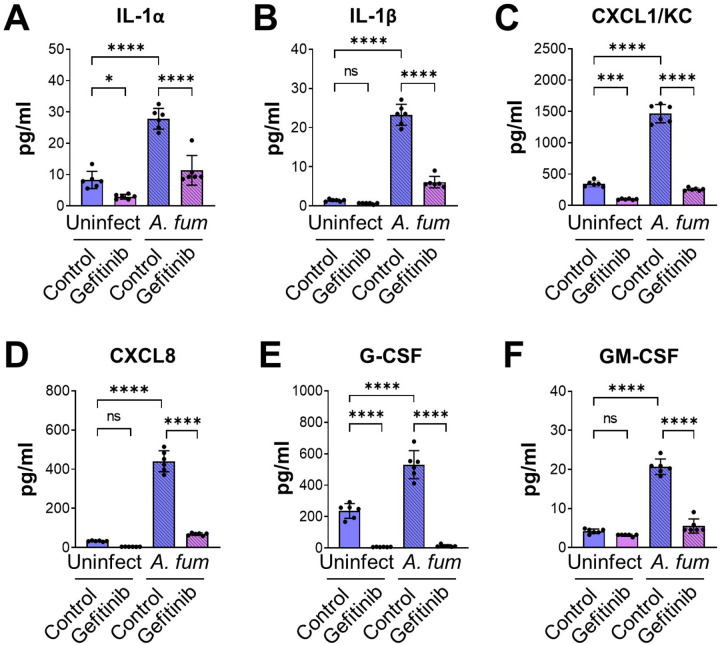
EGFR is required for maximal cytokine release in HSAE cells infected with A. fumigatus. (A-F) HSAE cells were treated with gefitinib or DMSO control, infected with A. fumigatus for 16 h, and then levels of the indicated cytokines were measured. Results are mean ± SD of 3 independent experiments, each performed in duplicate. A. fum, A. fumigatus; uninfect, uninfected; ns, not significant; *P < 0.05; ***P < 0.001; ****P < 0.0001 by one way ANOVA with the Dunnett’s test for multiple comparisons.
FIG 4
FIG 4
Gefitinib worsens outcome in immunosuppressed mice infected with A. fumigatus. (A) Effects of gefitinib on the survival of mice infected with A. fumigatus by aerosol inhalation. Results are the combined data from 2 experiments (n=24 mice per group). (B) Effects of gefitinib on pulmonary fungal burden after 4 d of infection, measured by the relative fungal DNA content in the infected mouse lungs. (C-H) Effects of gefitinib on the levels of the indicated inflammatory mediators in homogenates of the lungs of mice after 4 d of infection. Results in (B-H) are median ± interquartile range of 12 mice per group in a single experiment. ns, not significant, **P < 0.01, ***P < 0.001, ****P < 0.0001 by the log rank test (A) or Mann-Whitney test (B-H).
FIG 5
FIG 5
Gefitinib inhibits A. fumigatus killing by immune cells during invasive aspergillosis. (A-C) Corticosteroid-immunosuppressed mice were infected intratracheally with A. fumigatus conidia expressing DsRed and labeled with AlexaFluor 633. After 12 h, the tissue macrophages (A) neutrophils (B) and dendritic cells (C) were analyzed by flow cytometry to determine the number of cells in the samples, the percentage of cells with phagocytosed conidia, and the percentage of phagocytosed conidia that had been killed. Results are the median ± interquartile range of 6 mice per group in a single experiment. ns, not significant, *P < 0.05, **P < 0.01 by the Mann-Whitney test.
FIG 6
FIG 6
Gefitinib treatment of HSAE cells infected with A. fumigatus inhibits human neutrophil chemotaxis. Effects of gefitinib on neutrophil migration across transwell inserts induced by medium alone, and medium conditioned by uninfected HSAE cells, HSAE cells infected with live A. fumigatus (Af), HSAE cells incubated with paraformaldehyde killed A. fumigatus, live A. fumigatus or paraformaldehyde killed A. fumigatus. Results are the mean ± SD of 4 experiments each performed in duplicate. ns, not significant, *P < 0.05, **P < 0.01 , ****P < 0.0001 by one-way ANOVA with Sidak’s multiple comparisons test.

References

    1. Maertens JA, Rahav G, Lee DG, Ponce-de-Leon A, Ramirez Sanchez IC, Klimko N, Sonet A, Haider S, Diego Velez J, Raad I, Koh LP, Karthaus M, Zhou J, Ben-Ami R, Motyl MR, Han S, Grandhi A, Waskin H, study i. 2021. Posaconazole versus voriconazole for primary treatment of invasive aspergillosis: a phase 3, randomised, controlled, non-inferiority trial. Lancet 397:499–509. - PubMed
    1. Maertens JA, Raad II, Marr KA, Patterson TF, Kontoyiannis DP, Cornely OA, Bow EJ, Rahav G, Neofytos D, Aoun M, Baddley JW, Giladi M, Heinz WJ, Herbrecht R, Hope W, Karthaus M, Lee DG, Lortholary O, Morrison VA, Oren I, Selleslag D, Shoham S, Thompson GR 3rd, Lee M, Maher RM, Schmitt-Hoffmann AH, Zeiher B, Ullmann AJ. 2016. Isavuconazole versus voriconazole for primary treatment of invasive mould disease caused by Aspergillus and other filamentous fungi (SECURE): a phase 3, randomised-controlled, non-inferiority trial. Lancet 387:760–9. - PubMed
    1. Resendiz-Sharpe A, Mercier T, Lestrade PPA, van der Beek MT, von dem Borne PA, Cornelissen JJ, De Kort E, Rijnders BJA, Schauwvlieghe A, Verweij PE, Maertens J, Lagrou K. 2019. Prevalence of voriconazole-resistant invasive aspergillosis and its impact on mortality in haematology patients. J Antimicrob Chemother 74:2759–2766. - PubMed
    1. Liu H, Lee MJ, Solis NV, Phan QT, Swidergall M, Ralph B, Ibrahim AS, Sheppard DC, Filler SG. 2016. Aspergillus fumigatus CalA binds to integrin α5β1 and mediates host cell invasion. Nat Microbiol 2:16211. - PMC - PubMed
    1. Bertuzzi M, Schrettl M, Alcazar-Fuoli L, Cairns TC, Munoz A, Walker LA, Herbst S, Safari M, Cheverton AM, Chen D, Liu H, Saijo S, Fedorova ND, Armstrong-James D, Munro CA, Read ND, Filler SG, Espeso EA, Nierman WC, Haas H, Bignell EM. 2014. The pH-responsive PacC transcription factor of Aspergillus fumigatus governs epithelial entry and tissue invasion during pulmonary aspergillosis. PLoS Pathog 10:e1004413. - PMC - PubMed

Publication types