


Social status mediates the propagation of unfairness
- PMID: 39315034
- PMCID: PMC11417036
- DOI: 10.3389/fpsyg.2024.1253831
Social status mediates the propagation of unfairness
Abstract
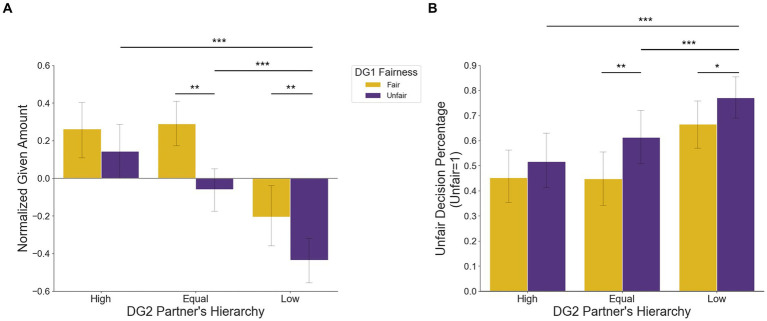
Fairness constitutes a cornerstone of social norms, emphasizing equal treatment and equitable distribution in interpersonal relationships. Unfair treatment often leads to direct responses and can spread to others through a phenomenon known as pay-it-forward (PIF) reciprocity. This study examined how unfairness spreads in interactions with new partners who have higher, equal, or lower status than the participants. In the present study, participants (N = 47, all Korean) were given either fair or unfair treatment in the first round of a dictator game. They then allocated monetary resources among partners positioned at various hierarchical levels in the second round. Our main goal was to determine if the severity of inequity inflicted on new partners was influenced by their hierarchical status. The results revealed an inclination among participants to act more generously towards partners of higher ranking despite prior instances of unfair treatment, whereas a tendency for harsher treatment was directed towards those with lower ranking. The interaction between the fairness in the first round (DG1) and the hierarchical status of the partner in the second round (DG2) was significant, indicating that the effect of previous fairness on decision-making differed depending on the ranking of the new partners. This study, therefore, validates the presence of unfairness PIF reciprocity within hierarchical contexts.
Keywords: dictator game; economic decision-making; fairness; hierarchy; pay-it-forward reciprocity; self-enhancement; sense of power.
Copyright © 2024 Kang, Kim, Kim and Kim.
Conflict of interest statement
The authors declare that the research was conducted in the absence of any commercial or financial relationships that could be construed as a potential conflict of interest.
Figures
References
-
- Ball S., Eckel C., Grossman P. J., Zame W. (2001). Status in markets. Q. J. Econ. 116, 161–188. doi: 10.1162/003355301556374 - DOI
-
- Bandura A. (1999). Social cognitive theory of personality. Handbook of personality: theory and research. New York: Guilford Publications.
-
- Bartholomew K. (2006). Ending nurse-to-nurse hostility: Why nurses eat their young and each other. Chicago, IL: HC Pro, Inc.
LinkOut - more resources
Full Text Sources
