


Supporting General Practitioners and people with hypertension to maximise medication use to control blood pressure: the contribution of Collective Intelligence to the development of the 'Maximising Adherence, Minimising Inertia' (MIAMI) intervention
- PMID: 39315072
- PMCID: PMC11418048
- DOI: 10.1080/21642850.2024.2404038
Supporting General Practitioners and people with hypertension to maximise medication use to control blood pressure: the contribution of Collective Intelligence to the development of the 'Maximising Adherence, Minimising Inertia' (MIAMI) intervention
Abstract
Background: Hypertension remains one of the most important modifiable risk factors for stroke and heart disease. Anti-hypertensive medications are effective, but are often not used to maximum benefit. Sub-optimal dosing by prescribers and challenges with medication-taking for patients remain barriers to effective blood pressure control.
Objectives: We aimed to systematically develop a theory-based complex intervention to support General Practitioners (GPs) and people with hypertension to maximise medication use to control blood pressure.
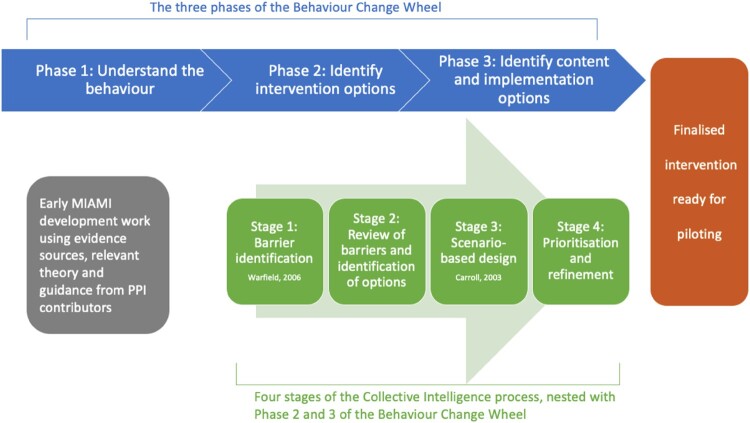
Methods: We used the three-phase Behaviour Change Wheel (BCW) as the overarching intervention development framework. Collective Intelligence methodology was used to operationalise the stakeholder input to Phases 2 and 3 of the BCW. This took the form of a Collective Intelligence workshop with 19 stakeholders from diverse backgrounds including lived experience, general practice, nursing, pharmacy and health psychology. Techniques such as barrier identification, idea-writing and scenario-based design were used to generate possible intervention options. Intervention options were then selected and refined using the Acceptability, Practicability, Effectiveness, Affordability, Side-effects and Equity (APEASE) criteria and guidance from the MIAMI Public and Patient Involvement Panel.
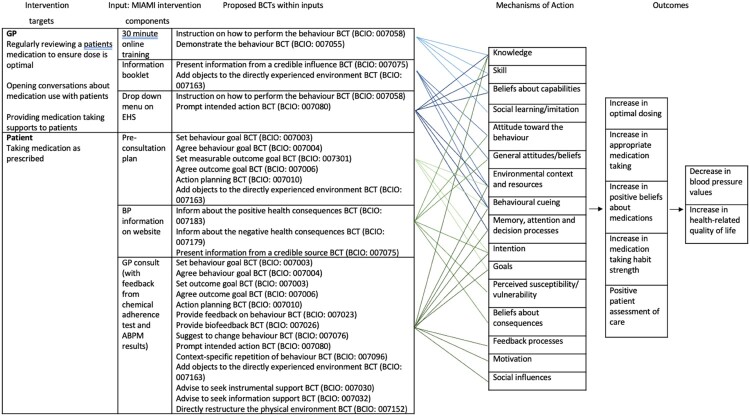
Results: The finalised MIAMI intervention consists of both GP and patient supports. GP supports include a 30-minute online training, information booklet and consultation guide (drop-down menu) embedded within the patient electronic health system. Patient supports include a pre-consultation plan, website, and a structured GP consultation with results from an Ambulatory Blood Pressure Monitor and urine chemical adherence test. The intervention components have been mapped to the intervention functions of the BCW and Behaviour Change Technique Ontology.
Conclusion: Collective Intelligence offered a novel method to operationalise stakeholder input to Phases 2 and 3 of the BCW. The MIAMI intervention is now at pilot evaluation stage.
Keywords: Hypertension; SDG 3: Good health and well-being; behaviour change wheel; collective intelligence; complex intervention; intervention development.
© 2024 The Author(s). Published by Informa UK Limited, trading as Taylor & Francis Group.
Conflict of interest statement
No potential conflict of interest was reported by the author(s).
Figures
References
-
- Albarqouni, L., Montori, V., Jørgensen, K. J., Ringsten, M., Bulbeck, H., & Johansson, M. (2023). Applying the time needed to treat to NICE guidelines on lifestyle interventions. BMJ Evidence-Based Medicine, 28, 354–355. - PubMed
-
- Broome, B. J., & Chen, M. (1992). Guidelines for computer-assisted group problem solving: Meeting the challenges of complex issues. Small Group Research, 23(2), 216–236. 10.1177/1046496492232005 - DOI
-
- Burnier, M., Prejbisz, A., Weber, T., Azizi, M., Cunha, V., Versmissen, J, et al. , & Working Group on Cardiovascular Therapy and Adherence of the European Society of Hypertension. (2021). Hypertension healthcare professional beliefs and behaviour regarding patient medication adherence: A survey conducted among European Society of Hypertension Centres of Excellence. Blood Pressure, 30(5), 282–290. 10.1080/08037051.2021.1963209 - DOI - PubMed
-
- Carroll, J. M. (2003). Making use: Scenario-based design of human-computer interactions. MIT Press.
LinkOut - more resources
Full Text Sources
