. 2024 Sep 24;228(4):iyae155.
doi: 10.1093/genetics/iyae155. Online ahead of print.

Admixture in the fungal pathogen Blastomyces

Affiliations

Admixture in the fungal pathogen Blastomyces

Gaston I Jofre et al. Genetics. .

Abstract

Blastomyces is an emerging primary fungal pathogen that affects patients worldwide. The evolutionary processes that have resulted in the current diversity in the genus remain largely unexplored. We used whole genome sequences from 99 Blastomyces isolates, including two sequenced in this study using long-read technologies, to infer the phylogenetic relationships between Blastomyces species. We find that five different methods infer five different phylogenetic trees. Additionally, we find gene tree discordance along the genome with differences in the relative phylogenetic placement of several species of Blastomyces, which we hypothesize is caused by introgression. Our results suggest the urgent need to systematically collect Blastomyces samples around the world and study the evolutionary processes that govern intra- and interspecific variation in these medically important fungi.

Keywords: hybridization; introgression; speciation.


Conflict of interest statement

Conflicts of interest The authors declare no conflict of interest.

Figures

Fig. 1.
Fig. 1.
Phylogenetic relationships among species of the genus Blastomyces. a) ML tree using concatenated whole-genome data places B. percursus, B. helicus, B. emzantsi, B. parvus, and B. silverae as a monophyletic clade sister to the B. dermatitidis/B. gilchristii dyad. b) The BUSCO-based ASTRAL tree places the B. helicus/B. percursus dyad as sister to the B. dermatitidis/B. gilchristii dyad. Node values in a) are the ultrafast bootstrap value and CF for that node. Node values in b) are ASTRAL posterior probability support values.
Fig. 2.
Fig. 2.
Tree topologies across the genome suggest extensive phylogenetic discordance. a) We considered 4 clades, which yield 15 possible rooted topologies. Note that B. dermatitidis and B. gilchristii were considered a single lineage for these analyses. Trees were rooted with Emmonsia. b) A variety of topologies have high weights across the whole-genome. The most frequent topology (topology 1, ∼29.0% of the genomic windows, red bar) has B. percursus as sister to B. helicus with B. dermatitidis/B. gilchristii as the most closely related group to the dyad, which is the most likely species tree as inferred by the BUSCO-based ASTRAL tree (Fig. 1b). The second most common topology (∼28.4% of the genomic windows, orange bar) has B. percursus and B. dermatitidis/B. gilchristii as sister clades, which is consistent with the reference-free topology (Supplementary Fig. 1). The third most common topology (∼14.4% of the genomic windows) has B. helicus, B. percursus, and B. emsantzi form a triad, which is consistent with the whole-genome ML tree. c) Each 100-kb window is marked on the y-axis according to the 15 topologies in a), with transparency indicating the topology weight. Numbers on the top of the panel correspond to the supercontig number in the B. dermatitidis reference genome (see “Methods”). Numbers in the x-axis correspond to position within each supercontig.
Fig. 3.
Fig. 3.
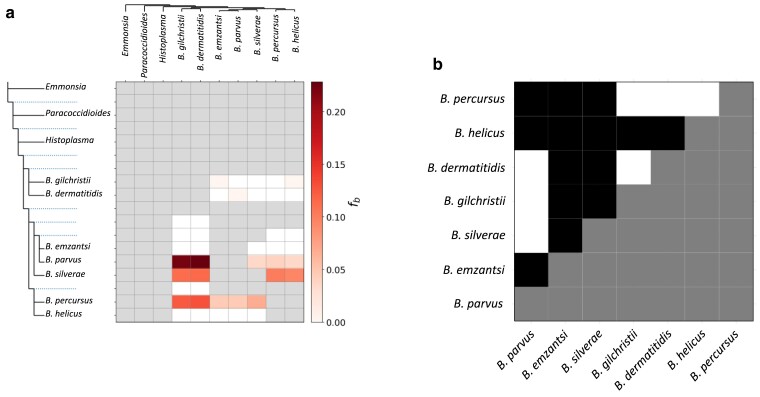
Evidence of introgression in multiple species of Blastomyces. a) f-branch statistics show excess sharing of derived alleles between the taxa on the x-axis and the branches on the y-axis. We used the ML whole-genome tree as the input for the test. The color of a tile indicates the level of introgression event between each given pair using fb as a metric. 0.5 is the highest amount of the introgression metric possible. White tiles show no evidence for introgression (fb = 0). Gray tiles show tests that could not be performed. Dotted branches symbolize internal branches of the tree. b) Both DCTs and BLTs are consistent with a history of introgression. Instances in the upper triangular matrix where both tests show evidence of introgression between a species pair are marked in white; instances in which introgression is not supported are marked with black. Supplementary Table 5 shows the results summarized in this panel.

References

    1. Almeida F, Rodrigues ML, Coelho C. 2019. The still underestimated problem of fungal diseases worldwide. Front Microbiol. 10:214. 10.3389/fmicb.2019.00214. - DOI - PMC - PubMed
    1. Anderson JL, Dieckman JL, Reed KD, Meece JK. 2014. Canine blastomycosis in Wisconsin: a survey of small-animal veterinary practices. Med Mycol. 52(7):774–779. 10.1093/mmy/myu051. - DOI - PubMed
    1. Bagal UR, Ireland M, Gross A, Fischer J, Bentz M, Berkow EL, Litvintseva AP, Chow NA. 2022. Molecular epidemiology of Blastomyces gilchristii clusters, Minnesota, USA. Emerg Infect Dis. 28(9):1924–1926. 10.3201/eid2809.220392. - DOI - PMC - PubMed
    1. Ballouz S, Dobin A, Gillis JA. 2019. Is it time to change the reference genome? Genome Biol. 20(1):159. 10.1186/s13059-019-1774-4. - DOI - PMC - PubMed
    1. Baum DA. 2007. Concordance trees, concordance factors, and the exploration of reticulate genealogy. Taxon. 56(2):417–426. 10.1002/tax.562013. - DOI

LinkOut - more resources