


Monomorphic epitheliotropic intestinal T-cell lymphoma with obstructive pattern: A rare case of small bowel lymphoma
- PMID: 39317016
- PMCID: PMC11456898
- DOI: 10.1016/j.ijscr.2024.110327
Monomorphic epitheliotropic intestinal T-cell lymphoma with obstructive pattern: A rare case of small bowel lymphoma
Abstract
Introduction: Monomorphic epitheliotropic intestinal T-cell lymphoma (MEITL) is a very rare and aggressive type of gastrointestinal non-Hodgkin's lymphoma (NHL) with a poor prognosis.
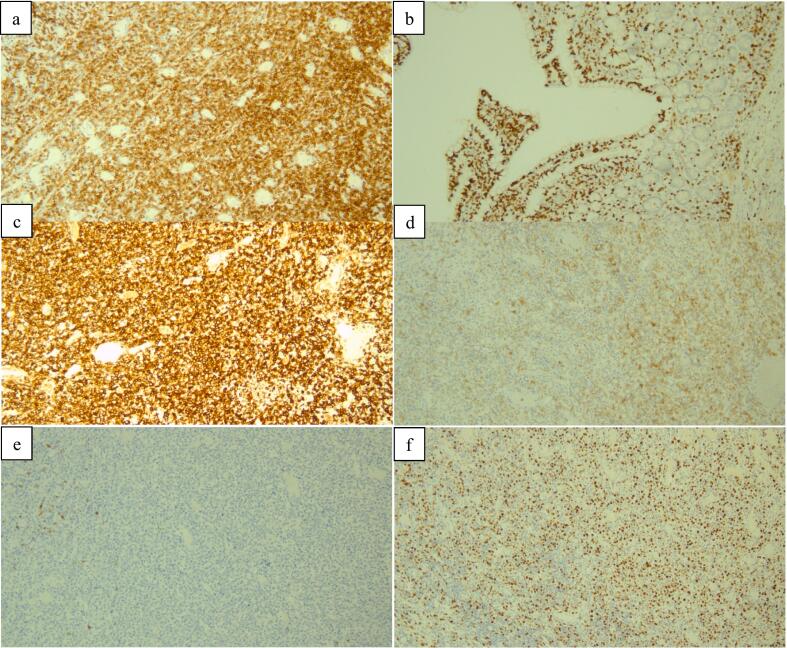
Case presentation: A 59-year-old man presented with a three-days history of diffuse abdominal pain associated with distention and obstipation. Abdominal computed tomography (CT) scan showed small bowel obstruction (SBO) due to moderately thickened jejunal loop. The SBO was treated conservatively, and after a workup, the patient underwent a laparoscopic oncological small bowel resection. The final pathology sampling revealed transmural sheets of atypical lymphoid cells that were identified as MEITL, which is a very rare type of small bowel lymphoma, by the histo-immunopathoplogy studies. He responded to three courses of chemotherapy, and the patient went into remission at the end of the third chemotherapy session. Five months post remission patient was rushed to the emergency with acute mesenteric ischemia and died shortly after.
Discussion: An extremely uncommon and aggressive type of T-cell lymphoma is called monomorphic epitheliotropic intestinal T-cell lymphoma (MEITL). Gastrointestinal involvement was detected in the majority of the patients. 40 % of the published cases had stage IV disease. Based on morphological classification, the tumors were classified into two groups: Typical (58 %) and atypical (i.e., non-monomorphic or exhibiting necrosis, angiotropism, or starry-sky pattern) (42 %). Mostly caused by driver gene changes that de-regulate JAK/STAT signaling and histone methylation, it is resistant to standard therapy and includes morphologic and genetic variants that carry a very high clinical risk.
Conclusion: We report a case of MEITL detected after jejunal resection in a patient presented initially with SBO. Our patient has a recurrence-free survival of 5 months after chemotherapy, but passed away 5 months after remission due to acute mesenteric ischemia.
Keywords: Case report; Enteropathy associated T-cell lymphoma type II; Intestinal lymphoma; Monomorphic epitheliotrophic intestinal T-cell lymphoma; Small bowel non Hodgkin lymphoma; Small bowel obstruction.
Copyright © 2024 The Authors. Published by Elsevier Ltd.. All rights reserved.
Conflict of interest statement
Conflict of interest statement The authors report no conflicts of interest.
Figures


References
-
- Al-Toma A., Goerres M.S., Meijer J.W., Pena A.S., Crusius J.B., Mulder C.J. Human leukocyte antigen-DQ2 homozygosity and the development of refractory celiac disease and enteropathy-associated T-cell lymphoma. Clin. Gastroenterol. Hepatol. 2006;4:315–319. - PubMed
-
- Veloza L., Cavalieri D., Missiaglia E., Ledoux-Pilon A., Bisig B., Pereira B., Bonnet C., Poullot E., Quintanilla-Martinez L., Dubois R., Llamas-Gutierrez F., Bossard C., De Wind R., Drieux F., Fontaine J., Parrens M., Sandrini J., Fataccioli V., Delfau-Larue M.-H.…De Leval L. Monomorphic epitheliotropic intestinal T-cell lymphoma comprises morphologic and genomic heterogeneity impacting outcome. Haematologica. 2022;108(1):181–195. doi: 10.3324/haematol.2022.281226. - DOI - PMC - PubMed
-
- Ishibashi H., Nimura S., Kayashima Y., Takamatsu Y., Iwasaki H., Harada N., Momosaki S., Takedatsu H., Sakisaka S., Takeshita M. Endoscopic and clinicopathological characteristics of gastrointestinal adult T-cell leukemia/lymphoma. J. Gastrointest. Oncol. Aug 2019;10(4):723–733. doi: 10.21037/jgo.2019.03.03. (PMID: 31392053; PMCID: PMC6657316) - DOI - PMC - PubMed
Publication types
LinkOut - more resources
Full Text Sources
