


New perspectives in hepatocellular carcinoma surveillance after hepatitis C virus eradication
- PMID: 39319076
- PMCID: PMC11420110
- DOI: 10.1093/gastro/goae085
New perspectives in hepatocellular carcinoma surveillance after hepatitis C virus eradication
Abstract
Achieving a sustained virologic response (SVR) through direct-acting antivirals for hepatitis C virus (HCV) infection significantly reduces the long-term risk of hepatocellular carcinoma (HCC), particularly in patients with advanced fibrosis (F3) or cirrhosis (F4). However, despite this improvement, the risks associated with HCC and the optimal surveillance strategies for patients who have achieved SVR remain topics of debate. This controversy is compounded by challenges in reliably staging liver fibrosis non-invasively, especially at advanced fibrosis (F3), and the unclear cost-effectiveness, modality, frequency, and duration of HCC surveillance in individuals with SVR but without cirrhosis. These factors contribute to significant variations in surveillance guidelines recommended by different professional societies. Therefore, there is a pressing need for an optimal surveillance strategy that is both simplified and cost-effective to facilitate wider adoption by clinicians. This review article evaluates the existing data, addresses ongoing controversies, and aims to provide new perspectives on HCC surveillance strategies for patients who have achieved SVR from HCV.
Keywords: advanced fibrosis; chronic HCV infection; direct-acting antivirals; hepatitis C virus; liver cancer surveillance; sustained virologic response.
© The Author(s) 2024. Published by Oxford University Press and Sixth Affiliated Hospital of Sun Yat-sen University.
Conflict of interest statement
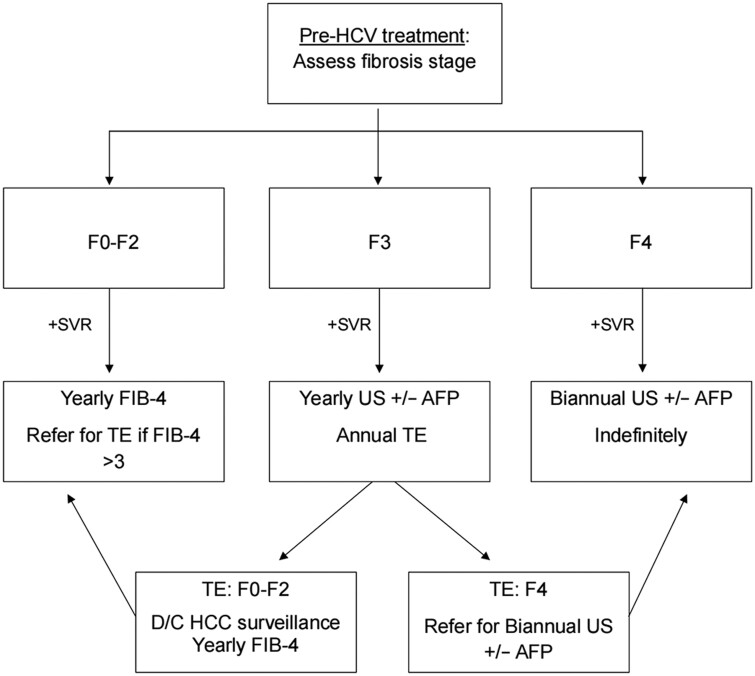
All authors have completed the ICMJE uniform disclosure form and have no other conflicts of interest to declare. C.Q.P. received institutional research grants from Gilead Sciences and Wuxi Hisky Medical Technologies Co., Ltd. Table 1.Recommendations from international guidelines on HCC surveillance after DAA therapyPre-DAA assessmentAASLDEASLAPASLF0–F2N/AN/AUS+tumor markersa every 6 months for 2 years, followed by annually indefinitelyF3NoUS±AFP every 6 months indefinitelyUS+tumor markersa every 6 months indefinitelyF4US±AFP every 6 months indefinitelyUS±AFP every 6 months indefinitelyUS+tumor markersa every 6 months indefinitelyAASLD = American Association for the Study of Liver Diseases, EASL = European Association for the Study of Liver, APASL = Asian Pacific Association for the Study of Liver, SVR = sustained virologic response, DAA = direct acting antiviral agents, TE = transient elastography, FIB-4 = Fibrosis-4 index, US = ultrasound, N/A = not available, AFP = alpha-fetoprotein, AFP-L3 = lens culinaris agglutinin-reactive AFP isoform, DCP = des gamma carboxy-prothrombin.aTumor markers: AFP, AFL-L3, DCP.
Figures
References
-
- De Mitri MS, Poussin K, Baccarini P. et al. HCV-associated liver cancer without cirrhosis. Lancet 1995;345:413–5. - PubMed
-
- World Health Organization . Global Health Sector Strategy on Viral Hepatitis, 2016–2021. Geneva, Switzerland: World Health Organization; 2016. https://apps.who.int/iris/bitstream/handle/10665/246177/WHO-HIV-2016.06-... (15 April 2024, date last accessed).
Publication types
LinkOut - more resources
Full Text Sources
Medical
Miscellaneous
