. 2024 Sep 1;15(9):e1.
doi: 10.14309/ctg.0000000000000743.

Predicting Response to Neuromodulators or Prokinetics in Patients With Suspected Gastroparesis Using Machine Learning: The "BMI, Infectious Prodrome, Delayed GES, and No Diabetes" Model

Affiliations

Predicting Response to Neuromodulators or Prokinetics in Patients With Suspected Gastroparesis Using Machine Learning: The "BMI, Infectious Prodrome, Delayed GES, and No Diabetes" Model

Will Takakura et al. Clin Transl Gastroenterol. .

Abstract

Introduction: Pharmacologic therapies for symptoms of gastroparesis (GP) have limited efficacy, and it is difficult to predict which patients will respond. In this study, we implemented a machine learning model to predict the response to prokinetics and/or neuromodulators in patients with GP-like symptoms.

Methods: Subjects with suspected GP underwent simultaneous gastric emptying scintigraphy (GES) and wireless motility capsule and were followed for 6 months. Subjects were included if they were started on neuromodulators and/or prokinetics. Subjects were considered responders if their GP Cardinal Symptom Index at 6 months decreased by ≥1 from baseline. A machine learning model was trained using lasso regression, ridge regression, or random forest. Five-fold cross-validation was used to train the models, and the area under the receiver operator characteristic curve (AUC-ROC) was calculated using the test set.

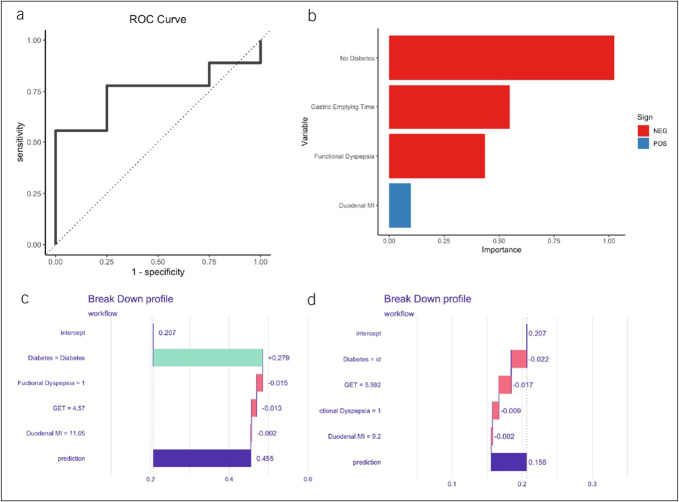
Results: Of the 150 patients enrolled, 123 patients received either a prokinetic and/or a neuromodulator. Of the 123, 45 were considered responders and 78 were nonresponders. A ridge regression model with the variables, such as body mass index, infectious prodrome, delayed gastric emptying scintigraphy, no diabetes, had the highest AUC-ROC of 0.72. The model performed well for subjects on prokinetics without neuromodulators (AUC-ROC of 0.83) but poorly for those on neuromodulators without prokinetics. A separate model with gastric emptying time, duodenal motility index, no diabetes, and functional dyspepsia performed better (AUC-ROC of 0.75).

Discussion: This machine learning model has an acceptable accuracy in predicting those who will respond to neuromodulators and/or prokinetics. If validated, our model provides valuable data in predicting treatment outcomes in patients with GP-like symptoms.


Conflict of interest statement

Guarantor of the article: Allen A. Lee, MD, MS.

Specific author contributions: B.S., L.A.A.N., H.P.P., S.S.C.R., R.W.M., M.S., J.M.W., I.S., B.M., B.K., W.H., A.L.: planning and/or conducting the study: W.T., B.S., L.A.A.N., H.P.P., S.S.C.R., R.W.M., M.S., J.M.W., I.S., B.M., B.K., W.H., A.L.: collecting and/or interpreting data. W.T., B.S., L.A.A.N., H.P.P., S.S.C.R., R.W.M., M.S., J.M.W., I.S., B.M., B.K., W.H., A.L.: drafting the manuscript. All authors have approved the final draft submitted.

Financial support: Medtronic.

Potential competing interests: W.T., B.S., L.A.A.N., H.P.P., M.S., J.M.W., A.L. reports no conflict of interest. S.S.C.R., R.W.M., B.M., B.K., W.H. has received research grant support from Medtronics. B.K. and I.S. are consultants for Medtronics.

Figures

Figure 1.
Figure 1.
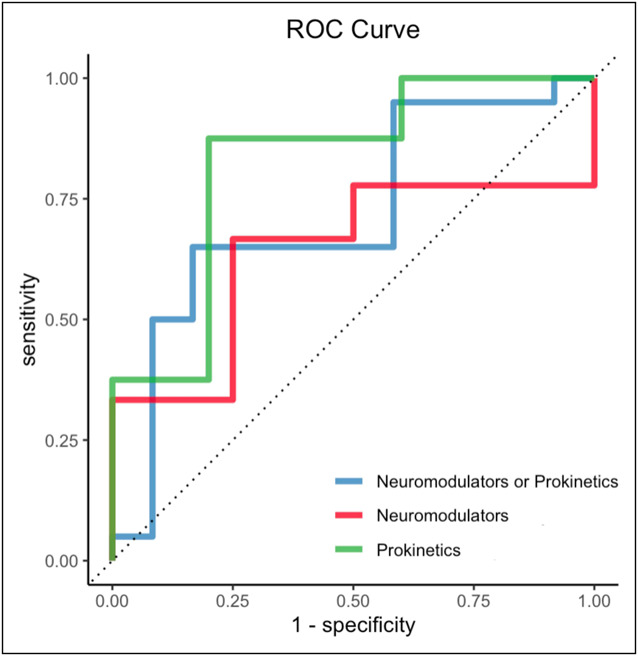
AUC-ROC of the final model to predict a response to prokinetics or neuromodulators with the predictors delayed GCSI, diabetes, infectious prodrome, and BMI using ridge regression. The AUC-ROC were 0.72 for neuromodulators or prokinetics (blue line), 0.64 for neuromodulators without prokinetics (red line), and 0.83 for prokinetics without neuromodulators (green line). AUC-ROC, area under the receiver operator characteristic curve; BMI, body mass index; GCSI, Gastroparesis Cardinal Symptom Index.
Figure 2.
Figure 2.
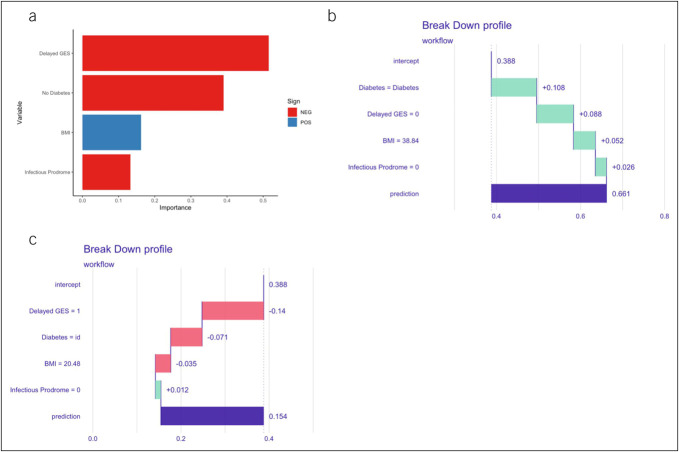
(a) VIP for neuromodulator and/or prokinetics. The most important variables were delayed GES, no diabetes, and BMI, followed by infectious prodrome. Break down plots for subjects with (b) high and (c) low predicted probability for response to neuromodulators and/or prokinetics. The intercept represents the mean model-specific predicted probability for response to neuromodulators and/or prokinetics while each subsequent variable increases (green bar) or decreases (red bar) the predicted probability and results in the overall predicted probability (purple bar, labeled prediction). BMI, body mass index; GES, gastric emptying scintigraphy; id, idiopathic; VIP, variable importance plot.
Figure 3.
Figure 3.
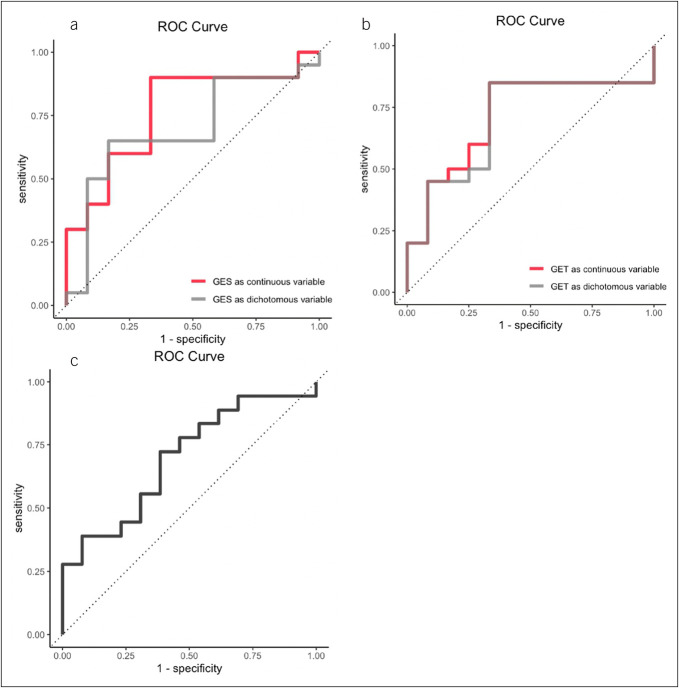
(a) AUC-ROC using GES as dichotomous variable (delayed or not delayed) was 0.72 (gray line) and 0.77 using GES as a continuous variable (% retention at 4 hour) (red line). (b) AUC-ROC substituting GES for GET through WMC was similar with AUC of 0.7 as dichotomous variable (delayed vs not delayed) and 0.73 as continuous variable. (c) AUC-ROC with a lower threshold of a change in GCSI ≥0.75 was 0.7. AUC-ROC, area under the receiver operator characteristic curve; GCSI, Gastroparesis Cardinal Symptom Index; GES, gastric emptying scintigraphy; GET, gastric emptying time; WMC, wireless motility capsule.
Figure 4.
Figure 4.
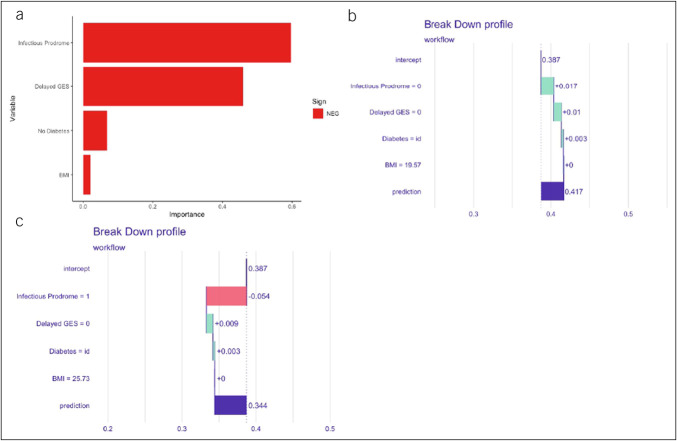
(a) VIP plot for prokinetics without neuromodulators. The most important variables were infectious prodrome, diabetes, delayed GES, and followed by BMI. Breakdown plot for subjects with (b) high and (c) low predicted probability for response to prokinetics without neuromodulators. BMI, body mass index; GES, gastric emptying scintigraphy; id, idiopathic; VIP, variable importance plot.
Figure 5.
Figure 5.
(a) ROC curve with predictor variables derived from those on neuromodulator without prokinetics. (b) VIP of the model. Breakdown plot for subjects with (c) high and (d) low predicted probability for response to neuromodulators without prokinetics. ROC, receiver operator characteristic curve; GET, gastric emptying time; id, idiopathic; MI, motility index; VIP, variable importance plot.

References

    1. Jung HK, Choung RS, Locke GR, III, et al. The incidence, prevalence, and outcomes of patients with gastroparesis in Olmsted County, Minnesota, from 1996 to 2006. Gastroenterology 2009;136(4):1225–33. - PMC - PubMed
    1. Lacy BE, Tack J, Gyawali CP. AGA clinical practice update on management of medically refractory gastroparesis: Expert review. Clin Gastroenterol Hepatol 2022;20(3):491–500. - PubMed
    1. Ingrosso MR, Camilleri M, Tack J, et al. Efficacy and safety of drugs for gastroparesis: Systematic review and network meta-analysis. Gastroenterology 2023;164(4):642–54. - PubMed
    1. Hasler WL, Rao SSC, McCallum RW, et al. Influence of gastric emptying and gut transit testing on clinical management decisions in suspected gastroparesis. Clin Transl Gastroenterol 2019;10(10):e00084. - PMC - PubMed
    1. Camilleri M, Kuo B, Nguyen L, et al. ACG clinical guideline: Gastroparesis. Am J Gastroenterol 2022;117(8):1197–220. - PMC - PubMed

Substances

LinkOut - more resources