


Pubertal timing mediates the association between threat adversity and psychopathology
- PMID: 39324385
- PMCID: PMC11496226
- DOI: 10.1017/S003329172400179X
Pubertal timing mediates the association between threat adversity and psychopathology
Abstract
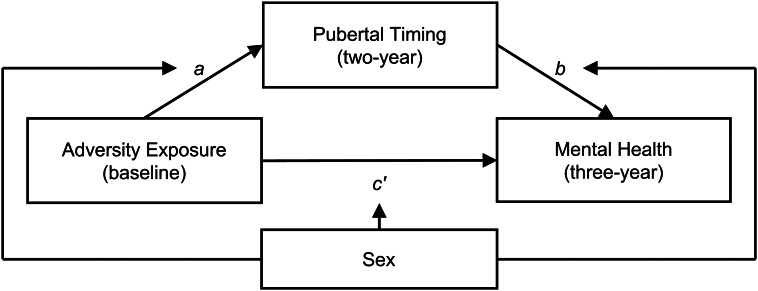
Background: Exposure to adversity in childhood is a risk factor for lifetime mental health problems. Altered pace of biological aging, as measured through pubertal timing, is one potential explanatory pathway for this risk. This study examined whether pubertal timing mediated the association between adversity (threat and deprivation) and adolescent mental health problems (internalizing and externalizing), and whether this was moderated by sex.
Methods: Aims were examined using the Adolescent Brain and Cognitive Development study, a large community sample from the United States. Data were used from three timepoints across the ages of 9-14 years. Latent scores from confirmatory factor analysis operationalized exposure to threat and deprivation. Bayesian mixed-effects regression models tested whether pubertal timing in early adolescence mediated the relationship between adversity exposure and later internalizing and externalizing problems. Sex was examined as a potential moderator of this pathway.
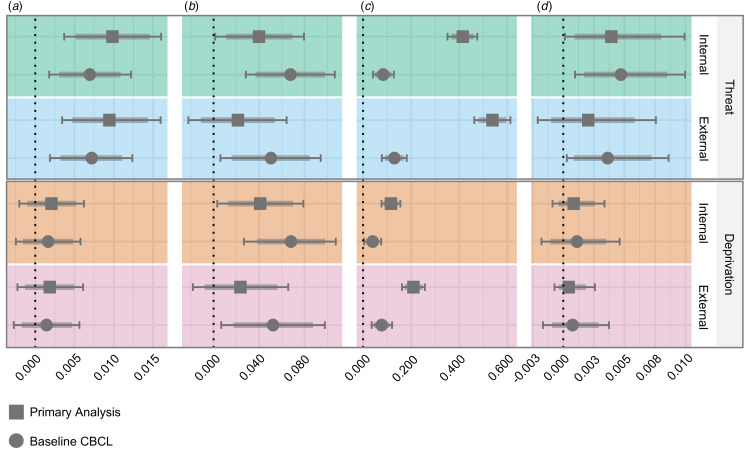
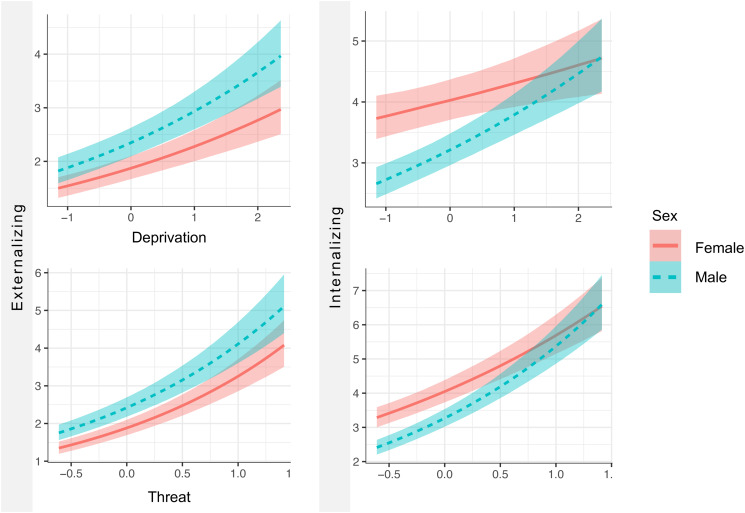
Results: Both threat and deprivation were associated with later internalizing and externalizing symptoms. Threat, but not deprivation, was associated with earlier pubertal timing, which mediated the association of threat with internalizing and externalizing problems. Sex differences were only observed in the direct association between adversity and internalizing problems, but no such differences were present for mediating pathways.
Conclusions: Adversity exposure had similar associations with the pace of biological aging (as indexed by pubertal timing) and mental health problems in males and females. However, the association of adversity on pubertal timing appears to depend on the dimension of adversity experienced, with only threat conferring risk of earlier pubertal timing.
Keywords: adverse childhood experiences; childhood trauma; developmental psychology; puberty.
Conflict of interest statement
None.
Figures
References
-
- Achenbach, T. M. (2009). The Achenbach system of empirically based assessment (ASEBA): Development, findings, theory, and applications. Burlington, VT: University of Vermont Research Center for Children, Youth, & Families.
-
- Barch, D. M., Albaugh, M. D., Avenevoli, S., Chang, L., Clark, D. B., Glantz, M. D., … Sher, K. J. (2018). Demographic, physical and mental health assessments in the adolescent brain and cognitive development study: Rationale and description. Developmental Cognitive Neuroscience, 32, 55–66. doi: 10.1016/j.dcn.2017.10.010 - DOI - PMC - PubMed
-
- Cicchetti, D., & Rogosch, F. (1996). Equifinality and multifinality in developmental psychopathology. Development and Psychopathology, 8(4), 597–600. doi: 10.1017/S0954579400007318 - DOI
-
- Colich, N. L., Platt, J. M., Keyes, K. M., Sumner, J. A., Allen, N. B., & McLaughlin, K. A. (2020a). Earlier age at menarche as a transdiagnostic mechanism linking childhood trauma with multiple forms of psychopathology in adolescent girls. Psychological Medicine, 50(7), 1090–1098. doi: 10.1017/S0033291719000953 - DOI - PMC - PubMed
Grants and funding
- U24 DA041147/DA/NIDA NIH HHS/United States
- U01 DA051039/DA/NIDA NIH HHS/United States
- U01 DA041120/DA/NIDA NIH HHS/United States
- U01 DA051018/DA/NIDA NIH HHS/United States
- U01 DA041093/DA/NIDA NIH HHS/United States
- U24 DA041123/DA/NIDA NIH HHS/United States
- U01 DA051038/DA/NIDA NIH HHS/United States
- U01 DA051037/DA/NIDA NIH HHS/United States
- U01 DA051016/DA/NIDA NIH HHS/United States
- U01 DA041106/DA/NIDA NIH HHS/United States
- U01 DA041117/DA/NIDA NIH HHS/United States
- U01 DA041148/DA/NIDA NIH HHS/United States
- U01 DA041174/DA/NIDA NIH HHS/United States
- U01 DA041134/DA/NIDA NIH HHS/United States
- U01 DA041022/DA/NIDA NIH HHS/United States
- U01 DA041156/DA/NIDA NIH HHS/United States
- U01 DA050987/DA/NIDA NIH HHS/United States
- U01 DA041025/DA/NIDA NIH HHS/United States
- U01 DA050989/DA/NIDA NIH HHS/United States
- U01 DA041089/DA/NIDA NIH HHS/United States
- U01 DA050988/DA/NIDA NIH HHS/United States
- U01 DA041028/DA/NIDA NIH HHS/United States
- U01 DA041048/DA/NIDA NIH HHS/United States
LinkOut - more resources
Full Text Sources
