Carbonated Beverage, Fruit Drink, and Water Consumption and Risk of Acute Stroke: the INTERSTROKE Case-Control Study
- PMID: 39326863
- PMCID: PMC11471353
- DOI: 10.5853/jos.2024.01543
Carbonated Beverage, Fruit Drink, and Water Consumption and Risk of Acute Stroke: the INTERSTROKE Case-Control Study
Abstract
Background and purpose: Cold beverage intake (carbonated drinks, fruit juice/drinks, and water) may be important population-level exposures relevant to stroke risk and prevention. We sought to explore the association between intake of these beverages and stroke.
Methods: INTERSTROKE is an international matched case-control study of first stroke. Participants reported beverage intake using food frequency questionnaires or were asked "How many cups do you drink each day of water?" Multivariable conditional logistic regression estimated odds ratios (OR) and 95% confidence intervals (CI) for associations with stroke.
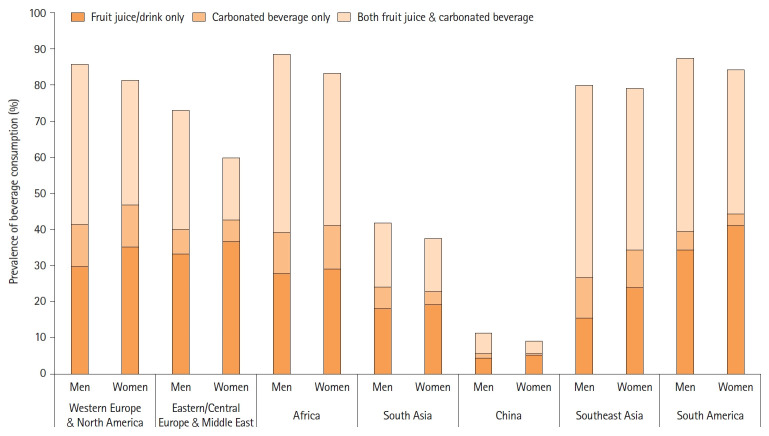
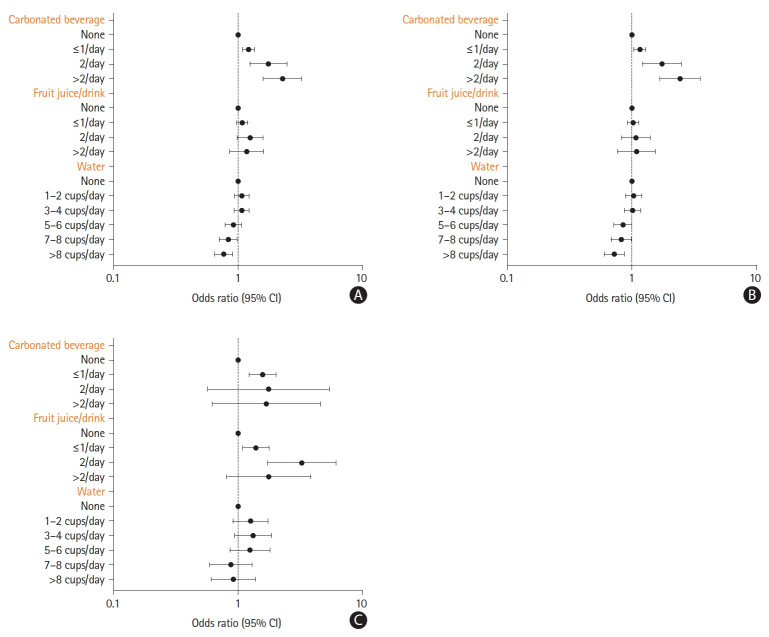
Results: We include 13,462 cases and 13,488 controls; mean age was 61.7±13.4 years and 59.6% (n=16,010) were male. After multivariable adjustment, carbonated beverages were linearly associated with ischemic stroke (OR 2.39 [95% CI 1.64-3.49]); only consumption once/day was associated with intracerebral hemorrhage (ICH) (OR 1.58 [95% CI 1.23-2.03]). There was no association between fruit juice/drinks and ischemic stroke, but increased odds of ICH for once/day (OR 1.37 [95% CI 1.08-1.75)] or twice/day (OR 3.18 [95% CI 1.69-5.97]). High water intake (>7 cups/day) was associated ischemic stroke (OR 0.82 [95% CI 0.68-0.99]) but not ICH. Associations differed by Eugeographical region-increased odds for carbonated beverages in some regions only; opposing directions of association of fruit juices/drinks with stroke in selected regions.
Conclusion: Carbonated beverages were associated with increased odds of ischemic stroke and ICH, fruit juice/drinks were associated with increased odds of ICH, and high water consumption was associated with reduced odds of ischemic stroke, with important regional differences. Our findings suggest optimizing water intake, minimizing fruit juice/drinks, and avoiding carbonated beverages.
Keywords: Carbonated beverages; Diet; Fruit juice; Stroke; Water.
Conflict of interest statement
The authors have no financial conflicts of interest.
Figures
References
-
- O’Donnell M, Yusuf S. Tackling the global burden of stroke: the need for large-scale international studies. Lancet Neurol. 2009;8:306–307. - PubMed
-
- Callegaro CC, Moraes RS, Negrão CE, Trombetta IC, Rondon MU, Teixeira MS, et al. Acute water ingestion increases arterial blood pressure in hypertensive and normotensive subjects. J Hum Hypertens. 2007;21:564–570. - PubMed
-
- Khan SQ, Dhillon OS, O’Brien RJ, Struck J, Quinn PA, Morgenthaler NG, et al. C-terminal provasopressin (copeptin) as a novel and prognostic marker in acute myocardial infarction: Leicester Acute Myocardial Infarction Peptide (LAMP) study. Circulation. 2007;115:2103–2110. - PubMed
-
- Swerdel JN, Janevic TM, Kostis WJ, Faiz A, Cosgrove NM, Kostis JB. Association between dehydration and short-term risk of ischemic stroke in patients with atrial fibrillation. Transl Stroke Res. 2017;8:122–130. - PubMed
Grants and funding
- CAPMC/ CIHR/Canada
- Heart and Stroke Foundation of Canada
- Canadian Stroke Network
- Swedish Research Council Formas
- Swedish Heart and Lung Foundation
- Health and Medical Care Committee of the Regional Executive Board, Region Västra Götaland
- AstraZeneca
- Boehringer Ingelheim (Canada)
- Pfizer Canada
- MSD
- Chest, Heart and Stroke Scotland
- Stroke Association
- UK Stroke Research Network
- Department of Neurology at the University Duisburg-Essen
- German Research Council
- German Ministry of Education and Research
- European Union
- NH/NIH HHS/United States
- Bertelsmann Foundation
- HeinzNixdorf Foundation
LinkOut - more resources
Full Text Sources