. 2024 Sep 17;31(9):5544-5556.
doi: 10.3390/curroncol31090411.

The Landscape of Breast Cancer Molecular and Histologic Subtypes in Canada

Affiliations

The Landscape of Breast Cancer Molecular and Histologic Subtypes in Canada

Anna N Wilkinson et al. Curr Oncol. .

Abstract

Purpose: To characterize the histologic and molecular subtype distribution of, and survival from, breast cancer (BC) among Canadian women overall, and by stage and age at diagnosis. Methods: Invasive BC cases from the Canadian Cancer Registry for women aged 15-99 years between 2012 and 2017 in Canada, excluding Quebec, were examined using pre-existing mortality linkages. Stage at diagnosis, molecular, and histologic subtypes, and 5-year net survival (NS) by age, subtype, and stage were determined. Results: 107,271 women with BC were included. Luminal A was the most common subtype, present in increasing proportions as women aged, up to a maximum of 55% of cases in 70-74. Ductal and luminal A were most likely to be diagnosed at stage I, while HER2+ had the highest proportion of diagnosis at stage III; triple negative (TN) and unknown had the highest proportion of stage IV. For all stages combined, luminal A had a five-year NS of 98%, while TN was 74%. NS for stage I BC was 99-100% for all subtypes, excepting TN, which was 96%. Survival decreased with advancing stage, most markedly for TN, for which stage III was 47% and stage IV 7%. Survival by equivalent stage and subtype was comparable across age groups but declined in older age categories. Conclusions: The varying natural histories of BC subtypes and histologies can inform prognoses, health system economics, and screening practices. The NS of 96% or greater for stage I, regardless of subtype, highlights the importance of early detection for all subtypes of BC, especially in aggressive subtypes.

Keywords: breast cancer; histology; molecular subtype; net survival; outcomes; registries; stage.


Conflict of interest statement

The authors declare no conflicts of interest.

Figures
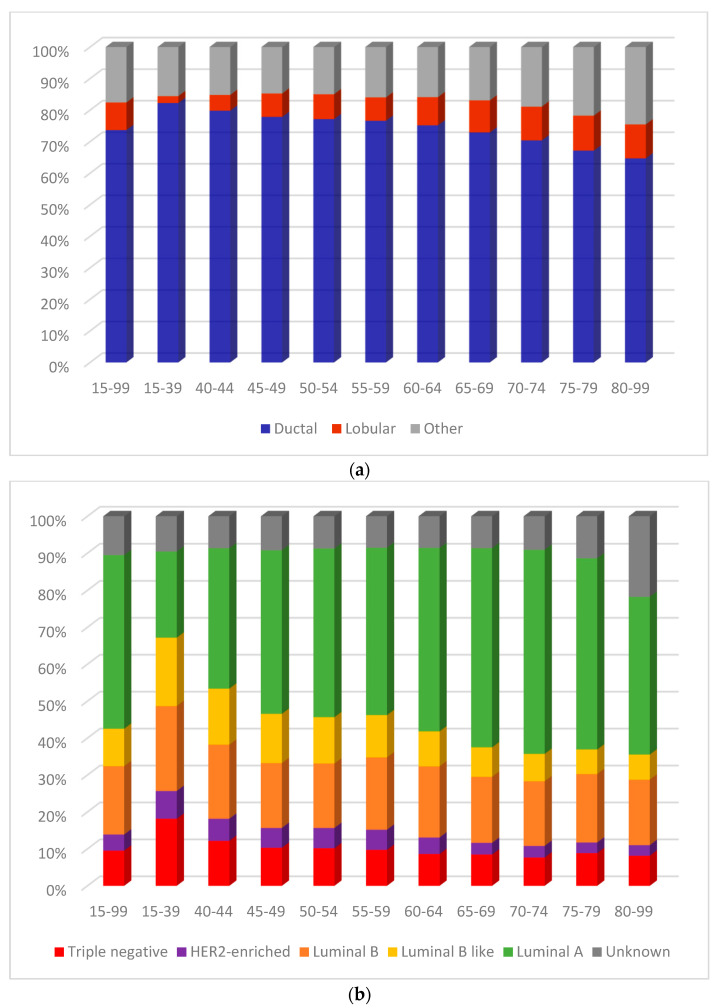
Figure 1
Figure 1
(a) Female breast cancer histologic subtype distribution by age group, ages 15 to 99 years, Canada excluding Quebec, 2012 to 2017 diagnosis period. (b) Female breast cancer molecular subtype distribution by age group, ages 15 to 99 years, Canada excluding Quebec, 2012 to 2017 diagnosis period. Notes: Quebec is excluded because cases diagnosed in that province from 2011 onward had not been submitted to the Canadian Cancer Registry at the time that the source file was created. Source: Statistics Canada, Canadian Cancer Registry death linked file (1992 to 2017).
Figure 2
Figure 2
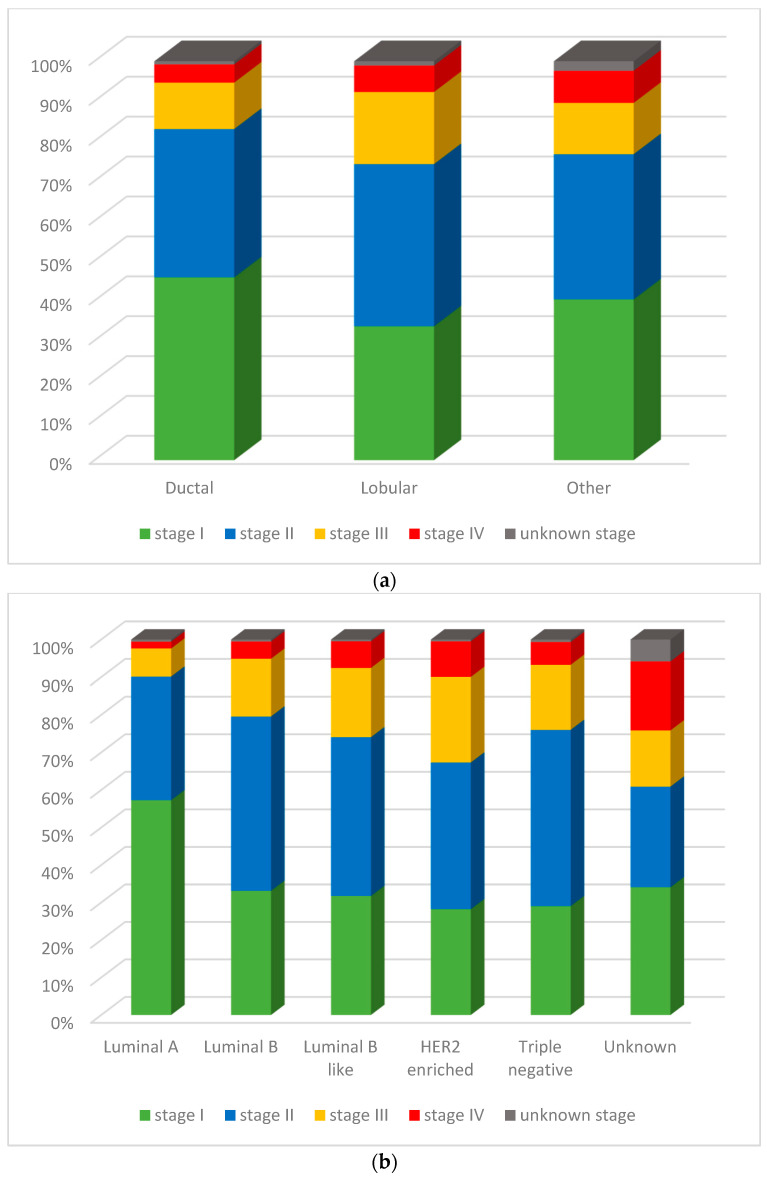
(a) Female breast cancer stage at diagnosis distribution by histologic subtype, ages 15 to 99 years, Canada excluding Quebec, 2012 to 2017 diagnosis period. (b) Female breast cancer stage at diagnosis distribution by molecular subtype, ages 15 to 99 years, Canada excluding Quebec, 2012 to 2017 diagnosis period. Notes: Quebec is excluded because cases diagnosed in that province from 2011 onward had not been submitted to the Canadian Cancer Registry at the time that the source file was created. Source: Statistics Canada, Canadian Cancer Registry death linked file (1992 to 2017).
Figure 3
Figure 3
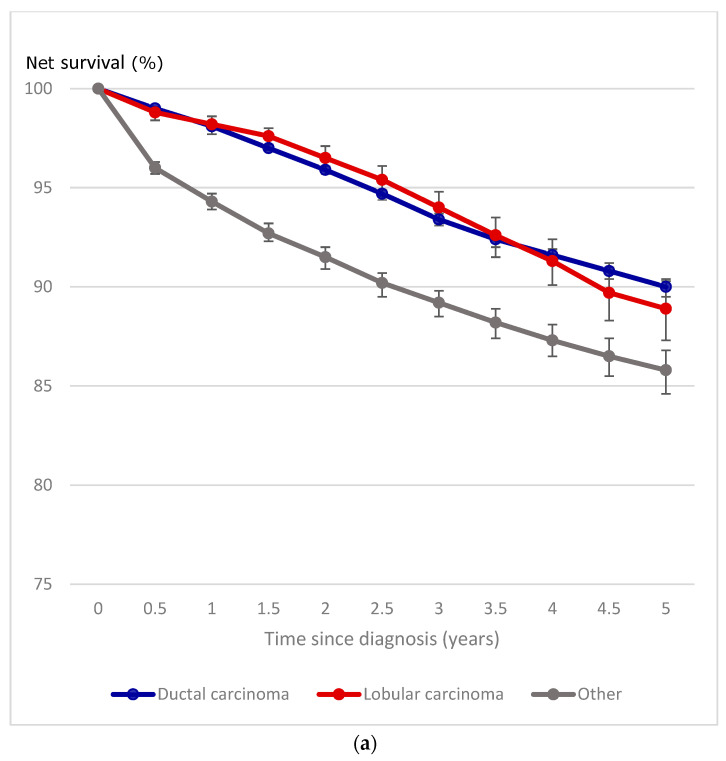
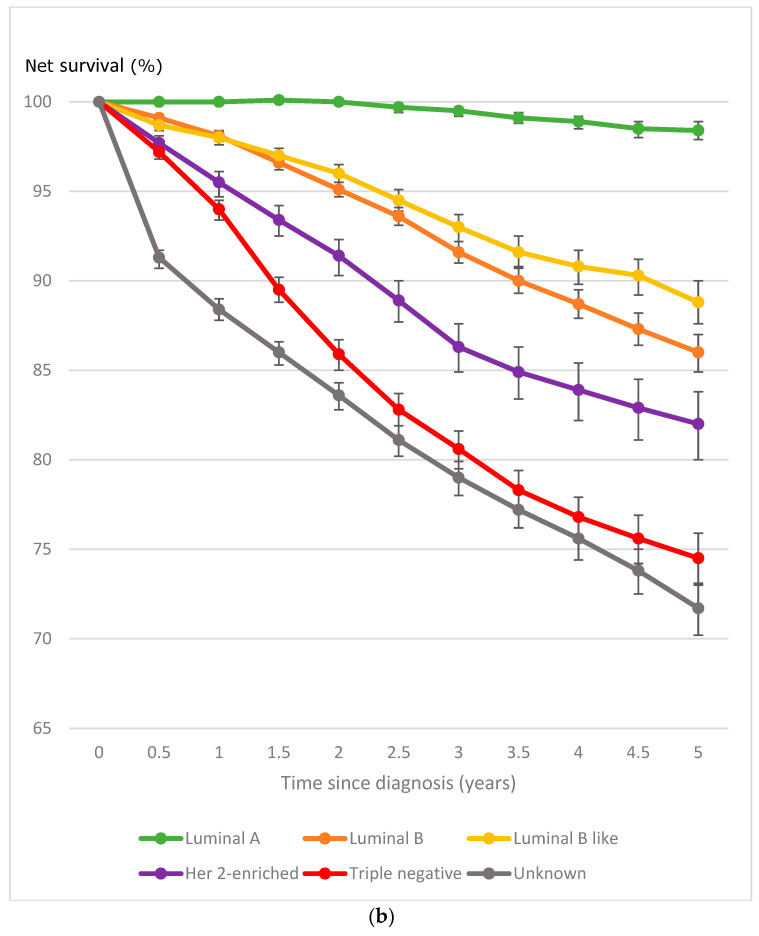
(a) Five-year cumulative female breast cancer net survival, by histologic subtype, ages 15 to 99 years, Canada excluding Quebec, 2012 to 2017 diagnosis period. (b) Five-year cumulative female breast cancer net survival, by molecular subtype, ages 15 to 99 years, Canada excluding Quebec, 2012 to 2017 diagnosis period. Notes: Quebec is excluded because cases diagnosed in that province from 2011 onward had not been submitted to the Canadian Cancer Registry. Follow-up of cases is available to the end of 2017. Overlaid vertical bars denote 95% confidence intervals. Confidence intervals are undefined for unrounded point estimates of 100% or greater. Sources: Statistics Canada, Canadian Cancer Registry death linked file (1992 to 2017) and life tables.
Figure 3
Figure 3
(a) Five-year cumulative female breast cancer net survival, by histologic subtype, ages 15 to 99 years, Canada excluding Quebec, 2012 to 2017 diagnosis period. (b) Five-year cumulative female breast cancer net survival, by molecular subtype, ages 15 to 99 years, Canada excluding Quebec, 2012 to 2017 diagnosis period. Notes: Quebec is excluded because cases diagnosed in that province from 2011 onward had not been submitted to the Canadian Cancer Registry. Follow-up of cases is available to the end of 2017. Overlaid vertical bars denote 95% confidence intervals. Confidence intervals are undefined for unrounded point estimates of 100% or greater. Sources: Statistics Canada, Canadian Cancer Registry death linked file (1992 to 2017) and life tables.

References

    1. Perou C.M., Sørlie T., Eisen M.B., Van De Rijn M., Jeffrey S.S., Rees C.A., Pollack J.R., Ross D.T., Johnsen H., Akslen L.A., et al. Molecular portraits of human breast tumours. Nature. 2000;406:747–752. doi: 10.1038/35021093. - DOI - PubMed
    1. Provenzano E., Ulaner G.A., Chin S.F. Molecular classification of breast cancer. PET Clin. 2018;13:325–338. doi: 10.1016/j.cpet.2018.02.004. - DOI - PubMed
    1. Partridge A.H., Hughes M.E., Warner E.T., Ottesen R.A., Wong Y.-N., Edge S.B., Theriault R.L., Blayney D.W., Niland J.C., Winer E.P., et al. Subtype-dependent relationship between young age at diagnosis and breast cancer survival. J. Clin. Oncol. 2016;34:3308–3314. doi: 10.1200/JCO.2015.65.8013. - DOI - PubMed
    1. Dai X., Li T., Bai Z., Yang Y., Liu X., Zhan J., Shi B. Breast cancer intrinsic subtype classification, clinical use and future trends. Am. J. Cancer Res. 2015;5:2929. - PMC - PubMed
    1. Goldhirsch A., Wood W.C., Coates A.S., Gelber R.D., Thürlimann B., Senn H.J. Strategies for subtypes—Dealing with the diversity of breast cancer: Highlights of the St. Gallen International Expert Consensus on the Primary Therapy of Early Breast Cancer 2011. Ann. Oncol. 2011;22:1736–1747. doi: 10.1093/annonc/mdr304. - DOI - PMC - PubMed

Publication types