Social Risks and Health Care Use in Medically Complex Patients
- PMID: 39331394
- PMCID: PMC11437378
- DOI: 10.1001/jamanetworkopen.2024.35199
Social Risks and Health Care Use in Medically Complex Patients
Abstract
Importance: Integrated health care systems have initiated major investments to identify and address social risks, particularly for patients with multiple medical conditions.
Objective: To evaluate the association of social risks with health care use among patients with complex multimorbidity.
Design, setting, and participants: This longitudinal cohort study assessed Kaiser Permanente Northern California (KPNC) patients with (1) moderate medical complexity (defined by high comorbidity score, high risk of hospitalization, and/or prior emergency department [ED] admissions) and (2) high medical complexity (eg, meeting additional criteria, such as ≥7 medications and laboratory evidence of poor disease control).
Exposure: Social risks (eg, requiring medical financial assistance and self-reported social barriers to care).
Main outcomes and measures: Inpatient and outpatient health care use during 12 months of follow-up (January 15, 2023, to January 14, 2024).
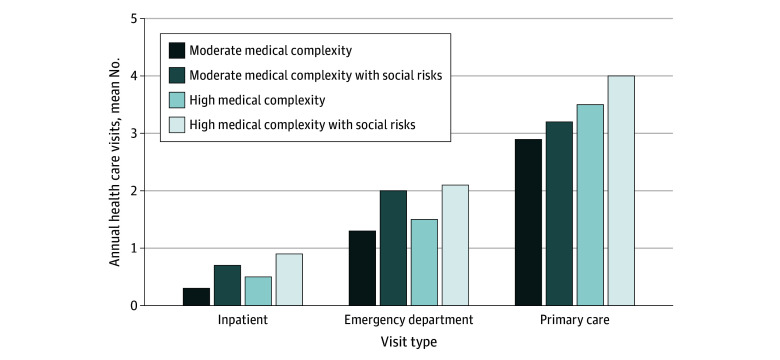
Results: The sample included 97 252 KPNC patients (mean [SD] age, 69.5 [16] years; 52.1% female; 10.6% Asian, 11.1% Black, 18.3% Hispanic, 54.6% White, and 5.5% other race or ethnicity [eg, American Indian or Alaskan Native, Native Hawaiian or Pacific Islander, multiracial, or unknown race]; and 8.8% insured by Medicaid), including 27 827 with moderate medical complexity (5074 [18.2%] with social risks) and 69 425 with high medical complexity (17 343 [25.0%] with social risks). In fully adjusted models, for moderate medical complexity, social risks were associated with higher odds of inpatient admissions (odds ratio [OR], 1.2; 95% CI, 1.1-1.4), ED visits (OR, 1.2; 95% CI, 1.1-1.3), and mental health visits (OR, 1.2; 95% CI, 1.1-1.3) vs individuals without social risks. Among individuals with high medical complexity, social risks were associated with higher odds of inpatient admissions (OR, 1.2; 95% CI, 1.1-1.2), ED visits (OR, 1.2; 95% CI, 1.1-1.2), and 30-day readmissions (OR, 1.2; 95% CI, 1.1-1.3) and higher odds of mental health visits (OR, 1.3; 95% CI, 1.2-1.3) vs individuals without social risks.
Conclusions and relevance: In this cohort study of individuals with medical complexity, coexisting social risks were associated with substantial downstream health care use. Efforts to reduce use in individuals with complex medical comorbidity could include concurrent efforts to identify and reduce social risks.
Conflict of interest statement
Figures
Comment in
-
Optimizing Health Care Utilization for Patients With Complex Medical Needs-Should We Be Targeting Social Risks?JAMA Netw Open. 2024 Sep 3;7(9):e2435152. doi: 10.1001/jamanetworkopen.2024.35152. JAMA Netw Open. 2024. PMID: 39331401 Free PMC article. No abstract available.
References
-
- Cohen SB. Statistical brief 455: The concentration of health care expenditures and related expenses for costly medical conditions. Agency for Healthcare Research and Quality. October 2014. Accessed November 14, 2023. https://meps.ahrq.gov/data_files/publications/st455/stat455.shtml - PubMed
-
- Cohen SB. Statistical brief 449: The concentration and persistence in the level of health expenditures over time: estimates for the US population, 2011–2012. Agency for Healthcare Research and Quality. October 2014. Accessed November 14, 2023. https://meps.ahrq.gov/data_files/publications/st449/stat449.shtml
-
- Whicher D, Dahlberg ML, Apton KL, et al, eds. Effective Care for High-Need Patients: Opportunities for Improving Outcomes. National Academies Press; 2017. The Learning Health System Series. - PubMed
Publication types
MeSH terms
LinkOut - more resources
Full Text Sources