


Integrative taxonomy clarifies the evolution of a cryptic primate clade
- PMID: 39333396
- PMCID: PMC11726463
- DOI: 10.1038/s41559-024-02547-w
Integrative taxonomy clarifies the evolution of a cryptic primate clade
Abstract
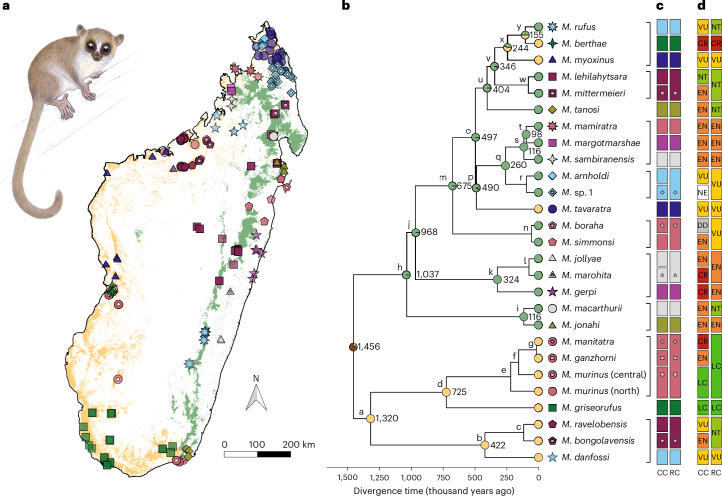
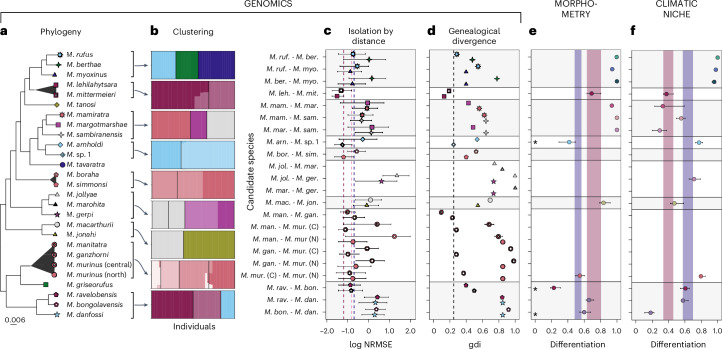
Global biodiversity is under accelerating threats, and species are succumbing to extinction before being described. Madagascar's biota represents an extreme example of this scenario, with the added complication that much of its endemic biodiversity is cryptic. Here we illustrate best practices for clarifying cryptic diversification processes by presenting an integrative framework that leverages multiple lines of evidence and taxon-informed cut-offs for species delimitation, while placing special emphasis on identifying patterns of isolation by distance. We systematically apply this framework to an entire taxonomically controversial primate clade, the mouse lemurs (genus Microcebus, family Cheirogaleidae). We demonstrate that species diversity has been overestimated primarily due to the interpretation of geographic variation as speciation, potentially biasing inference of the underlying processes of evolutionary diversification. Following a revised classification, we find that crypsis within the genus is best explained by a model of morphological stasis imposed by stabilizing selection and a neutral process of niche diversification. Finally, by clarifying species limits and defining evolutionarily significant units, we provide new conservation priorities, bridging fundamental and applied objectives in a generalizable framework.
© 2024. The Author(s).
Conflict of interest statement
Competing interests: The authors declare no competing interests.
Figures



References
MeSH terms
Grants and funding
- RSG-12973-1/Rufford Foundation (Rufford Small Grants Foundation)
- RSG-10941-1/Rufford Foundation (Rufford Small Grants Foundation)
- NSFDEB-NERC: 2148914/National Science Foundation (NSF)
- 91565325/Deutscher Akademischer Austauschdienst (German Academic Exchange Service)
- LABEX TULIP: ANR-10-LABX-0041/Agence Nationale de la Recherche (French National Research Agency)
- 01LC1617A/Bundesministerium für Bildung und Forschung (Federal Ministry of Education and Research)
- RSG-15472-1/Rufford Foundation (Rufford Small Grants Foundation)
- BEEG-B IRP/Centre National de la Recherche Scientifique (National Center for Scientific Research)
- T237/22985/2012/kg/Bauer-Hollmann Stiftung (Bauer-Hollman Foundation)
- Ka 1082/8-1; Ka 1082/8-2; Ka 1082/19-1/Deutsche Forschungsgemeinschaft (German Research Foundation)
- TULIP-Visiting Scientist grant/Agence Nationale de la Recherche (French National Research Agency)
- Ga 342/19/Deutsche Forschungsgemeinschaft (German Research Foundation)
- Ra 502/23-1; Ra 502/7-1; Ra 502/7-3; RA 502/20-1; RA 502/20-3/Deutsche Forschungsgemeinschaft (German Research Foundation)
- LABEX CEBA: ANR-10-LABX-25-01/Agence Nationale de la Recherche (French National Research Agency)
- R35 GM136290/GM/NIGMS NIH HHS/United States
- 91529232/Deutscher Akademischer Austauschdienst (German Academic Exchange Service)
LinkOut - more resources
Full Text Sources
Other Literature Sources
