


Epidemiological characteristics, diagnosis and treatment effect of rifampicin-resistant pulmonary tuberculosis (RR-PTB) in Guizhou Province
- PMID: 39333894
- PMCID: PMC11429120
- DOI: 10.1186/s12879-024-09976-9
Epidemiological characteristics, diagnosis and treatment effect of rifampicin-resistant pulmonary tuberculosis (RR-PTB) in Guizhou Province
Abstract
Background: Rifampicin-resistant pulmonary tuberculosis (RR-PTB) presents a significant threat to global public health security. China bears a substantial burden of RR-PTB cases globally, with Guizhou Province experiencing particularly alarming trends, marked by a continual increase in patient numbers. Understanding the population characteristics and treatment modalities for RR-PTB is crucial for mitigating morbidity and mortality associated with this disease.
Methods: We gathered epidemiological, diagnostic, and treatment data of all RR-PTB cases recorded in Guizhou Province from January 1, 2017 to December 31, 2023. Utilizing composition ratios as the analytical metric, we employed Chi-square tests to examine the spatiotemporal distribution patterns of RR-PTB patients and the evolving trends among different patient classifications over the study period.
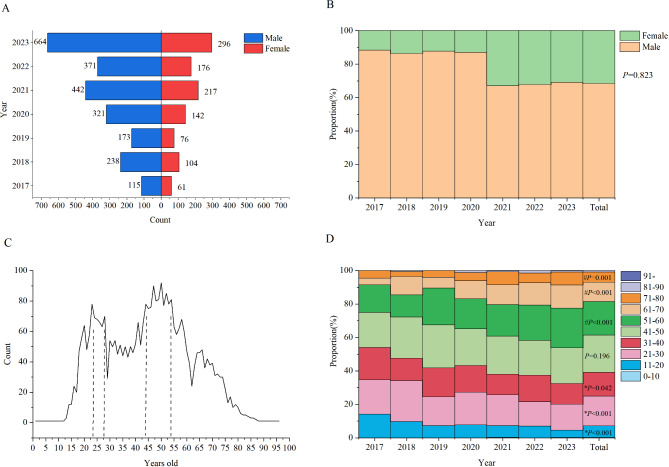
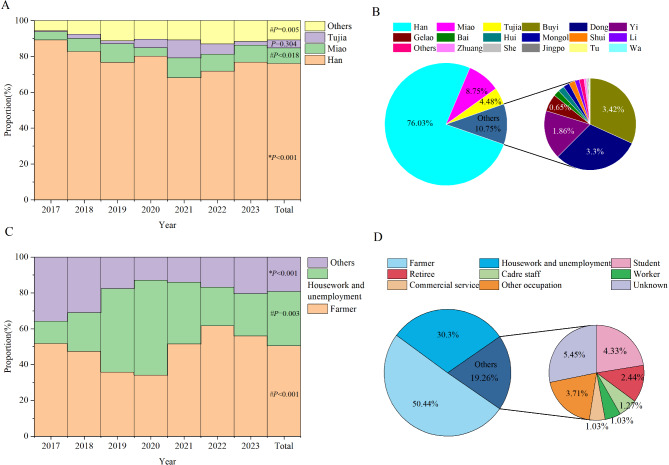
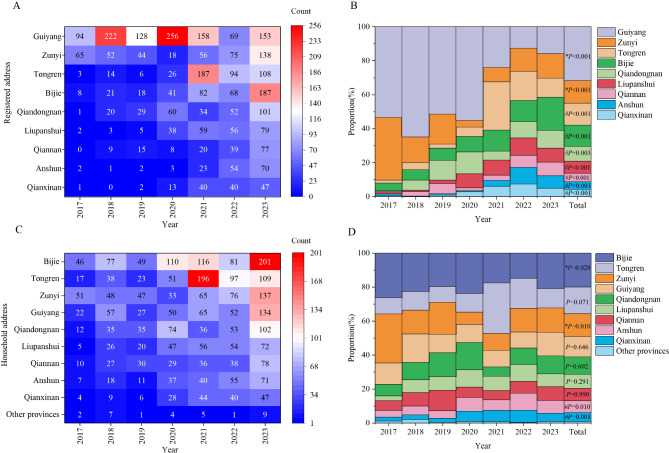
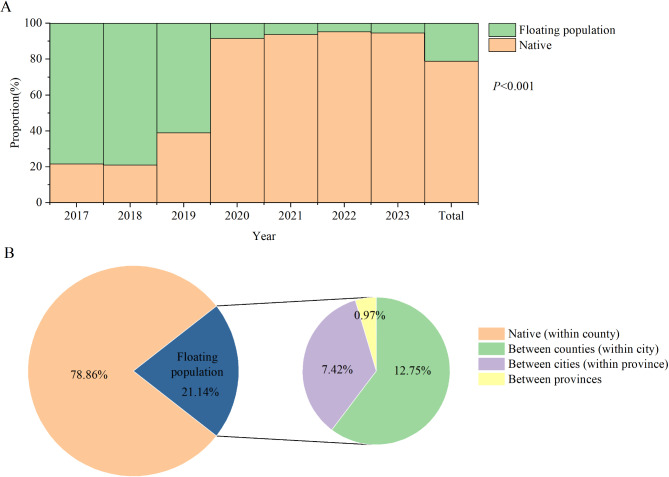
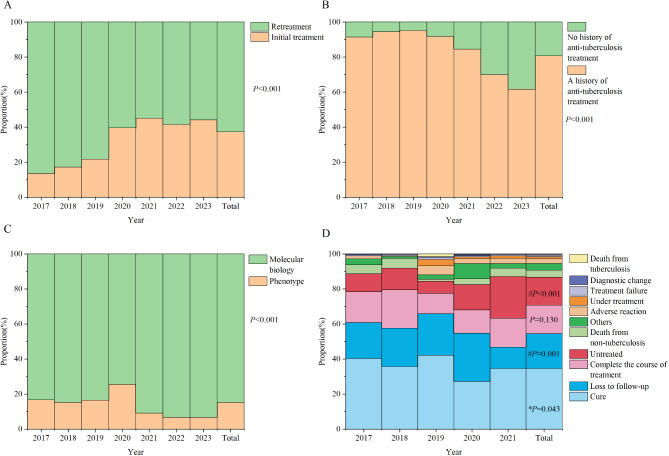
Results: In our study, 3396 cases of RR-PTB were analyzed, with an average age of 45 years. The number of RR-PTB patients rose significantly from 176 in 2017 to 960 in 2023, peaking notably among individuals aged 23-28 and 44-54, with a rising proportion in the 51-80 age group (P < 0.001). Since 2021, there has been a notable increase in the proportion of female patients. While individuals of Han ethnic group comprised the largest group, their proportion decreased over time (P < 0.001). Conversely, the Miao ethnicity showed an increasing trend (P < 0.05). The majority of patients were farmers, with their proportion showing an upward trajectory (P < 0.001), while students represented 4.33% of the cases. Geographically, most patients were registered in Guiyang and Zunyi, with a declining trend (P < 0.001), yet household addresses primarily clustered in Bijie, Tongren, and Zunyi. The proportion of floating population patients gradually decreased, alongside an increase in newly treated patients and those without prior anti-tuberculosis therapy. Additionally, there was a notable rise in molecular biological diagnostic drug sensitivity (real-time PCR and melting curve analysis) (P < 0.001). However, the cure rate declined, coupled with an increasing proportion of RR-PTB patients lost to follow-up and untreated (P < 0.05).
Conclusions: Enhanced surveillance is crucial for detecting tuberculosis patients aged 23-28 and 44-54 years. The distribution of cases varies among nationalities and occupations, potentially influenced by cultural and environmental factors. Regional patterns in RR-PTB incidence suggest tailored prevention and control strategies are necessary. Despite molecular tests advances, challenges persist with low cure rates and high loss to follow-up. Strengthening long-term management, resource allocation, and social support systems for RR-PTB patients is essential.
Keywords: Diagnosis and treatment; Epidemiology; Rifampicin-resistant pulmonary tuberculosis; Spatio-temporal distribution; Western China.
© 2024. The Author(s).
Conflict of interest statement
The authors declare no competing interests.
All the authors declared that there was no conflict of interest in the study.
Figures
References
-
- World Health Organization. Global tuberculosis report 2023. Geneva: World Health Organization; 2023.
-
- Jiang H, Liu MY, Zhang YJ. Study on the Change regularity of Tuberculosis epidemic in China from 2005 to 2016// Compilation of papers of the 33DR National Academic Conference of China Tuberculosis Prevention Association and China Tuberculosis Science and Technology AwaDR Presentation Conference. Qingdao: China National Tuberculosis Association, Chongqing Zhifei Biological Products Co., LTD., 2021:176–177.
-
- Yang X. Analysis of national tuberculosis epidemic characteristics and multi-regional incidence prediction from 2004 to 2014. Lanzhou: Lanzhou University; 2017.
-
- Lu LP. Statistical analysis of the distribution characteristics of tuberculosis incidence in China. Lanzhou: Lanzhou University of Finance and Economics; 2019.
-
- Yang LJ. Study on spatial distribution characteristics and influencing factors of tuberculosis. Beijing: Chinese Center for Disease Control and Prevention; 2020.
MeSH terms
Substances
Grants and funding
LinkOut - more resources
Full Text Sources
