


The Transition of Care Between Emergency Department and Primary Care: An Integrative Systematic Review
- PMID: 39334564
- PMCID: PMC11933523
- DOI: 10.1111/jocn.17434
The Transition of Care Between Emergency Department and Primary Care: An Integrative Systematic Review
Abstract
Aims: To identify the barriers and enablers of effective transitions of care between the emergency department and primary care providers.
Background: Successful patient care transitions from the emergency department to primary care providers are important because this process has implications for the quality, patient safety, and cost of patient care. Failure in follow-up consultations with primary care can result in representations to the emergency department, which can impact negative emergency department operational issues throughout the entire hospital.
Design and methods: An integrative systematic review was reported according to PRISMA guidelines. The reviewers followed a systematic review protocol registered with PROSPERO (CRD42022316165). A search strategy was applied to extract articles from included databases: CINAHL, MEDLINE, PsycINFO, Scopus, ProQuest Nursing and Allied Health databases. Articles were assessed using a predetermined eligibility criterion. Quality assessment and a narrative synthesis were conducted.
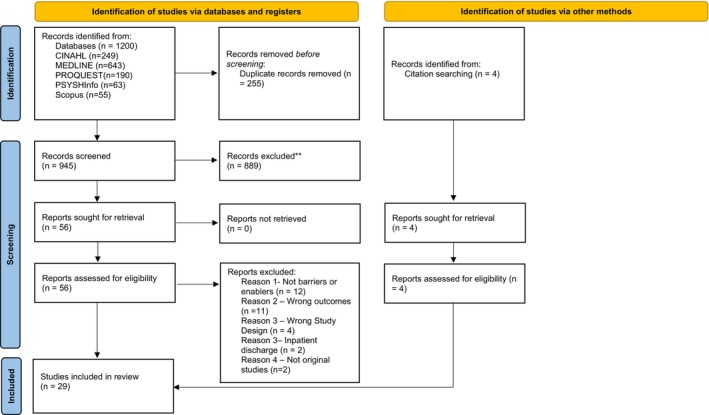
Results: Of the 1200 articles screened, 25 studies were included. Four additional articles were identified from reference lists. The range of study designs included: four qualitative, three mixed methods and 22 quantitative studies. A total of 291,012 patients were represented. Successful care transition was enhanced by access to insurance, ease of payment methods, effective communication, prior booked primary care provider appointments and access to transportation. Many patients experienced financial toxicity, and the shortfall between fees charged and rebates provided was found to influence primary care provider follow-up compliance.
Conclusion: Future recommendations to provide safe and effective transitions of care would be to optimise supported self-management for patients and deliver timely and clear communication with standardised discharge documentation to be shared between the emergency department and primary care providers.
Relevance for clinical practice: There is no one-size-fits-all approach to delivering safe care transitions between emergency department and primary care providers, and future research should target high-risk groups.
Trial registration: Prospero: CRD42022316165.
Keywords: care; emergency department; primary care; systematic review; transition.
© 2024 The Author(s). Journal of Clinical Nursing published by John Wiley & Sons Ltd.
Conflict of interest statement
The authors declare no conflicts of interest.
Figures
References
-
- Afilalo, M. , Lang E., Léger R., et al. 2007. “Impact of a Standardized Communication System on Continuity of Care Between Family Physicians and the Emergency Department.” Journal of the Canadian Association of Emergency Physicians 9, no. 2: 79–86. - PubMed
-
- Atzema, C. L. , Yu B., Ivers N. M., et al. 2018. “Predictors Of Obtaining Follow‐Up Care in the Province of Ontario, Canada, Following a New Diagnosis of Atrial Fibrillation, Heart Failure, and Hypertension in the Emergency Department.” Canadian Journal of Emergency Medicine 20, no. 3: 377–391. - PubMed
-
- Australian Commission of Safety and Quality in Health Care . 2018. “Hospital‐Acquired Complications Fact Sheets Supporting Safety and Quality in Australian Health Services.” https://www.safetyandquality.gov.au/sites/default/files/migrated/Short‐H....
Publication types
MeSH terms
LinkOut - more resources
Full Text Sources
