


Are There Benefits to Breastfeeding for Long Durations That Continue after Breastfeeding Has Stopped? An Analysis of Acute Respiratory Illness in Nigerian Children
- PMID: 39334676
- PMCID: PMC11430560
- DOI: 10.3390/children11091144
Are There Benefits to Breastfeeding for Long Durations That Continue after Breastfeeding Has Stopped? An Analysis of Acute Respiratory Illness in Nigerian Children
Abstract
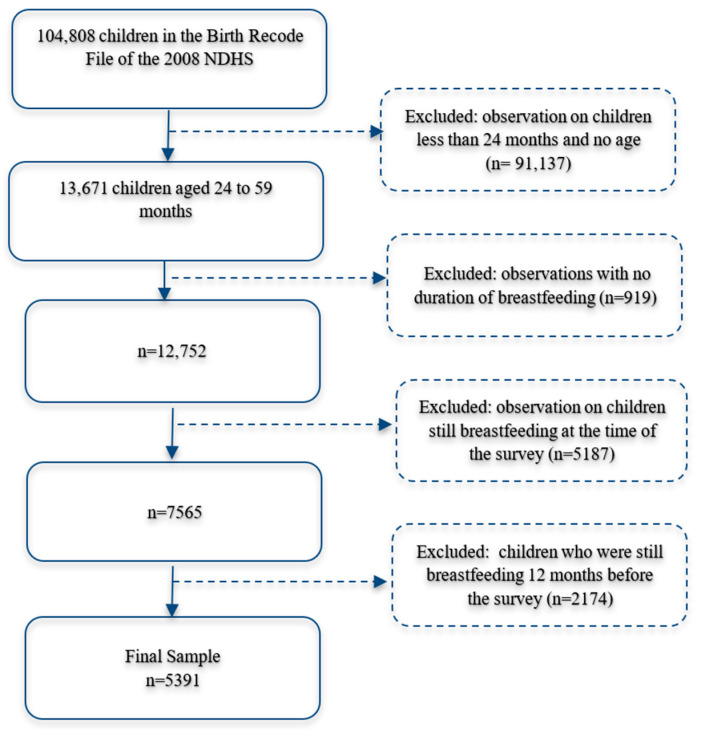
Background: While an abundance of evidence exists regarding infectious outcomes in children as they relate to the short-term benefits of breastfeeding, there is limited evidence related to similar impacts beyond one year and after breastfeeding has stopped. Specifically, little is known about the long-term benefits of breastfeeding for acute health outcomes after infancy, particularly in Nigeria. Methods: The Nigeria Demographic and Health Survey data was used in this study. We utilized data (n = 5391) on children who had stopped breastfeeding for at least 12 months before the survey. Breastfeeding duration was categorized into 1-6 months, 7-12 months, 13-18 months, 18-24 months, and > 24 months. Any recent incident of acute respiratory illness in children was operationalized using the responses to related questions (recent incidents of fever, cough, running nose, and short, rapid, or difficulty breathing in children). Adjusted logistic regression was used to estimate odds ratios, and statistical significance was determined at p ≤ 0.05. Results: Post-infancy and after breastfeeding had stopped, the odds of recent acute respiratory illness were significantly less (AOR = 0.37, 95% CI [0.15-0.79], p = 0.04) in children breastfed for 19-24 months compared to those breastfed for 1-6 months. No significant association was found between the other durations and ARI post-infancy (p > 0.05). Conclusions: These findings indicate that breastfeeding for up to 24 months has a long-term protective effect from an acute health condition that contributes to the high under-five mortality rates recorded for decades in Nigeria specifically, and more broadly, in sub-Saharan Africa.
Keywords: Nigeria; acute health outcomes; breastfeeding; breastfeeding duration; sub-Saharan Africa.
Conflict of interest statement
The authors of this article declare that they have no financial interests, affiliations, or conflicts of interest that could be perceived as influencing the objectivity of this work. The research presented in this article was conducted in the absence of any financial relationships that could pose a conflict of interest.
Figures
References
-
- Indicators for Assessing Infant and Young Child Feeding Practices: Definitions and Measurement Methods. [(accessed on 8 August 2024)]. Available online: https://www.who.int/publications/i/item/9789240018389.
-
- Oddy W.H. Breastfeeding protects against illness and infection in infants and children: A review of the evidence. [(accessed on 8 August 2024)];Breastfeed. Rev. 2001 9:11–18. Available online: https://search.informit.org/doi/abs/10.3316/informit.441794416336077. - DOI - PubMed
LinkOut - more resources
Full Text Sources
