Review
. 2024 Aug 24;13(9):1027.
doi: 10.3390/antiox13091027.

Metabolic and Biochemical Effects of Pyrroloquinoline Quinone (PQQ) on Inflammation and Mitochondrial Dysfunction: Potential Health Benefits in Obesity and Future Perspectives

Affiliations
Review

Metabolic and Biochemical Effects of Pyrroloquinoline Quinone (PQQ) on Inflammation and Mitochondrial Dysfunction: Potential Health Benefits in Obesity and Future Perspectives

Davide Charrier et al. Antioxidants (Basel). .

Abstract

Obesity is defined as a complex, systemic disease characterized by excessive and dysfunctional adipose tissue, leading to adverse health effects. This condition is marked by low-grade inflammation, oxidative stress, and metabolic abnormalities, including mitochondrial dysfunction. These factors promote energy dysregulation and impact body composition not only by increasing body fat but also by promoting skeletal muscle mass atrophy. The decline in muscle mass is associated with an increased risk of all-cause mortality in individuals with this disease. The European Food Safety Authority approved pyrroloquinoline quinone (PQQ), a natural compound, as a dietary supplement in 2018. This narrative review aims to provide a comprehensive overview of the potential role of PQQ, based on its anti-inflammatory and antioxidant properties, in addressing dysfunctional adipose tissue metabolism and related disorders.

Keywords: adipose tissue; inflammation; mitochondrial dysfunction; oxidative stress; pyrroloquinoline quinone (PQQ).


Conflict of interest statement

The authors declare no conflicts of interest.

Figures
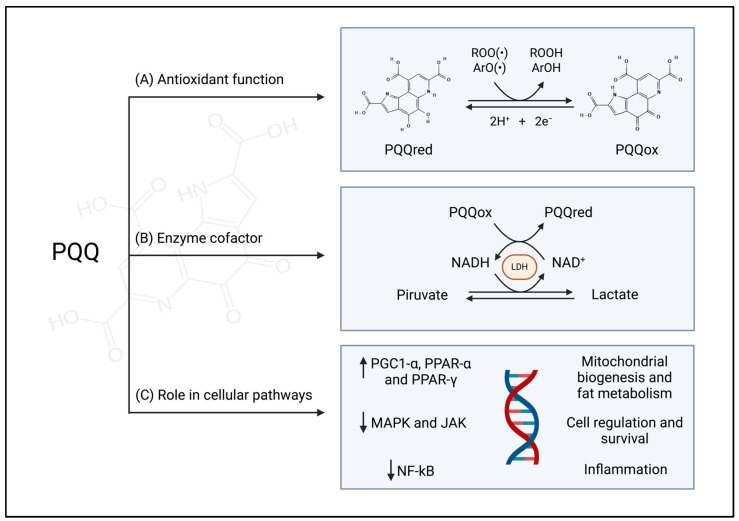
Figure 1
Figure 1
General properties of PQQ: (A) Antioxidant function: PQQ in its reduced state acts as a potent antioxidant, efficiently catalyzing electron transfer reactions. (B) Enzyme cofactor: PQQ serves as an enzyme cofactor in lactate dehydrogenase. (C) Role in cellular pathways: PQQ influences mitochondrial biogenesis and fat metabolism (by regulating PGC-1α, PPAR-α, and PPAR-γ), cell regulation (by regulating MAPK and JAK pathways), and inflammation (through the modulation of NF-κB). (ArO(•)): aroxyl radicals; NAD+/NADH: nicotinamide adenine dinucleotide oxidized and reduced; JAK: Janus kinase; LDH: Lactate dehydrogenase; MAPK: mitogen-activated protein kinase; NF-κB: nuclear factor kappa-light-chain-enhancer of activated B cells; PGC-1α: proliferator-activated receptor gamma coactivator 1-alpha; PPAR-α and PPAR-γ: Peroxisome proliferator-activated receptors alpha and gamma; PQQox: pyrroloquinoline quinone; PQQred: pyrroloquinoline quinol; (ROO(•)):Peroxyl radicals. Created with BioRender.com, accessed on 10 August 2024.
Figure 2
Figure 2
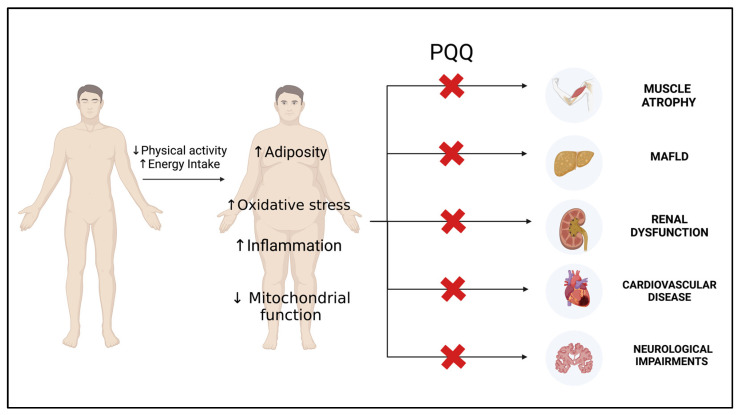
Different potential areas of action of PQQ as a protective factor against obesity-related diseases. MAFLD, metabolic-dysfunction-associated fatty liver disease. Created with BioRender.com, accessed on 31 July 2024.
Figure 3
Figure 3
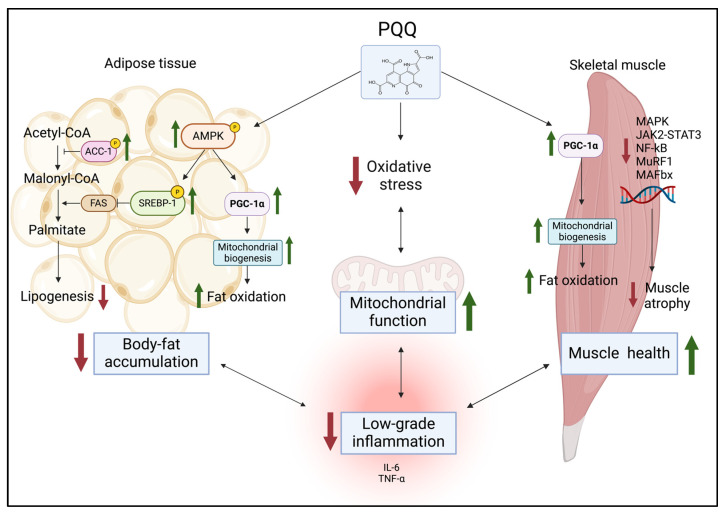
Representation of the main pathways involved in the multiple effects of PQQ on adipose metabolism, muscle health, and mitochondrial function. Up green arrows indicate an increase while down red arrows a decrease. Truncated black arrows suggest inhibitory activity. ACC, acetyl-CoA carboxylase; AMPK, AMP-activated protein kinase; FAS, fatty acid synthase; JAK, Janus kinase; MAFbx, muscle atrophy F-box; MAPK, mitogen-activated protein kinase; MuRF-1, muscle-specific RING finger-1; NF-κB, nuclear factor kappa-light-chain-enhancer of activated B cells; PGC-1α, proliferator-activated receptor gamma coactivator 1-alpha; SREBP, sterol regulatory element-binding protein 1. Created with BioRender.com, accessed on 31 July 2024.

References

    1. The GBD 2015 Obesity Collaborators Health Effects of Overweight and Obesity in 195 Countries over 25 Years. N. Engl. J. Med. 2017;377:13–27. doi: 10.1056/NEJMoa1614362. - DOI - PMC - PubMed
    1. Lin X., Li H. Obesity: Epidemiology, Pathophysiology, and Therapeutics. Front. Endocrinol. 2021;12:706978. doi: 10.3389/fendo.2021.706978. - DOI - PMC - PubMed
    1. de Mello A.H., Costa A.B., Engel J.D.G., Rezin G.T. Mitochondrial Dysfunction in Obesity. Life Sci. 2018;192:26–32. doi: 10.1016/j.lfs.2017.11.019. - DOI - PubMed
    1. Wang S., Liu Y., Chen J., He Y., Ma W., Liu X., Sun X. Effects of Multi-Organ Crosstalk on the Physiology and Pathology of Adipose Tissue. Front. Endocrinol. 2023;14:1198984. doi: 10.3389/fendo.2023.1198984. - DOI - PMC - PubMed
    1. Ji Y., Li M., Chang M., Liu R., Qiu J., Wang K., Deng C., Shen Y., Zhu J., Wang W., et al. Inflammation: Roles in Skeletal Muscle Atrophy. Antioxidants. 2022;11:1686. doi: 10.3390/antiox11091686. - DOI - PMC - PubMed

LinkOut - more resources