Review
. 2024 Sep 11;13(9):870.
doi: 10.3390/antibiotics13090870.

A Comprehensive Review on Phage Therapy and Phage-Based Drug Development

Affiliations
Review

A Comprehensive Review on Phage Therapy and Phage-Based Drug Development

Longzhu Cui et al. Antibiotics (Basel). .

Abstract

Phage therapy, the use of bacteriophages (phages) to treat bacterial infections, is regaining momentum as a promising weapon against the rising threat of multidrug-resistant (MDR) bacteria. This comprehensive review explores the historical context, the modern resurgence of phage therapy, and phage-facilitated advancements in medical and technological fields. It details the mechanisms of action and applications of phages in treating MDR bacterial infections, particularly those associated with biofilms and intracellular pathogens. The review further highlights innovative uses of phages in vaccine development, cancer therapy, and as gene delivery vectors. Despite its targeted and efficient approach, phage therapy faces challenges related to phage stability, immune response, and regulatory approval. By examining these areas in detail, this review underscores the immense potential and remaining hurdles in integrating phage-based therapies into modern medical practices.

Keywords: antibacterial phage capsid; antimicrobial resistance; bacteriophage; biofilm generating pathogen; intracellular pathogen; phage therapy; phage vector; phage-based medicine; phage-based vaccines.


Conflict of interest statement

The authors declare no conflicts of interest. The funders had no role in the design of the study; in the collection, analyses, or interpretation of data; in the writing of the manuscript; or in the decision to publish the results.

Figures
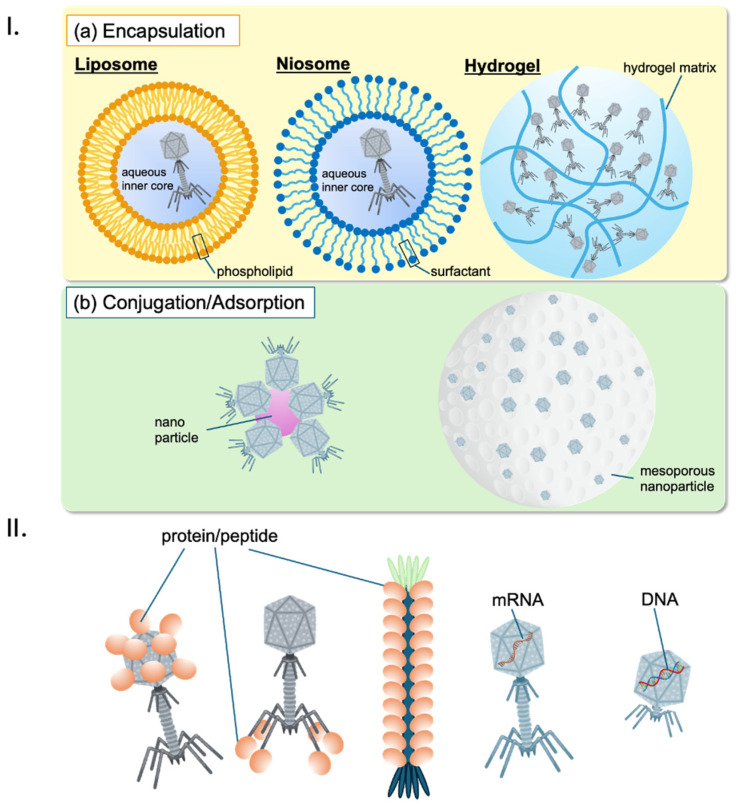
Figure 4
Figure 4
Phage-based drug-delivery systems: (I). Immobilization of phages: (a) Encapsulation of phage in liposomes (left) [182,245], niosomes (middle) [77,246] and in hydrogel beads (right) [247]; (b) conjugation/adsorption of phages onto nanoparticles (left) [248] and mesoporous nanoparticles (right) [249], respectively. These encapsulation methods protect phages from physicochemical stresses (e.g., pH, shear stress) and/or immunological reactions (e.g., phagocytosis, complement-mediated neutralization). (II) Possible drugs delivered by phages as vectors: Proteins (e.g., enzymes, antigens) or peptides can be expressed on the phage capsid, the tips of long tail fibers in Caudovirales, or the major coat proteins in filamentous phages. Additionally, mRNA and/or DNA-encoding targeted genes can be loaded into the phage capsid.
Figure 1
Figure 1
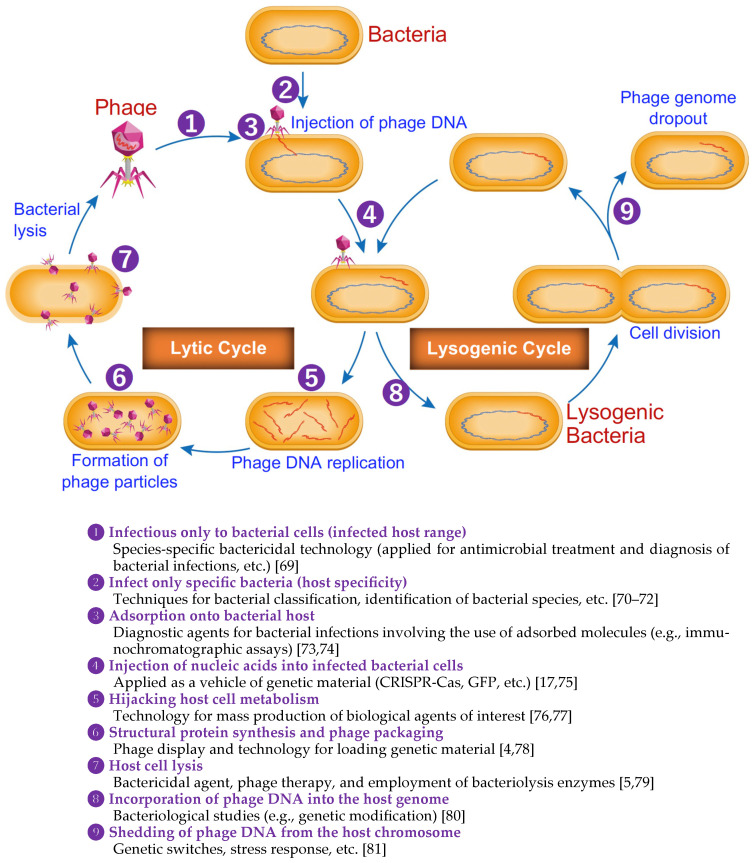
Life cycle of bacteriophages and its application to medicine [4,5,17,69,70,71,72,73,74,75,76,77,78,79,80,81]. Phages can be divided into two main groups based on their life cycles: lytic phages, which definitely destroy bacterial host upon infections, and lysogenic phages, which stay dormant in bacteria and replicate their DNA without destroying the host until they are induced to enter lytic life cycle [82]. Life cycles of phages have been adopted for use in various ways in medicine, industry, and research.
Figure 2
Figure 2
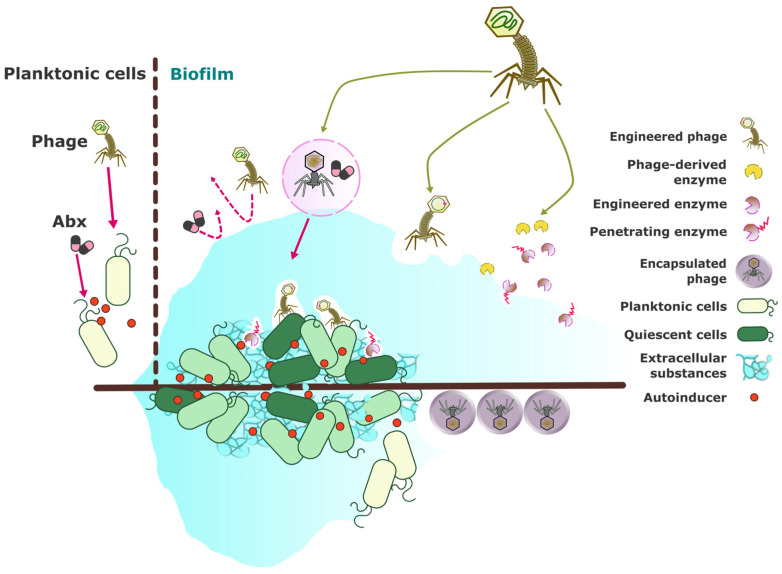
Schematic diagram of phage-based treatments for biofilm-forming bacteria. Biofilms provide a protective environment for pathogenic bacteria, often rendering conventional antimicrobial treatments that target planktonic bacteria ineffective. Strategies utilizing phages and phage-derived products to overcome biofilm-associated infections include (1) combinative phage-antibiotic or phage-antibiofilm regimens [141,142,143,144]; (2) engineering phages and phage-derived products to enhance the targeting of biofilm-associated bacteria [145,146,147,148] and induce biofilm dispersal [146,149,150]; and (3) formulation and encapsulation strategies for the effective delivery of phages to biofilm sites [98,151,152]. Abx: antibiotic.
Figure 3
Figure 3
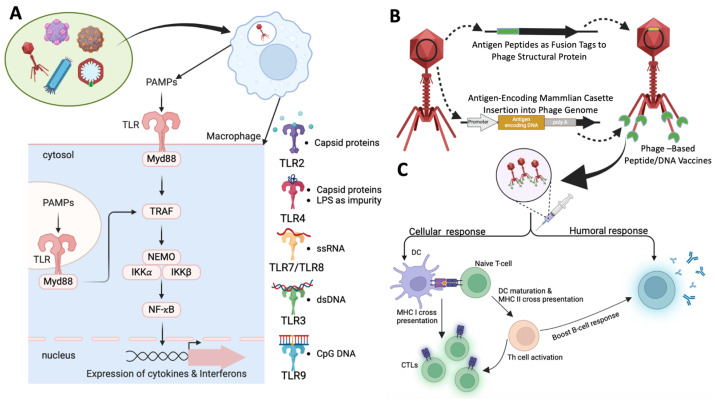
Mechanism of induction of immune responses by phage-based vaccines. (A) Mechanism of self-adjuvanting effect of phages and how phage prime innate immune response: Wide variety of phages, filamentous, tailed, or icosahedral were utilized as vaccine vectors. The intrinsic components of the phages such as the repetitive ordered capsid proteins, DNA, RNA, and CpG Islands can act as pathogen-associated molecular patterns (PAMPs) and can bind either cell-surface or endosomal Toll-like receptors (TLRs) such as TLR 2, 3, 4, 7, 8, and 9. These receptors are pattern-recognition receptors (PRRs) that are primarily seen in innate immune cells and functions in pathogen identification. The viral structural proteins are known to bind TLR2 and TLR4, whereas the DNA, RNA, and CpG Islands bind TLR3, TLR7 and 8, and TLR 9, respectively [181,182]. In addition to phage components, impurities derived from lysates can also induce an immune response, ex. LPS. The PAMPs’ post-binding of respective TLRs can activate Myd88 pathway and downstream signalling, leading to phosphorylation of IKK complex, IKK-α, IKK-β, and NEMO subunits. The IKK complex when phosphorylated frees NF-κB enables nuclear translocation that furthers the expression of array of pro-inflammatory cytokines and interferons imparting adjuvant-like effect [182]. (B) Construction of peptide vaccine and DNA vaccine using phages: Peptide vaccines were prepared by inserting antigenic epitopes as fusion tags to the structural proteins of the capsids. This technique enables the display of the antigens on the surface that could mediate an antigen-specific immune response. In case of DNA vaccine, the phage genome is inserted with an antigen-encoding gene cassette. In this way, the DNA of the antigen is encapsulated in phage head and is delivered to the target immune cells wherein the DNA is transcribed and translated to express antigen of interest [183]. (C) Mechanism of phage vaccine imparting antigen-specific response: The peptide epitope (from peptide vaccine) or the antigens expressed (from DNA vaccine) can impart an antigen-specific immune response. The phage vaccines taken up by APCs were processed and the antigens were presented to naive T-cells via MHC II or MHC I. This process of the presentation activates the naïve T-cells to become CTLs or Th cells. The activated Th cells further boost the memory CTL production and also impart a boost towards antigen-specific antibody production via humoral B-cell responses. The adaptive immune response is known to be further boosted by the self-adjuvanting activity of the phages itself via production of wide array of pro-inflammatory cytokines [184]. Created with templates from BioRender.com.

References

    1. Twort F.W. An Investigation on the Nature of Ultra-Microscopic Viruses. Lancet. 1915;186:1241–1243. doi: 10.1016/s0140-6736(01)20383-3. - DOI - PMC - PubMed
    1. Corner E.S. On an invisible microbe antagonistic to dysentery bacilli. Note by M. F. d’Herelle, presented by M. Roux. Comptes Rendus Academie des Sciences 1917; 165:373–5. Bacteriophage. 2014;1:3–5. doi: 10.4161/bact.1.1.14941. - DOI
    1. Thiel K. Old dogma, new tricks—21st century phage therapy. Nat. Biotechnol. 2004;22:31–36. doi: 10.1038/nbt0104-31. - DOI - PubMed
    1. Frenzel A., Schirrmann T., Hust M. Phage display-derived human antibodies in clinical development and therapy. MAbs. 2016;8:1177–1194. doi: 10.1080/19420862.2016.1212149. - DOI - PMC - PubMed
    1. Stevens R.H., Zhang H., Kajsik M., Płoski R., Rydzanicz M., Sabaka P., Šutovský S. Successful use of a phage endolysin for treatment of chronic pelvic pain syndrome/chronic bacterial prostatitis. Front. Med. 2023;10:1238147. doi: 10.3389/fmed.2023.1238147. - DOI - PMC - PubMed

LinkOut - more resources