


Antibacterial, Antibiofilm, and Wound Healing Activities of Rutin and Quercetin and Their Interaction with Gentamicin on Excision Wounds in Diabetic Mice
- PMID: 39336103
- PMCID: PMC11429020
- DOI: 10.3390/biology13090676
Antibacterial, Antibiofilm, and Wound Healing Activities of Rutin and Quercetin and Their Interaction with Gentamicin on Excision Wounds in Diabetic Mice
Erratum in
-
Correction: Almuhanna et al. Antibacterial, Antibiofilm, and Wound Healing Activities of Rutin and Quercetin and Their Interaction with Gentamicin on Excision Wounds in Diabetic Mice. Biology 2024, 13, 676.Biology (Basel). 2025 May 27;14(6):617. doi: 10.3390/biology14060617. Biology (Basel). 2025. PMID: 40503568 Free PMC article.
Abstract
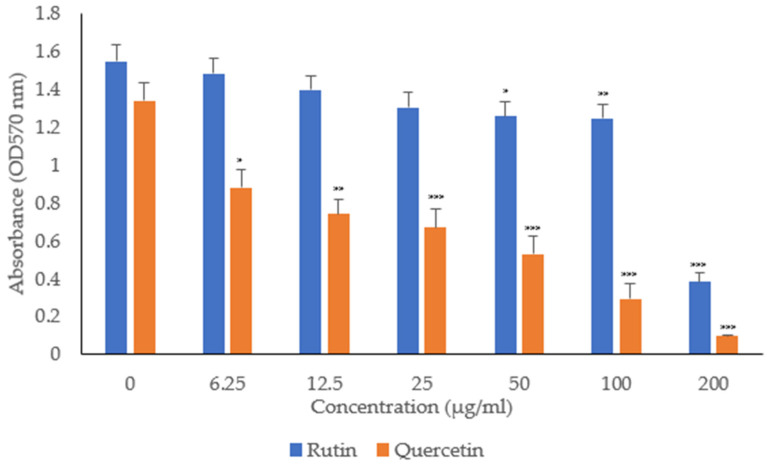
Phytochemicals are effective and are gaining attention in fighting against drug-resistant bacterial strains. In the present study, rutin and quercetin were tested for antibacterial, antibiofilm, and wound healing activities on excision wounds infected with MDR-P. aeruginosa in diabetic mice. Antibacterial and antibiofilm activities were studied in vitro using broth dilution assay and crystal violet assay, respectively. These phytochemicals were tested alone for wound-healing activities at different concentrations (0.5% and 1% in ointment base) and in combination with gentamicin to evaluate any additive effects. Rutin and quercetin demonstrated effectiveness against MDR-P. aeruginosa at higher concentrations. Both phytochemicals inhibited biofilm formation in vitro and contributed to the healing of diabetic wounds by eradicating biofilm in the wounded tissue. Rutin at a low concentration (0.5%) had a lesser effect on reducing the epithelization period and regeneration of the epithelial layer compared to quercetin. When combined with gentamicin, quercetin (1%) displayed the maximum effect on epithelium regeneration, followed by rutin (1%) in combination with gentamicin. Both phytochemicals were found to be more effective in controlling biofilm and wound-healing activities when used as an additive with gentamicin. The study supports the traditional use of phytochemicals with antibacterial, antibiofilm, and wound-healing activities in managing diabetic infections.
Keywords: antibacterial compounds; antibiotic resistance; bioactive compounds; histology; quercetin; rutin; wound healing.
Conflict of interest statement
The authors declare no conflicts of interest.
Figures


References
-
- Al-Ghanayem A.A., Alhussaini M.S., Asad M., Joseph B. Kaempferol promotes wound-healing in diabetic rats through antibacterial and antioxidant effects, devoid of proliferative action. Biosci. J. 2024;40:e40015. doi: 10.14393/BJ-v40n0a2024-68974. - DOI
Grants and funding
LinkOut - more resources
Full Text Sources
Molecular Biology Databases
