


Association of Evening Shifts, Night Shifts, and Consistent Overtime Exceeding 10 Hours per Day with Sudden Cardiac Arrest: A Case-Control Study
- PMID: 39336880
- PMCID: PMC11432743
- DOI: 10.3390/jcm13185393
Association of Evening Shifts, Night Shifts, and Consistent Overtime Exceeding 10 Hours per Day with Sudden Cardiac Arrest: A Case-Control Study
Abstract
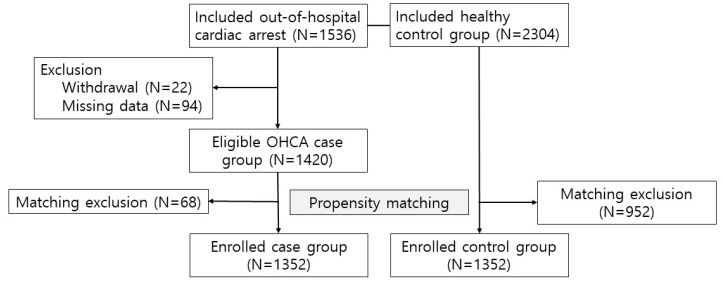
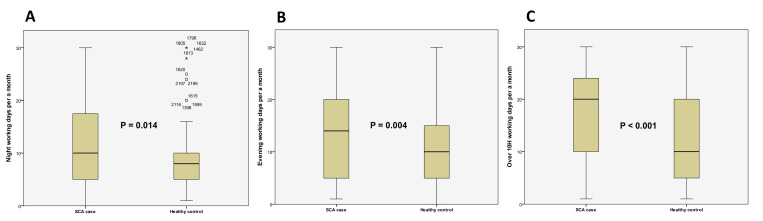
Background: We investigated the relationship between employment status, work patterns, and sudden cardiac arrest (SCA). Methods: This was a case-control study from September 2017 through December 2022 involving 17 emergency departments and 9 public health centers. The cases included patients aged 20-79 years with SCA, excluding those with traumatic arrest, terminal illness, pregnancy, unreliable information, or a "Do Not Resuscitate" order. Controls were selected from various health screening centers in Korea. All participants completed structured questionnaires. Propensity score matching was used to ensure comparability by age, sex, and socioeconomic status. Results: Of the 1536 patients enrolled, 116 from the case group were excluded due to missing employment data, leaving 1420 cases and 2304 controls for analysis. Employment was reported by 47.5% of cases and 59.4% of controls. There was no significant difference in the proportion of sole proprietors (20.6% vs. 22.5%, p = 0.39). The case group had a higher proportion of employers (13.2% vs. 6.5%, p < 0.001) and fewer employees (63.3% vs. 69.1%, p = 0.02). Professional roles were more common among controls (23.6% vs. 31.6%, p < 0.001), while labor-intensive jobs were more frequent in cases (27.7% vs. 17.8%, p < 0.001). The case group had more evening and night shifts (odds ratio [OR]: 1.04, 95% confidence interval [CI]: 1.01-1.06; OR: 1.05, 95% CI: 1.01-1.09) and longer workdays (OR: 1.06, 95% CI: 1.03-1.08). Conclusions: SCA patients were more likely to work evening and night shifts and have longer workdays, often exceeding 10 h.
Keywords: cardiac arrest; case–control study; occupations; risk factor.
Conflict of interest statement
The authors declare no conflict of interest.
Figures
References
-
- Kiguchi T., Okubo M., Nishiyama C., Maconochie I., Ong M.E.H., Kern K.B., Wyckoff M.H., McNally B., Christensen E.F., Tjelmeland I., et al. Out-of-hospital cardiac arrest across the world: First report from the International Liaison Committee on Resuscitation (ILCOR) Resuscitation. 2020;152:39–49. doi: 10.1016/j.resuscitation.2020.02.044. - DOI - PubMed
-
- Park J.H., Cha K.C., Ro Y.S., Song K.J., Shin S.D., Jung W.J., Roh Y.I., Kim S.C., Shin J., You Y., et al. Healthy lifestyle factors, cardiovascular comorbidities, and the risk of sudden cardiac arrest: A case-control study in Korea. Resuscitation. 2022;175:142–149. doi: 10.1016/j.resuscitation.2022.03.030. - DOI - PubMed
LinkOut - more resources
Full Text Sources
