


Identification of a Novel Subset of Human Airway Epithelial Basal Stem Cells
- PMID: 39337350
- PMCID: PMC11432080
- DOI: 10.3390/ijms25189863
Identification of a Novel Subset of Human Airway Epithelial Basal Stem Cells
Abstract
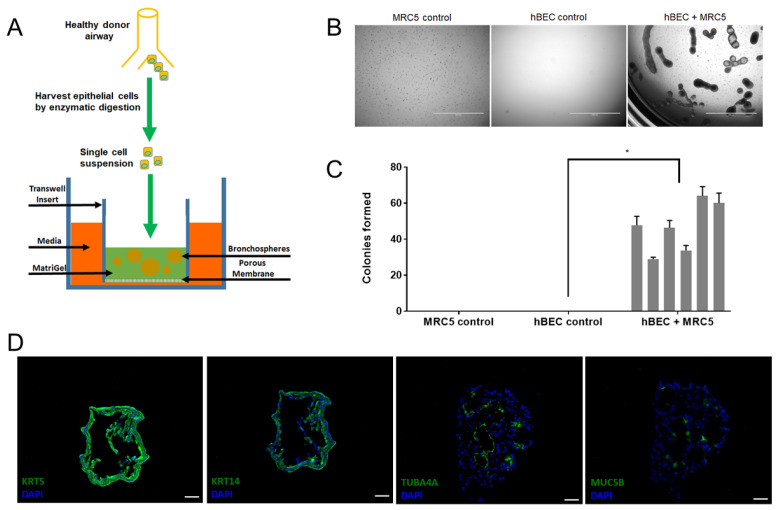
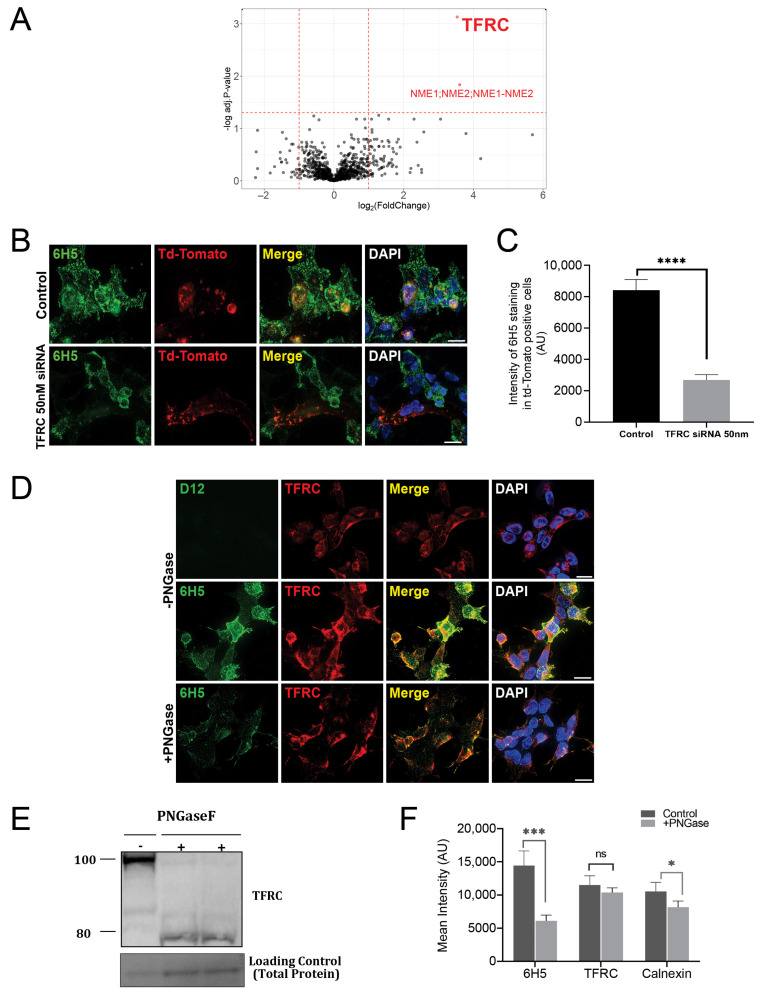
The basal cell maintains the airway's respiratory epithelium as the putative resident stem cell. Basal cells are known to self-renew and differentiate into airway ciliated and secretory cells. However, it is not clear if every basal cell functions as a stem cell. To address functional heterogeneity amongst the basal cell population, we developed a novel monoclonal antibody, HLO1-6H5, that identifies a subset of KRT5+ (cytokeratin 5) basal cells. We used HLO1-6H5 and other known basal cell-reactive reagents to isolate viable airway subsets from primary human airway epithelium by Fluorescence Activated Cell Sorting. Isolated primary cell subsets were assessed for the stem cell capabilities of self-renewal and differentiation in the bronchosphere assay, which revealed that bipotent stem cells were, at minimum 3-fold enriched in the HLO1-6H5+ cell subset. Crosslinking-mass spectrometry identified the HLO1-6H5 target as a glycosylated TFRC/CD71 (transferrin receptor) proteoform. The HLO1-6H5 antibody provides a valuable new tool for identifying and isolating a subset of primary human airway basal cells that are substantially enriched for bipotent stem/progenitor cells and reveals TFRC as a defining surface marker for this novel cell subset.
Keywords: CD71; aminooxy-sulfhydryl-biotin crosslinking; basal cells; bronchospheres; cell heterogeneity; fluorescence activated cell sorting; glycosylated transferrin receptor; monoclonal antibody; respiratory epithelium; stem cells.
Conflict of interest statement
The authors declare no conflicts of interest.
Figures



References
-
- Garcıá S.R., Deprez M., Lebrigand K., Cavard A., Paquet A., Arguel M.J., Magnone V., Truchi M., Caballero I., Leroy S., et al. Novel Dynamics of Human Mucociliary Differentiation Revealed by Single-Cell RNA Sequencing of Nasal Epithelial Cultures. Development. 2019;146:dev177428. doi: 10.1242/dev.177428. - DOI - PMC - PubMed
MeSH terms
Substances
Grants and funding
- P30 EY010572/EY/NEI NIH HHS/United States
- 5U01HL110964-04/NH/NIH HHS/United States
- Emerging Technology Fund/Oregon Health & Science University
- P30EY010572/NH/NIH HHS/United States
- 5T32HL083808-08/NH/NIH HHS/United States
- S10 OD012246/OD/NIH HHS/United States
- BOUCHR19R0/Cystic Fibrosis Foundation
- U01 HL110964/HL/NHLBI NIH HHS/United States
- S10OD012246/NH/NIH HHS/United States
- DK065988/NH/NIH HHS/United States
- S10 RR025571/RR/NCRR NIH HHS/United States
- S10RR025571/NH/NIH HHS/United States
- P30CA069533/NH/NIH HHS/United States
- RANDEL24XX0/Cystic Fibrosis Foundation
- T32 HL083808/HL/NHLBI NIH HHS/United States
- P30 CA069533/CA/NCI NIH HHS/United States
- P30 DK065988/DK/NIDDK NIH HHS/United States
LinkOut - more resources
Full Text Sources
Medical
Research Materials
Miscellaneous
