Review
. 2024 Sep 16;25(18):9969.
doi: 10.3390/ijms25189969.

A Snapshot of the Most Recent Transthyretin Stabilizers

Affiliations
Review

A Snapshot of the Most Recent Transthyretin Stabilizers

Carlo Marotta et al. Int J Mol Sci. .

Abstract

In recent years, several strategies have been developed for the treatment of transthyretin-related amyloidosis, whose complex clinical manifestations involve cardiomyopathy and polyneuropathy. In view of this, transthyretin stabilizers represent a major cornerstone in treatment thanks to the introduction of tafamidis into therapy and the entry of acoramidis into clinical trials. However, the clinical treatment of transthyretin-related amyloidosis still presents several challenges, urging the development of new and improved therapeutics. Bearing this in mind, in this paper, the most promising among the recently published transthyretin stabilizers were reviewed. Their activity was described to provide some insights into their clinical potential, and crystallographic data were provided to explain their modes of action. Finally, structure-activity relationship studies were performed to give some guidance to future researchers aiming to synthesize new transthyretin stabilizers. Interestingly, some new details emerged with respect to the previously known general rules that guided the design of new compounds.

Keywords: SAR; TTR; activity; binding affinity; crystallographic studies; stabilizers; structure–activity relationship studies; synthetic compounds; transthyretin.


Conflict of interest statement

The authors declare no conflict of interest.

Figures

Figure 1
Figure 1
Graphical representation of the human TTR crystal structure. All the structural figures were drawn by author using the Protein Data Bank (PDB) id and PyMol program scripts [16,17]. (a) TTR tetramer, Cys10 in red. (b) TTR monomer. (c) Left TTR-T4 binding mode (pdb id: 2ROX), right scheme of halogen-binding pockets (HBPs).
Figure 2
Figure 2
Chemical structures of tafamidis, diflunisal, tolcapone, and acoramidis.
Figure 3
Figure 3
Schematic representation of the main therapeutic strategies for the treatment of ATTR. (* still under study or in clinical trials).
Figure 4
Figure 4
Chemical structures of compounds 15.
Figure 5
Figure 5
Binding modes of compounds 13 versus tolcapone (pdb id: 6SUH, 8C85, and 8C86). (a) Overview of TTR in complex with compound 3. (b) Superposition of 13 and tolcapone. (c) Comparison between compounds 1 and 2. (d) Detailed view of compound 3 superposed on tolcapone.
Figure 6
Figure 6
TTR in complex with compounds 4 (pdb id: 7QC5) and 5 (pdb id: 8PM9, 8PMA, and 8PMO). (a) Superposition between the complexes of tolcapone and 4 with wt-TTR. (b) Comparison of compound 5 in complex with wt-TTR, V30M-TTR, and V122I-TTR.
Figure 7
Figure 7
SARs of the tolcapone-derived molecules. Changes with respect to the structure of tolcapone have been highlighted in different colors based on their function and relationships.
Figure 8
Figure 8
Chemical structures of compounds 67.
Figure 9
Figure 9
Graphical representation of T4BPs’ surface: wt-TTR in complex with compound 6 (pdb id: 7ERH) (a) and V30M-TTR in complex with compound 7 (pdb id: 7ERH) (b).
Figure 10
Figure 10
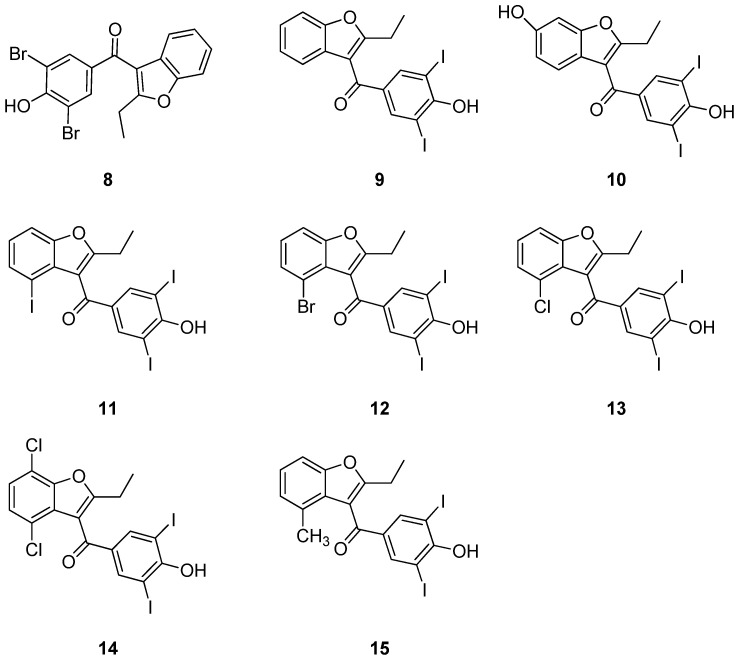
Chemical structures of compounds 815.
Figure 11
Figure 11
Crystal structures of compounds 810 in complex with V30M-TTR. (a) Superposition of 8 and 9, pdb id 8II2 and 8II1, respectively. (b) Comparison between compounds 8, 9, and 10 (pdb id 8II4).
Figure 12
Figure 12
Compounds 11 and 14 in complex with V30M-TTR. (a) Double binding mode of 11 in the T4BP (pdb id 8WGS). (b) Pose of derivative 14 in the TTR cavity (pdb id 8WGT).
Figure 13
Figure 13
SAR for the reported scaffold, as described in [129].

References

    1. Yokoyama T., Mizuguchi M. Transthyretin Amyloidogenesis Inhibitors: From Discovery to Current Developments. J. Med. Chem. 2020;63:14228–14242. doi: 10.1021/acs.jmedchem.0c00934. - DOI - PubMed
    1. Ciccone L., Tonali N., Nencetti S., Orlandini E. Natural Compounds as Inhibitors of Transthyretin Amyloidosis and Neuroprotective Agents: Analysis of Structural Data for Future Drug Design. J. Enzym. Inhib. Med. Chem. 2020;35:1145–1162. doi: 10.1080/14756366.2020.1760262. - DOI - PMC - PubMed
    1. Nencetti S., Orlandini E. TTR Fibril Formation Inhibitors: Is There a SAR? Curr. Med. Chem. 2012;19:2356–2379. doi: 10.2174/092986712800269326. - DOI - PubMed
    1. Wojtczak A., Cody V., Luft J.R., Pangborn W. Structure of Rat Transthyretin (rTTR) Complex with Thyroxine at 2.5 Å Resolution: First Non-Biased Insight into Thyroxine Binding Reveals Different Hormone Orientation in Two Binding Sites. Acta Crystallogr. D Biol. Crystallogr. 2001;57:1061–1070. doi: 10.1107/S0907444901007235. - DOI - PubMed
    1. Wojtczak A., Cody V., Luft J.R., Pangborn W. Structures of Human Transthyretin Complexed with Thyroxine at 2.0 Å Resolution and 3′,5′-Dinitro-N-Acetyl-L-Thyronine at 2.2 Å Resolution. Acta Crystallogr. D Biol. Crystallogr. 1996;52:758–765. doi: 10.1107/S0907444996003046. - DOI - PubMed

Supplementary concepts

LinkOut - more resources