Review
. 2024 Sep 16;25(18):9984.
doi: 10.3390/ijms25189984.

Cartilage Repair: Promise of Adhesive Orthopedic Hydrogels

Affiliations
Review

Cartilage Repair: Promise of Adhesive Orthopedic Hydrogels

Peyman Karami et al. Int J Mol Sci. .

Abstract

Cartilage repair remains a major challenge in human orthopedic medicine, necessitating the application of innovative strategies to overcome existing technical and clinical limitations. Adhesive hydrogels have emerged as promising candidates for cartilage repair promotion and tissue engineering, offering key advantages such as enhanced tissue integration and therapeutic potential. This comprehensive review navigates the landscape of adhesive hydrogels in cartilage repair, discussing identified challenges, shortcomings of current treatment options, and unique advantages of adhesive hydrogel products and scaffolds. While emphasizing the critical need for in situ lateral integration with surrounding tissues, we dissect current limitations and outline future perspectives for hydrogel scaffolds in cartilage repair. Moreover, we examine the clinical translation pathway and regulatory considerations specific to adhesive hydrogels. Overall, this review synthesizes the existing insights and knowledge gaps and highlights directions for future research regarding adhesive hydrogel-based devices in advancing cartilage tissue engineering.

Keywords: ACI; adhesion; carrier; cartilage; delivery; hydrogel; integration; therapeutics.


Conflict of interest statement

Author A.L. was employed by LAM Biotechnologies SA (Epalinges, Switzerland) during this work. The remaining authors declare no conflicts of interest in relation with this work.

Figures
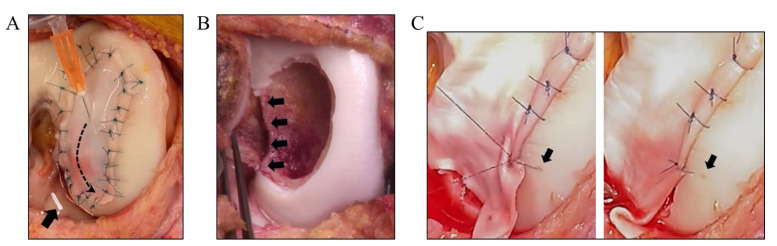
Figure 1
Figure 1
Some existing critical challenges in therapeutic delivery and retention in cell-based therapies, such as (A) leakage of cell suspension between sutures and weak performance of fibrin glue, (B) application in uncontained defects, and (C) suturing complexity to surrounding cartilage: tissue tearing from suture tightening.
Figure 2
Figure 2
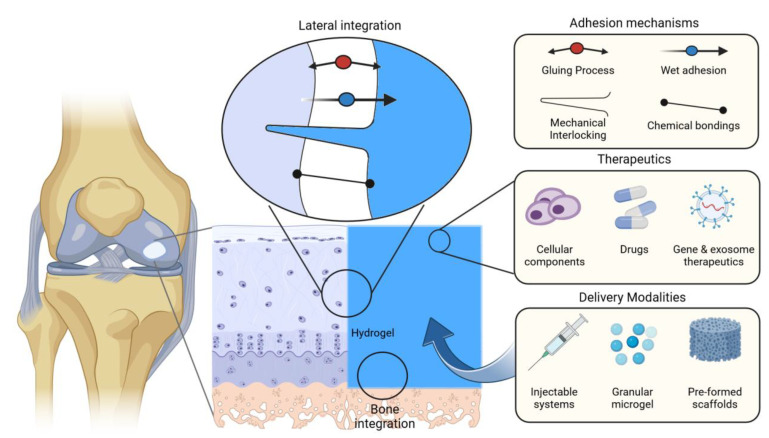
Schematic illustration of adhesive hydrogels as promising therapeutic carriers in cartilage repair and related tissue integration mechanisms. Various mechanisms for promoting the adhesive performance of hydrogel systems, therapeutic options, and hydrogel delivery methods are shown.
Figure 3
Figure 3
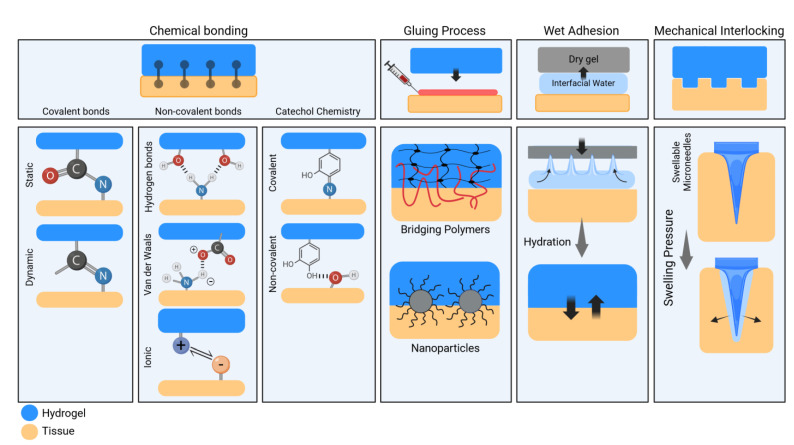
Classification and mechanisms of hydrogel adhesion to tissues with representative examples. Explanations of the adhesive aspects are reported in the text.
Figure 4
Figure 4
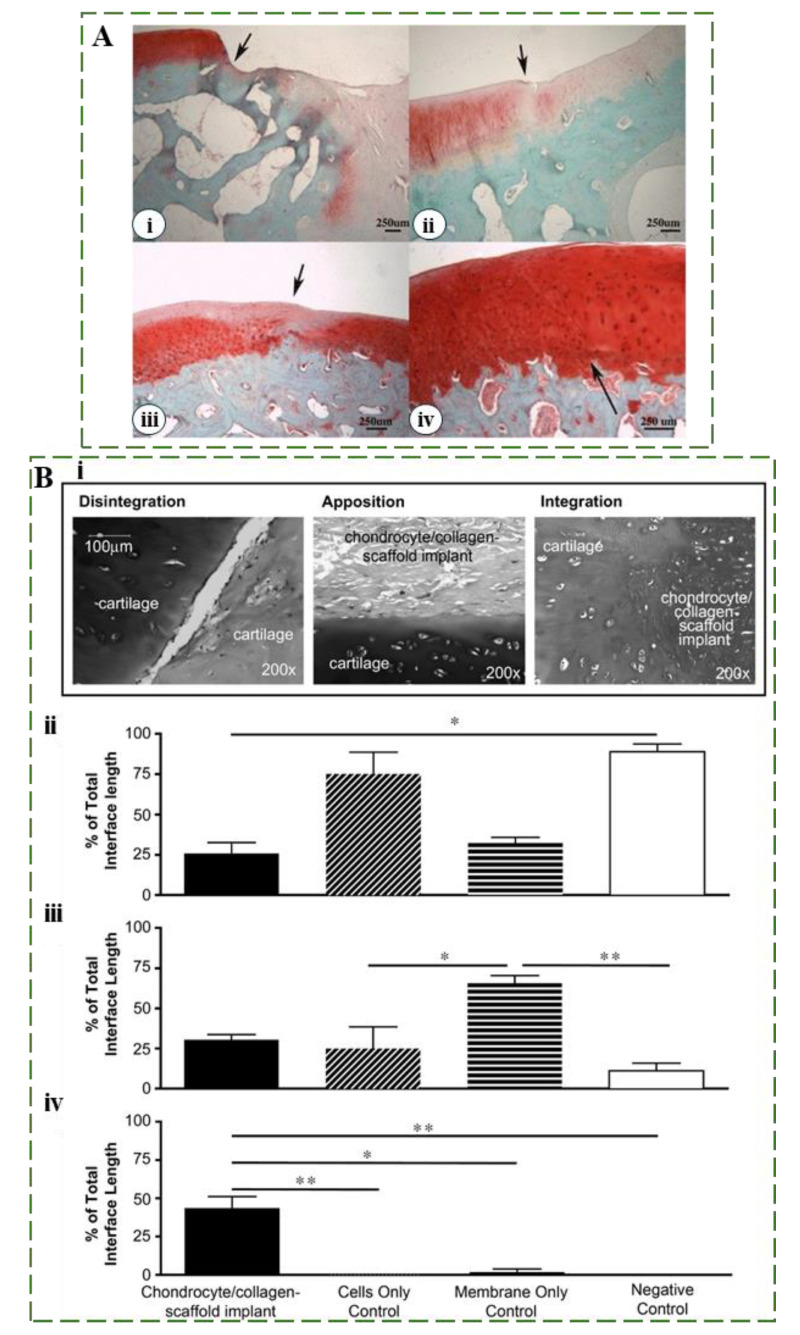
(A) Representative Safranin O-stained sections depicting varying grades of integration with native cartilage. Black arrows highlight the junction area: (i) Poor integration, no tissue fusion; (ii) Integration with hypocellularity and surface fissuring; (iii) Enhanced integration with residual hypocellularity; (iv) Excellent integration; Reproduced with permission from Ref. [101], Copyright 2014, Springer. (B) Schematic representation of integration examination for repaired and native cartilage. Cartilage integration facilitated by a chondrocyte/collagen-scaffold implant system: Chondrocytes seeded onto a collagen membrane formed the implant, positioned between two cartilage discs. Histomorphometric analysis compared how well different groups integrated along the interface after 40 days: implanted chondrocytes, cells-only, membrane-only, and negative controls. Integration quality was categorized into disintegration, apposition, and integration percentages across the interface length. Statistical analysis was reported using the Kruskal–Wallis non-parametric ANOVA, fol-lowed by the Mann–Whitney U-test with a Dunn post hoc correction for multiple compar-isons. * p < 0.05; ** p < 0.01. Comparisons not marked with an asterisk are not statistically significant. Reproduced with permission from [102], Copyright 2009 Elsevier Ltd.
Figure 5
Figure 5
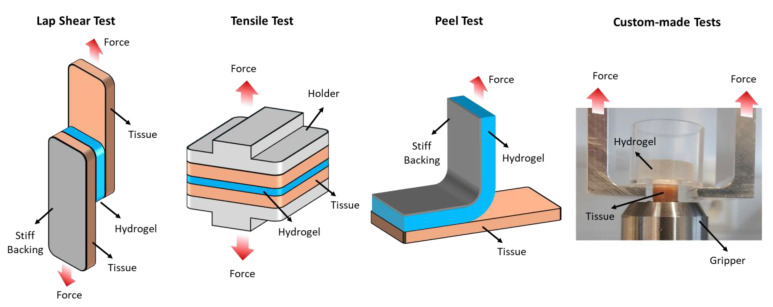
Mechanical adhesion testing methods, including lap shear, tensile, peel, and an example of a custom-made testing setup.

References

    1. Gomoll A.H., Minas T. The quality of healing: Articular cartilage. Wound Repair Regen. 2014;22:30–38. doi: 10.1111/wrr.12166. - DOI - PubMed
    1. Martin R., Laurent A., Applegate L., Philippe V. Grands défects chondraux et ostéochondraux du genou: Traitement par greffe chondrocytaire autologue. Rev. Med. Suisse. 2022;18:2384–2390. doi: 10.53738/REVMED.2022.18.808.2384. - DOI - PubMed
    1. Martin R., Jakob R.P. Review of KH Pridie (1959) on “A method of resurfacing osteoarthritic knee joints”. J. ISAKOS. 2022;7:39–46. doi: 10.1016/j.jisako.2021.11.001. - DOI - PubMed
    1. Campbell T.M., Trudel G. Protecting the regenerative environment: Selecting the optimal delivery vehicle for cartilage repair—A narrative review. Front. Bioeng. Biotechnol. 2024;12:1283752. doi: 10.3389/fbioe.2024.1283752. - DOI - PMC - PubMed
    1. Philippe V., Laurent A., Abdel-Sayed P., Hirt-Burri N., Ann Applegate L., Martin R. Human platelet lysate as an alternative to autologous serum for human chondrocyte clinical use. Cartilage. 2021;13:509S–518S. doi: 10.1177/19476035211035433. - DOI - PMC - PubMed

LinkOut - more resources