


Anti-Aflatoxigenic Burkholderia contaminans BC11-1 Exhibits Mycotoxin Detoxification, Phosphate Solubilization, and Cytokinin Production
- PMID: 39338429
- PMCID: PMC11434526
- DOI: 10.3390/microorganisms12091754
Anti-Aflatoxigenic Burkholderia contaminans BC11-1 Exhibits Mycotoxin Detoxification, Phosphate Solubilization, and Cytokinin Production
Abstract
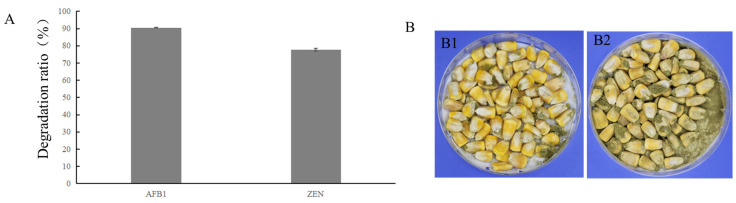
The productivity and quality of agricultural crops worldwide are adversely affected by disease outbreaks and inadequate nutrient availability. Of particular concern is the potential increase in mycotoxin prevalence due to crop diseases, which poses a threat to food security. Microorganisms with multiple functions have been favored in sustainable agriculture to address such challenges. Aspergillus flavus is a prevalent aflatoxin B1 (AFB1)-producing fungus in China. Therefore, we wanted to obtain an anti-aflatoxigenic bacterium with potent mycotoxin detoxification ability and other beneficial properties. In the present study, we have isolated an anti-aflatoxigenic strain, BC11-1, of Burkholderia contaminans, from a forest rhizosphere soil sample obtained in Luzhou, Sichuan Province, China. We found that it possesses several beneficial properties, as follows: (1) a broad spectrum of antifungal activity but compatibility with Trichoderma species, which are themselves used as biocontrol agents, making it possible to use in a biocontrol mixture or individually with other biocontrol agents in an integrated management approach; (2) an exhibited mycotoxin detoxification capacity with a degradation ratio of 90% for aflatoxin B1 and 78% for zearalenone, suggesting its potential for remedial application; and (3) a high ability to solubilize phosphorus and produce cytokinin production, highlighting its potential as a biofertilizer. Overall, the diverse properties of BC11-1 render it a beneficial bacterium with excellent potential for use in plant disease protection and mycotoxin prevention and as a biofertilizer. Lastly, a pan-genomic analysis suggests that BC11-1 may possess other undiscovered biological properties, prompting further exploration of the properties of this unique strain of B. contaminans. These findings highlight the potential of using the anti-aflatoxigenic strain BC11-1 to enhance disease protection and improve soil fertility, thus contributing to food security. Given its multiple beneficial properties, BC11-1 represents a valuable microbial resource as a biocontrol agent and biofertilizer.
Keywords: biocontrol agent; biofertilizer; mycotoxin detoxification; phosphate-solubilizing microorganisms; phytohormone.
Conflict of interest statement
The authors declare no conflict of interest.
Figures
References
-
- Ristaino J.B., Anderson P.K., Bebber D.P., Brauman K.A., Cunniffe N.J., Fedoroff N.V., Finegold C., Garrett K.A., Gilligan C.A., Jones C.M., et al. The persistent threat of emerging plant disease pandemics to global food security. Proc. Natl. Acad. Sci. USA. 2021;118:e2022239118. doi: 10.1073/pnas.2022239118. - DOI - PMC - PubMed
-
- Pereira V.L., Fernandes J.O., Cunha S.C. Mycotoxins in cereals and related foodstuffs: A review on occurrence and recent methods of analysis. Trends Food Sci. Technol. 2014;36:96–136. doi: 10.1016/j.tifs.2014.01.005. - DOI
Grants and funding
- 2023NSFSC1261/Natural Science Foundation of Sichuan Province
- 1+9KJGG006/The "1+9" Key Scientific and Technological Project of Sichuan Academy of Agricultural Sciences
- 2024ZZCX007/Innovation funding of Sichuan Academy of Agricultural Sciences
- 2019QYXK002/Innovation funding of Sichuan Academy of Agricultural Sciences
- SKLCUSA-b202206/the Funding from State Key Laboratory for Conservation and Utilization of Subtropical Agro-Bioresources
LinkOut - more resources
Full Text Sources
Molecular Biology Databases
