


Maternal Folic Acid and Dietary Folate Intake in Relation to Sex Ratio at Birth and Sex-Specific Birth Weight in China
- PMID: 39339722
- PMCID: PMC11434778
- DOI: 10.3390/nu16183122
Maternal Folic Acid and Dietary Folate Intake in Relation to Sex Ratio at Birth and Sex-Specific Birth Weight in China
Abstract
Background: It is well-established that prenatal folic acid supplements can reduce neural tube defects. However, the associations between folic acid supplementation, dietary folate intake, and overall folate intake with sex-specific birth outcomes are not yet fully understood.
Objectives: This study aims to investigate the association of periconceptional folic acid supplement, dietary folate, and total folate intake with the sex ratio at birth and sex-specific birth weight.
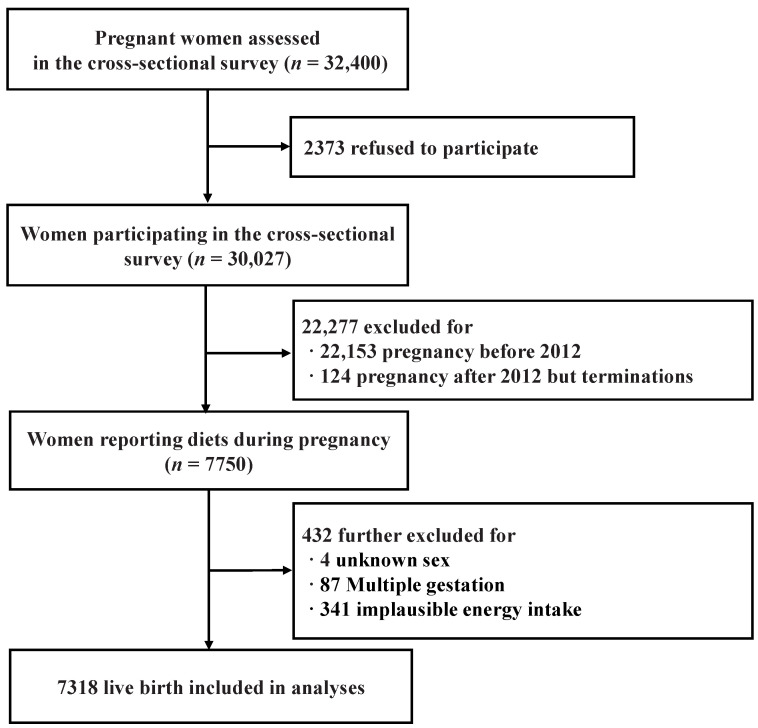
Methods: Data were sourced from a cross-sectional survey conducted between August and December 2013 in Northwest China, involving 7318 infants and their mothers, recruited using a stratified multistage random sampling method. Folic acid supplements (400 μg/d) were ascertained via a retrospective in-person interview. Dietary folate was evaluated using a validated food frequency questionnaire. Birth outcomes, including sex and weight at birth, were obtained from the Medical Certificate of Birth. Generalized linear models were employed to calculate relative risks (RRs) or differences with 95% confidence intervals (CIs).
Results: No association or dose-response relationship was observed between folic acid supplement, dietary folate, and total folate intake during periconception and the likelihood of male births. However, women who took folic acid supplements during pre- and post-conception were associated with an increased male birth weight by 52.8 (8.1 to 97.5) g. Additionally, the total folate intake during periconception was associated with birth weight for males (upper vs. lower tertile: β = 38.8, 95%CI: 5.0 to 72.5 g, p-trend = 0.024) and females (upper vs. lower tertile: β = 42.4, 95%CI: 6.7 to 78.1; p-trend = 0.022).
Conclusions: Our findings indicate that periconceptional total folate intake does not correlate with sex ratio at birth but was positively linked to infant birth weights, regardless of gender. These findings offer novel insights into potential benefits of total folate intake, beyond the prevention of neural tube defects, for policymakers and public health.
Keywords: dietary folate; folic acid; sex ratio at birth; sex-specific birth weight.
Conflict of interest statement
The authors declared no conflicts of interest.
Figures
References
-
- Chao F., Gerland P., Cook A.R., Guilmoto C.Z., Alkema L. Projecting sex imbalances at birth at global, regional and national levels from 2021 to 2100: Scenario-based Bayesian probabilistic projections of the sex ratio at birth and missing female births based on 3.26 billion birth records. BMJ Glob. Health. 2021;6:e005516. doi: 10.1136/bmjgh-2021-005516. - DOI - PMC - PubMed
MeSH terms
Substances
LinkOut - more resources
Full Text Sources
Medical
