


Simultaneous Use of Iron/Anticoccidial Treatment and Vaccination against Oedema Disease: Impact on the Development of Serum-Neutralising Antibodies, Hematinic and Anticoccidial Activities in Piglets
- PMID: 39340034
- PMCID: PMC11435768
- DOI: 10.3390/vaccines12091004
Simultaneous Use of Iron/Anticoccidial Treatment and Vaccination against Oedema Disease: Impact on the Development of Serum-Neutralising Antibodies, Hematinic and Anticoccidial Activities in Piglets
Abstract
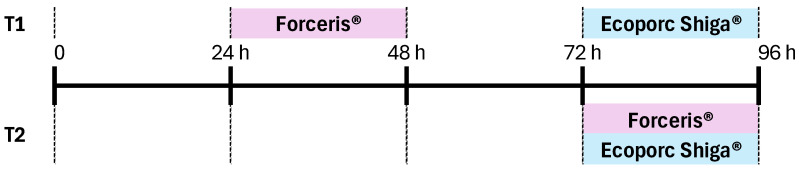
Oedema disease (OD) in weaned piglets is caused by shigatoxigenic Escherichia coli (STEC), which produces the Stx2e toxin. The disease is controlled by early vaccination (for example, with Ecoporc Shiga®). Iron-deficiency anaemia (IDA) and cystoisosporosis are the most common clinical conditions in piglets. These conditions are managed mainly by the intramuscular injection of iron and application of toltrazuril (for example, Forceris®). In the present study, we sought to evaluate any effect on the efficacy of OD vaccination and iron/anticoccidial treatment resulting from a simultaneous application. An evaluation was carried out by measuring the development of neutralising antibodies against the Stx2e toxin, hematinic indices and oocysts shedding. Six litters from Stx2e-antibody-negative sows were included in the study, with 12 piglets in each litter. The piglets were randomly allocated into two groups on their second day of life (DOL): (T1) iron/anticoccidial treatment and vaccine were administered on different days, and (T2) products were administered simultaneously. Blood samples were collected to determine the levels of serum-neutralising antibodies, haemoglobin and haematocrit. Faecal matter was examined for the presence of oocysts of Cystoisospora suis. No differences were found between the two groups in terms of the development of neutralising antibodies. The levels of haemoglobin and haematocrit were lower (p < 0.05 and p = 0.08, respectively) when iron/anticoccidial treatment and vaccine were applied simultaneously but within the optimal range, based on current interpretive criteria for IDA. Oocysts were not detected in the faecal samples from the animals in either group. In conclusion, we found that, under the conditions of our study, the efficacy of OD vaccination and iron/anticoccidial treatment was not affected by the simultaneous use.
Keywords: IDA; Oedema disease; cystoisosporosis; gleptoferron; haemoglobin; toltrazuril; vaccination.
Conflict of interest statement
Authors D.S., H.K., N.G. and A.D. are employees of CEVA Sante Animale, France. The remaining authors declare that the research was conducted in the absence of any commercial or financial relationships that could be construed as a potential conflict of interest.
Figures
References
-
- Fairbrother J.M., Nadeau E. Collibacillosis. In: Zimmerman J., Karriker L.A., Ramirez A., Schwartz K.J., Stevenson G.W., Zhang J., editors. Diseases of Swine. 11th ed. Wiley-Blackwell; Hoboken, NJ, USA: 2019. pp. 807–834.
-
- Berger P.I., Hermanns S., Kerner K., Schmelz F., Bauerfeind R., Schüler V., Ewers C., Doherr M.G. Cross-sectional study: Prevalence of oedema disease Escherichia coli (EDEC) in weaned piglets in Germany at pen and farm levels. Porc. Health Manag. 2023;9:49. doi: 10.1186/s40813-023-00343-9. - DOI - PMC - PubMed
-
- Lillie-Jaschniski K., Köchling M., Lindner T. Erste Erfahrungen mit dem Einsatz von ECOPORC SHIGA, der neuen Vakzine gegen die Ödemkrankheit-Auswertungen aus Feldversuchen in Deuschland. Tierärztl. Umschau. 2013;68:377–382.
LinkOut - more resources
Full Text Sources
