


Conceptualization and teaching health advocacy in undergraduate medical education: a document analysis
- PMID: 39342200
- PMCID: PMC11439203
- DOI: 10.1186/s12909-024-06039-0
Conceptualization and teaching health advocacy in undergraduate medical education: a document analysis
Abstract
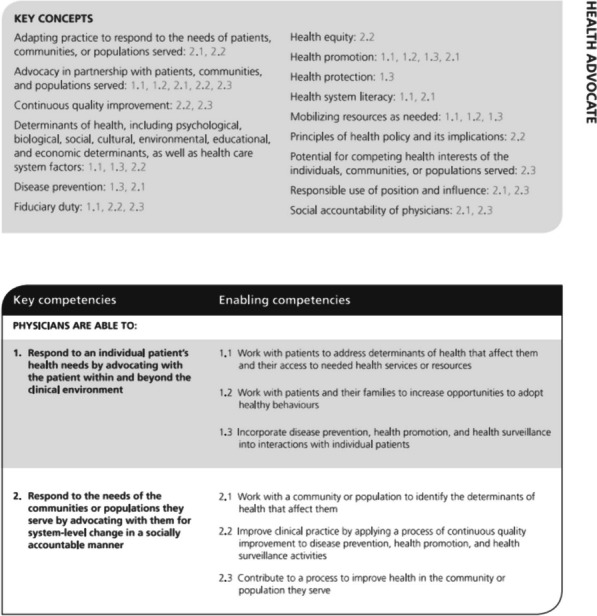
Background: Health advocacy is considered to be a core competence for physicians, but it remains unclear how the health advocacy role, despite being described in overarching competency frameworks, is operationalized in undergraduate medical education (UME). This study aimed to identify how health advocacy is conceptualized and taught in undergraduate medical curricula.
Methods: We performed a qualitative analysis of curriculum documents from all eight medical schools in the Netherlands, all of which offered competency-based UME. Thematic analysis was used to code all the documents and generate themes on health advocacy conceptualization and teaching. To categorize the emerging themes, we used the framework of Van Melle et al. for evaluating the implementation of competency-based medical educational programs.
Results: Health advocacy was mostly conceptualized in mission statements about social responsibility of future physicians, related to prevention and promoting health. We found key concepts of health advocacy to be taught mainly in public health and social medicine courses in the bachelor stage and in community-based clerkships in the master stage. Specific knowledge, skills and attitudes related to health advocacy were taught mostly in distinct longitudinal learning pathways in three curricula.
Conclusion: Health advocacy is conceptualized mostly as related to social responsibility for future physicians. Its teaching is mostly embedded in public health and social medicine courses and community-based settings. A wider implementation is warranted, extending its teaching to the full width of medical teaching, with longitudinal learning pathways providing a promising route for more integrative health advocacy teaching.
Keywords: Competency-based medical education; Document analysis; Health advocacy; Social responsibility of physicians; Undergraduate medical education.
© 2024. The Author(s).
Conflict of interest statement
The authors declare no competing interests.
Figures
References
-
- Frank JR, Schnell L, Sherbino J. CanMeds 2015 Physician Competency Framework. Ottawa: Royal College of Physicians and Surgeons of Canada; 2015.
-
- Mackenbach JP. Politics is nothing but medicine at a larger scale: reflections on public health’s biggest idea. J Epidemiol Community Health. 2009;63(3):181–4. 10.1136/jech.2008.077032. - PubMed
-
- Earnest MA, Wong SL, Federico SG, Perspective. Physician advocacy: what is it and how do we do it? Acad Med. 2010;85(1):63–7. 10.1097/ACM.0b013e3181c40d40. - PubMed
-
- Hubinette M, Dobson S, Scott I, Sherbino J. Health advocacy. Med Teach. 2017;39(2):128–35. 10.1080/0142159X.2017.1245853. - PubMed
MeSH terms
LinkOut - more resources
Full Text Sources
