[Preprint]. 2024 Sep 21:2024.09.17.612508.
doi: 10.1101/2024.09.17.612508.

A Kinetic Scout Approach Accelerates Targeted Protein Degrader Development

Affiliations

A Kinetic Scout Approach Accelerates Targeted Protein Degrader Development

Angela T Fan et al. bioRxiv. .

Update in

  • A Kinetic Scout Approach Accelerates Targeted Protein Degrader Development.
    Fan AT, Gadbois GE, Huang HT, Chaudhry C, Jiang J, Sigua LH, Smith ER, Wu S, Poirier GJ, Dunne-Dombrink K, Goyal P, Tao AJ, Sellers WR, Fischer ES, Donovan KA, Ferguson FM. Fan AT, et al. Angew Chem Int Ed Engl. 2025 Jan 27;64(5):e202417272. doi: 10.1002/anie.202417272. Epub 2024 Dec 16. Angew Chem Int Ed Engl. 2025. PMID: 39602499

Abstract

Bifunctional molecules such as targeted protein degraders induce proximity to promote gain-of-function pharmacology. These powerful approaches have gained broad traction across academia and the pharmaceutical industry, leading to an intensive focus on strategies that can accelerate their identification and optimization. We and others have previously used chemical proteomics to map degradable target space, and these datasets have been used to develop and train multiparameter models to extend degradability predictions across the proteome. In this study, we now turn our attention to develop generalizable chemistry strategies to accelerate the development of new bifunctional degraders. We implement lysine-targeted reversible-covalent chemistry to rationally tune the binding kinetics at the protein-of-interest across a set of 25 targets. We define an unbiased workflow consisting of global proteomics analysis, IP/MS of ternary complexes and the E-STUB assay, to mechanistically characterize the effects of ligand residence time on targeted protein degradation and formulate hypotheses about the rate-limiting step of degradation for each target. Our key finding is that target residence time is a major determinant of degrader activity, and this can be rapidly and rationally tuned through the synthesis of a minimal number of analogues to accelerate early degrader discovery and optimization efforts.


Conflict of interest statement

K.A.D receives or has received consulting fees from Kronos Bio and Neomorph Inc. H.-T.H has no conflict of interest. W.R.S. is a Board or SAB member and holds equity in Delphia Therapeutics, Ideaya Biosciences, Red Ridge Bio, Scorpion Therapeutics and has consulted for Array, Astex, CJ Biosciences, Epidarex Capital, Ipsen, Merck Pharmaceuticals, Pierre Fabre, Sanofi, Servier and Syndax Pharmaceuticals and receives research funding from Bayer Pharmaceutical, Bristol-Myers Squibb, Boehringer-Ingelheim, Ideaya Biosciences, Calico Biosciences, and Servier Pharmaceuticals. W.R.S. is a co-patent holder on EGFR mutation diagnostic patents. F.M.F. is a scientific co-founder and equity holder in Proximity Therapeutics, and was previously a scientific advisory board member (SAB) of Triana Biomedicines. F.M.F. is or was recently a consultant or received speaking honoraria from RA Capital, Eli Lilly and Co., Sorrento Pharma, Plexium Inc, Sygnature Discovery, Neomorph Inc. and Tocris BioTechne. The Ferguson lab receives or has received research funding or resources in kind from Ono Pharmaceutical Co. Ltd, Promega Corp, Eli Lilly and Co., and Merck and Co. F.M.F.’s interests have been reviewed and approved by the University of California San Diego in accordance with its conflict-of-interest policies. E.S.F. is a founder, scientific advisory board (SAB) member, and equity holder of Civetta Therapeutics, Proximity Therapeutics, Stelexis Biosciences, and Neomorph, Inc. (also board of directors). He is an equity holder and SAB member for Avilar Therapeutics, Photys Therapeutics, and Ajax Therapeutics and an equity holder in Lighthorse Therapeutics and Anvia Therapeutics. E.S.F. is a consultant to Novartis, EcoR1 capital, Odyssey and Deerfield. The Fischer lab receives or has received research funding from Deerfield, Novartis, Ajax, Interline, Bayer and Astellas.

Figures

Figure 1 |
Figure 1 |. Overview of the Kinetic Scout Degrader Approach.
A. Schematic showing variables that impact targeted protein degradation measured in this study. B. Design of kinetic scout degrader library. Pan-kinase binders with comparable kinome-wide selectivity profiles but distinct binding off-rates, mediated by reversible, reversible covalent and covalent interactions at the conserved lysine were employed. C. VHL NanoBRET target engagement assay to measure permeability of kinetic scout degrader library. HEK293 cells expression NanoLuc-VHL were treated with 1 μM tracer and indicated concentration of kinetic scout degrader for 2 hrs. BRET signal was normalized to DMSO BRET signal. D. Viability assay in MOLT4 and MOLT4 VHL−/− cells. Cells were treated with DMSO or indicated concentration of compound for 72 hr and luminescence was measured after addition of CellTiter-Glo reagents. C.-D. Data shown as the average of n = 3 replicates +/− standard deviation.
Figure 2 |
Figure 2 |. Degraded target space strongly influenced by residence time of pan-kinase recruiter.
A. Global proteomics analysis of MOLT4 cells treated with the indicated compound for 5 hrs. B. Venn diagram illustrating the overlap of degraded kinases by each compound. C. Influence of kinase binder residence time on CDK6 degradation. D. Immunoblot validating compound-specific CDK6 and NEK9 degradation. MOLT4 cells were treated for 6 hrs with the indicated compounds at the indicated concentrations. Data representative of n = 3 biological replicates. E. CDK6 NanoBRET assay showing minimal equilibrium IC50 differences between reversible kinetic scout degraders. HEK293 cells expressing CDK6-NanoLuc were treated with 0.5μM K-10 tracer and indicated compound at indicated concentrations for 2 hrs. The data was background corrected by subtracting BRET signal in the absence of tracer and then normalized to DMSO BRET signal. Data shown as the average of n = 3 replicates +/− standard deviation. F. CDK6 NanoBRET washout assay. Cells were treated with 10 μM of the indicated compound for 2 hrs, then washed with 2 x opti-MEM+10% FBS, followed by 2 x opti-MEM. 0.5 μM K-10 tracer was added and BRET signal read over a 2 hr time course.
Figure 3 |
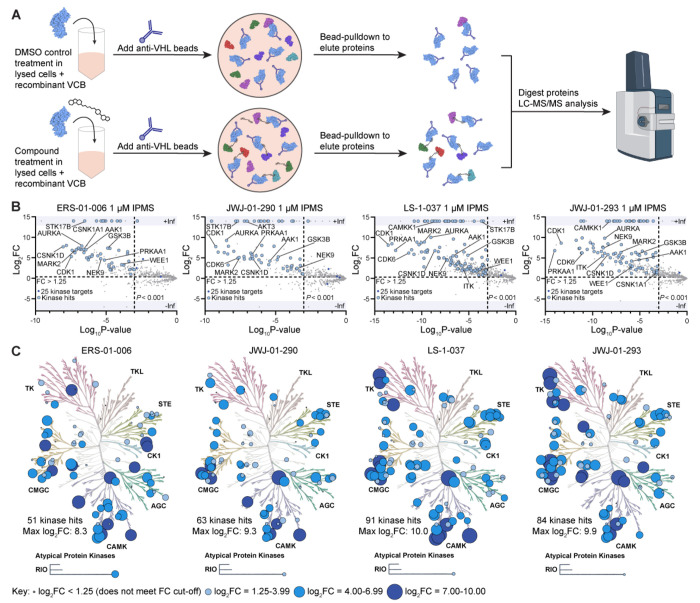
Figure 3 |. Kinetic scout degraders form ternary complexes with VHL kinome-wide.
A. Schematic depicting the VHL IP/MS assay. B. Scatterplot demonstrating relative protein abundance following Flag-VHL enrichment from in-lysate treatment with 1μM of each molecule. Scatterplots display fold change in abundance to DMSO. Significant changes were assessed by moderated t-test as implemented in the limma package78 with log2FC shown on the y-axis and negative log10P-value on the x-axis. C. Compound-dependent VHL IP/MS enrichment of kinases plotted on a kinome tree. Illustration reproduced courtesy of Cell Signaling Technology, Inc.
Figure 4 |
Figure 4 |. E-STUB reveals rapidly ubiquitinated kinases across the proteome.
A. Schematic depicting the E-STUB assay. B. E-STUB data showing fold change in abundance of streptavidin-enriched proteins following 1 hr compound treatment in 293T VHL−/− cells expressing VHL-BirA and A3-ubiquitin. C. Comparison of target-dependent degradation and ubiquitination. E-STUB data showing fold change in abundance (represented by size of dots) and statistical significance (represented by saturation of color) of B is overlaid onto a volcano plot (from Fig. 2A) of the global proteomics analysis of MOLT4 cells treated with the indicated compound for 5 hrs.
Figure 5 |
Figure 5 |. Multiparameter analysis reveals drivers of residence-time based degradation outcomes.
Multiparameter profiles for representative kinases that are preferentially degraded by degraders which incorporate A. fully reversible binders. B. reversible covalent binders C.-D. irreversible covalent binders. K192 NanoBRET measurements used negative control compounds.

References

    1. Whelan R. & Mayor-Ruiz C. Chemical rewiring of ubiquitination by degraders and their selectivity routes. Nat Struct Mol Biol 31, 205–207 (2024). 10.1038/s41594-024-01215-8 - DOI - PubMed
    1. O’Brien Laramy M. N., Luthra S., Brown M. F. & Bartlett D. W. Delivering on the promise of protein degraders. Nat Rev Drug Discov 22, 410–427 (2023). 10.1038/s41573-023-00652-2 - DOI - PubMed
    1. Burslem G. M. & Crews C. M. Proteolysis-Targeting Chimeras as Therapeutics and Tools for Biological Discovery. Cell 181, 102–114 (2020). 10.1016/j.cell.2019.11.031 - DOI - PMC - PubMed
    1. Cowan A. D. & Ciulli A. Driving E3 Ligase Substrate Specificity for Targeted Protein Degradation: Lessons from Nature and the Laboratory. Annu Rev Biochem 91, 295–319 (2022). 10.1146/annurev-biochem-032620-104421 - DOI - PubMed
    1. Donovan K. A. et al. Mapping the Degradable Kinome Provides a Resource for Expedited Degrader Development. Cell 183, 1714–1731 e1710 (2020). 10.1016/j.cell.2020.10.038 - DOI - PMC - PubMed

Publication types

LinkOut - more resources