


Effect of Ceftaroline, Ceftazidime/Avibactam, Ceftolozane/Tazobactam, and Meropenem/Vaborbactam on Establishment of Colonization by Vancomycin-Resistant Enterococci and Klebsiella pneumoniae in Mice
- PMID: 39345792
- PMCID: PMC11432534
- DOI: 10.20411/pai.v9i2.711
Effect of Ceftaroline, Ceftazidime/Avibactam, Ceftolozane/Tazobactam, and Meropenem/Vaborbactam on Establishment of Colonization by Vancomycin-Resistant Enterococci and Klebsiella pneumoniae in Mice
Abstract
Background: The potential for promotion of intestinal colonization with healthcare-associated pathogens by new antibiotics used to treat infections due to multidrug-resistant Gram-negative bacilli is unclear.
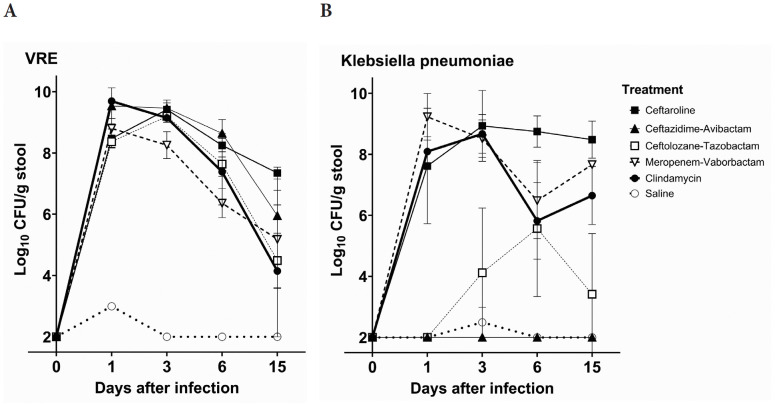
Methods: Mice treated for 3 days with daily subcutaneous phosphate-buffered saline (control), ceftazidime/avibactam, ceftolozane/tazobactam, ceftaroline, and meropenem/vaborbactam were challenged with 10,000 colony-forming units (CFU) of vancomycin-resistant Enterococcus (VRE) resistant to each of the antibioics or carbapenemase-producing Klebsiella pneumoniae 1 day after the final treatment dose. The concentrations of VRE or K. pneumoniae in stool were measured on days 1, 3, 6, and 15 after challenge.
Results: Control mice had transient low levels of VRE or K. pneumoniae (<3 log10 CFU/g) detected in stool with negative cultures on days 6 and 15 after challenge. In comparison to control mice, each of the antibiotics promoted establishment of high-density colonization with VRE (mean concentration, >8 log10 CFU/g of stool on day 1 after challenge) that persisted at >4 log10 CFU/g of stool through day 15 (P<0.01). In comparison to control mice, meropenem/vaborbactam and ceftaroline promoted high-density colonization with K. pneumoniae (peak concentration, >8 log10 CFU/g of stool) (P<0.01), ceftolozane/tazobactam promoted colonization to a lesser degree (peak concentration, >5 log10 CFU/g of stool), and ceftazidime/avibactam did not promote colonization (P>0.05).
Conclusions: Our results suggest that several beta-lactam antibiotics recently developed for treatment of infections with resistant Gram-negative bacilli have the potential to promote colonization by healthcare-associated pathogens. Additional studies are needed to examine the impact of these agents in patients.
Keywords: ceftaroline; ceftazidime/avibactam; ceftolozane/tazobactam; colonization resistance; meropenem/vaborbactam; vancomycin-resistant enterococci.
Copyright © 2024 Pathogens and Immunity.
Conflict of interest statement
The authors declare that no competing interests exist.
Figures

References
-
- Donskey CJ, Chowdhry TK, Hecker MT, Hoyen CK, Hanrahan JA, Hujer AM, Hutton-Thomas RA, Whalen CC, Bonomo RA, Rice LB. Effect of antibiotic therapy on the density of vancomycin-resistant enterococci in the stool of colonized patients. N Engl J Med. 2000;343(26):1925–32. doi: 10.1056/NEJM200012283432604. PubMed PMID: ; PMCID: . - DOI - PMC - PubMed
-
- Bhalla A, Pultz NJ, Ray AJ, Hoyen CK, Eckstein EC, Donskey CJ. Antianaerobic antibiotic therapy promotes overgrowth of antibiotic-resistant, gram-negative bacilli and vancomycin-resistant enterococci in the stool of colonized patients. Infect Control Hosp Epidemiol. 2003;24(9):644–9. doi: 10.1086/502267. PubMed PMID: . - DOI - PubMed
-
- Hoyen CK, Pultz NJ, Paterson DL, Aron DC, Donskey CJ. Effect of parenteral antibiotic administration on establishment of intestinal colonization in mice by Klebsiella pneumoniae strains producing extended-spectrum beta-lactamases. Antimicrob Agents Chemother. 2003;47(11):3610–2. doi: 10.1128/AAC.47.11.3610-3612.2003. PubMed PMID: ; PMCID: . - DOI - PMC - PubMed
LinkOut - more resources
Full Text Sources