


Psychological capital and music performance anxiety: the mediating role of self-esteem and flow experience
- PMID: 39346504
- PMCID: PMC11437525
- DOI: 10.3389/fpsyg.2024.1461235
Psychological capital and music performance anxiety: the mediating role of self-esteem and flow experience
Abstract
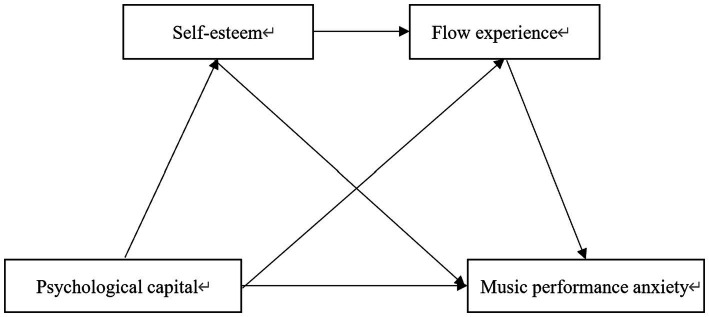
Background: This study aimed to explore the correlation between psychological capital and music performance anxiety among Chinese college students majoring in music. Additionally, the study evaluated the chain mediating effects of self-esteem and flow experience.
Methods: Three hundred twenty-nine college students pursuing a music major from institutions in Eastern China participated in the study. They were asked to complete the Psychological Capital, Self-Esteem, Flow Experience, and Music Performance Anxiety Scales. Descriptive statistics and correlation analysis were performed, and sophisticated mediation models were created.
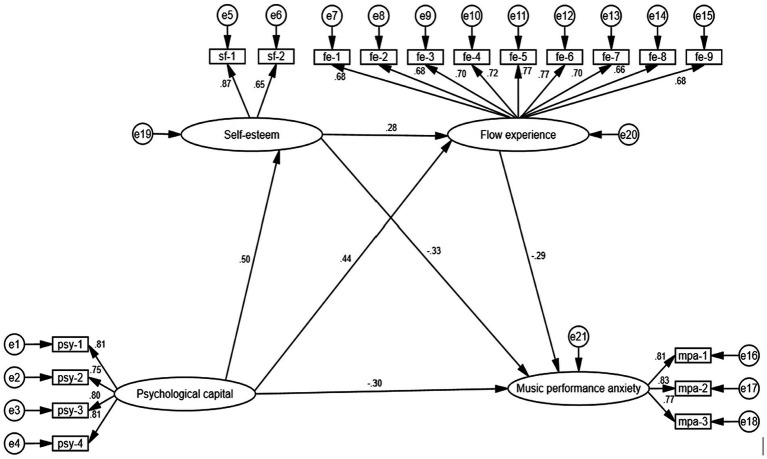
Results: The results suggest that self-esteem and flow experience play a role in connecting psychological capital and music performance anxiety. Moreover, the ultimate model elucidates significant connections linking psychological capital to self-esteem and flow experience in music performance anxiety.
Conclusion: This study offers useful insights for future interventions aimed at mitigating music performance anxiety through the cultivation of students' psychological capital, self-esteem, and flow experiences.
Keywords: flow experience; music major undergraduates; music performance anxiety; psychological capital; self-esteem.
Copyright © 2024 Jiang and Tong.
Conflict of interest statement
The authors declare that the research was conducted in the absence of any commercial or financial relationships that could be construed as a potential conflict of interest.
Figures
References
-
- Adlai-Gail W. S. (1995). Exploring the autotelic personality. Doctoral thesis. Chicago: The University of Chicago.
-
- Altenmüller E., Kesselring J., Wiesendanger M. (2012). Music, motor control and the brain. Oxford: Oxford University Press.
-
- Asakawa K. (2010). Flow experience, culture, and well-being: how do autotelic Japanese college students feel, behave, and think in their daily lives? J. Happiness Stud. 11, 205–223. doi: 10.1007/s10902-008-9132-3 - DOI
LinkOut - more resources
Full Text Sources
