


Breaking the cycle with trauma-focused mentalization-based treatment: theory and practice of a trauma-focused group intervention
- PMID: 39346509
- PMCID: PMC11427379
- DOI: 10.3389/fpsyg.2024.1426092
Breaking the cycle with trauma-focused mentalization-based treatment: theory and practice of a trauma-focused group intervention
Abstract
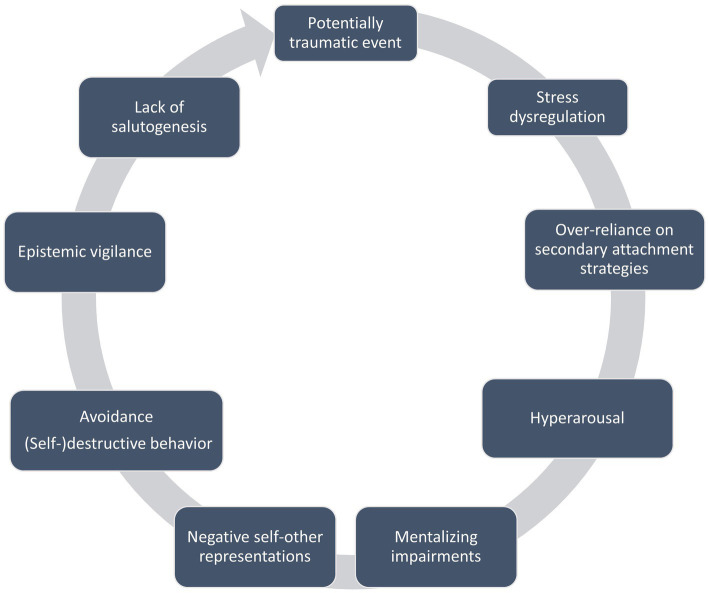
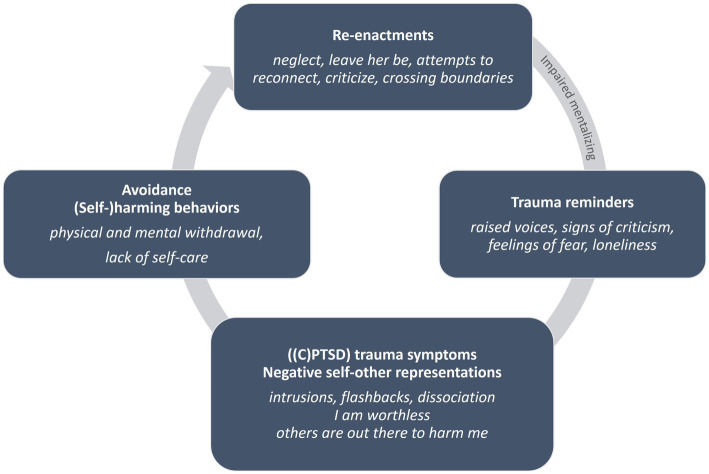
Trauma-Focused mentalization-based treatment (MBT-TF) is an adaptation of mentalization-based treatment (MBT) specifically developed for patients suffering from attachment or complex trauma, with the possibility of co-occurring borderline personality pathology. The creation of MBT-TF was driven by previous research and observations that interventions centered on mentalizing could be significantly improved by directly addressing the impact of trauma. MBT-TF aims to mitigate symptoms that arise post-trauma, such as hyperarousal, hypervigilance, intrusions, flashbacks, avoidance behaviors, dissociative experiences, negative perceptions of self and others, and ensuing relational difficulties. Implemented as a group intervention, MBT-TF typically spans 6-12 months. From a mentalizing perspective, trauma, particularly attachment trauma, leads to a failure in processing the effects of trauma through and with others. Stress and attachment behavioral systems are disrupted, which undermines the capacity for epistemic trust, and impairs mentalizing abilities. This paper offers a concise summary of the reasoning for MBT-TF's creation, its theoretical underpinnings, and its clinical strategy for addressing the adverse impacts of trauma. It further details the treatment phases, their main goals, and their interventions, supplemented by clinical case examples that underscore MBT-TF's distinctive attributes and frequent clinical hurdles.
Keywords: borderline personality disorder; complex PTSD; mentalization; mentalizing; posttraumatic stress disorder (PTSD); trauma.
Copyright © 2024 Smits, de Vos, Rüfenacht, Nijssens, Shaverin, Nolte, Luyten, Fonagy and Bateman.
Conflict of interest statement
AB, PF, PL, MS, LN, TN, JV, and LS are involved in the development, training, and/or dissemination of mentalization-based treatments. The remaining author declares that the research was conducted in the absence of any commercial or financial relationships that could be construed as a potential conflict of interest.
Figures
References
-
- Allen J. G., Fonagy P. (2006). The handbook of mentalization-based treatment. Hoboken, NJ, US: John Wiley & Sons, Inc.
-
- Allen J. G., Fonagy P. (2010). “The role of mentalizing in treating attachment trauma” in The hidden epidemic: the impact of early life trauma on health and disease. eds. Vermetten E., Lanius R. (New York: Cambridge University Press; ).
-
- Allen J. G., Fonagy P. (2019). “Mentalizing in psychotherapy” in The American Psychiatric Association publishing textbook of psychiatry. ed. Roberts L. W.. 7th ed (Washington DC: American Psychiatric Publishing; ).
-
- Allen J., Fonagy P., Bateman A. (2008). Mentalizing in clinical practice. Arlington, VA: American Psychiatric Publishing, Inc.
-
- American Psychiatric Association (2013). Diagnostic and statistical manual of mental disorders: DSM-5. 5th Edn. Washington, DC: American Psychiatric Association.
LinkOut - more resources
Full Text Sources
Miscellaneous
