. 2024 Sep 12;9(38):40122-40133.
doi: 10.1021/acsomega.4c06090. eCollection 2024 Sep 24.

Highly Sensitive Potentiometric pH Sensor Based on Polyaniline Modified Carbon Fiber Cloth for Food and Pharmaceutical Applications

Affiliations

Highly Sensitive Potentiometric pH Sensor Based on Polyaniline Modified Carbon Fiber Cloth for Food and Pharmaceutical Applications

Md Sanwar Hossain et al. ACS Omega. .

Abstract

This study introduces a potentiometric pH sensor that is extremely sensitive and specifically designed for food and pharmaceutical applications. The sensor utilizes a pH-sensitive interface fabricated by electropolymerizing polyaniline (PANI) on carbon fiber cloth (CFC). Structural and morphological analyses of PANI-CFC and CFC have been conducted by using X-ray diffraction (XRD), field emission scanning electron microscopy (FESEM), and X-ray photoelectron spectroscopy (XPS). The investigation of the functional groups was conducted by using Fourier transform infrared spectroscopy (FTIR) and Raman spectroscopy. The electrochemical characteristics were assessed by utilization of cyclic voltammetry (CV) and open-circuit potential (OCP) measurements in a three-electrode configuration. The sensor exhibited a sensitivity of 60.9 mV/pH, while retaining consistent performance within the pH range of 4 to 12. The repeatability and robustness of the sensors were verified. The accuracy of the PANI-CFC sensor was confirmed by validation using real samples, demonstrating its compatibility with commercially available pH sensors. The application of density functional theory (DFT) calculations revealed an interaction energy of -173.2886 kcal/mol, indicating a strong affinity of H+ ions towards PANI-CFC electrode. Further investigation was conducted to examine the chemical reactivity of PANI, revealing a HOMO-LUMO energy gap of -0.98 eV. This study highlights the PANI-CFC sensor as a reliable and efficient pH-sensing platform for food and pharmaceuticals applications, performing robustly in both laboratory and real-world settings.


Conflict of interest statement

The authors declare no competing financial interest.

Figures
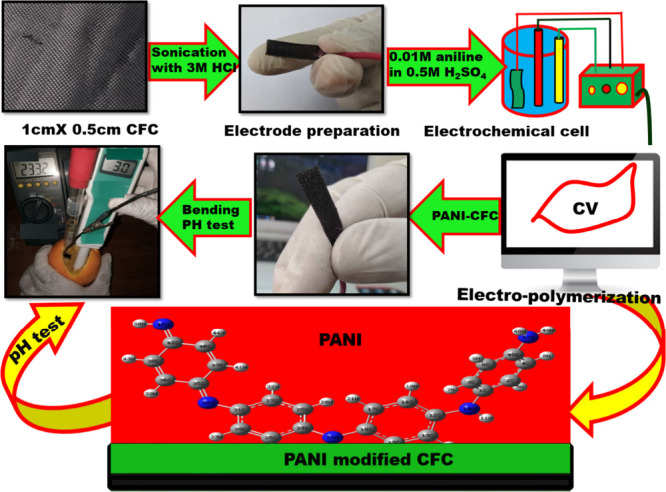
Scheme 1
Scheme 1. Preparation of PANI-CFC Electrode and Application
Figure 1
Figure 1
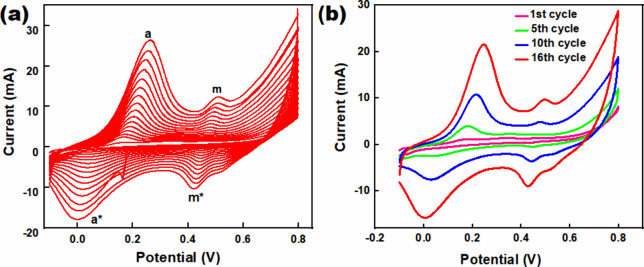
(a) Cyclic voltammogram (CV) of electropolymerization of polyaniline on CFC, and (b) CV summary of electropolymerization process on CFC (conditions: CFC working electrode, platinum wire counter electrode, and Ag/AgCl reference electrode, 0.1 M aniline in 1 M H2SO4 at scan rate 10 mV.s–1, oxidizing agent 1 M H2SO4).
Figure 2
Figure 2
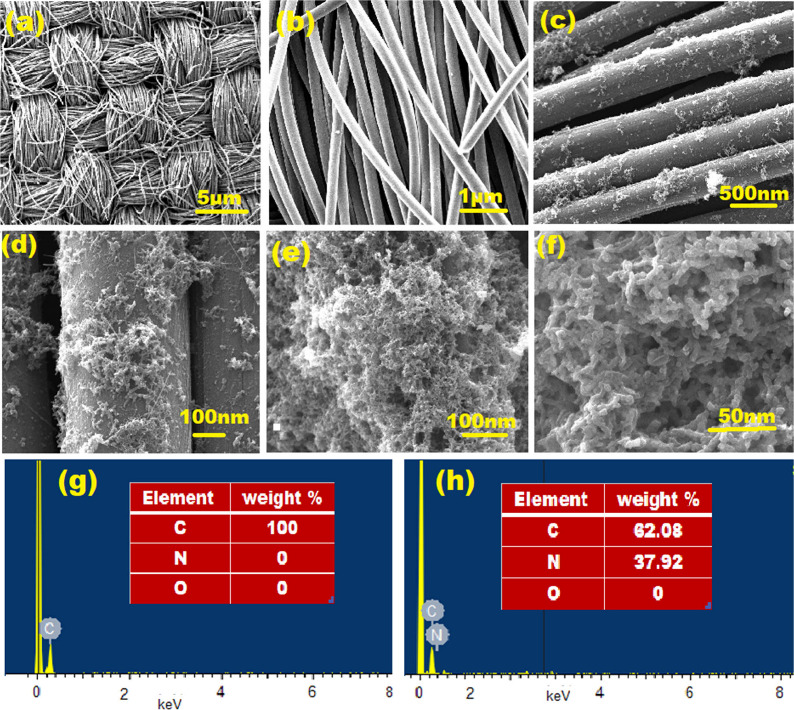
(a,b) SEM images of blank CFC with different magnification; (c,d) PANI-CFC after 10 cycles; (e,f) PANI-CFC after 16 cycles with different magnifications; and (g,h) EDX of CFC and PANI-CFC after 16 cycles with 0.1 M aniline.
Figure 3
Figure 3
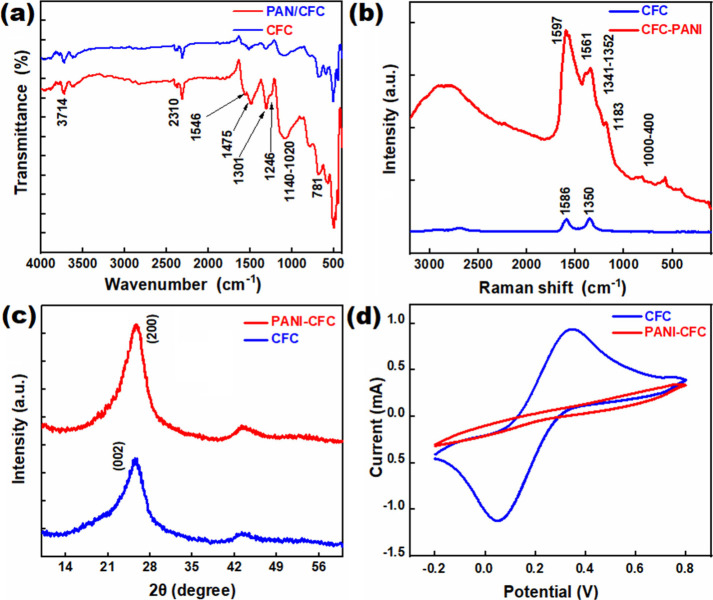
(a) FT-IR spectrum of PANI-CFC and CFC; (b) Raman spectrum; (c) XRD of PANI-CFC and unmodified CFC; and (d) CV of PANI-CFC and CFC.
Figure 4
Figure 4
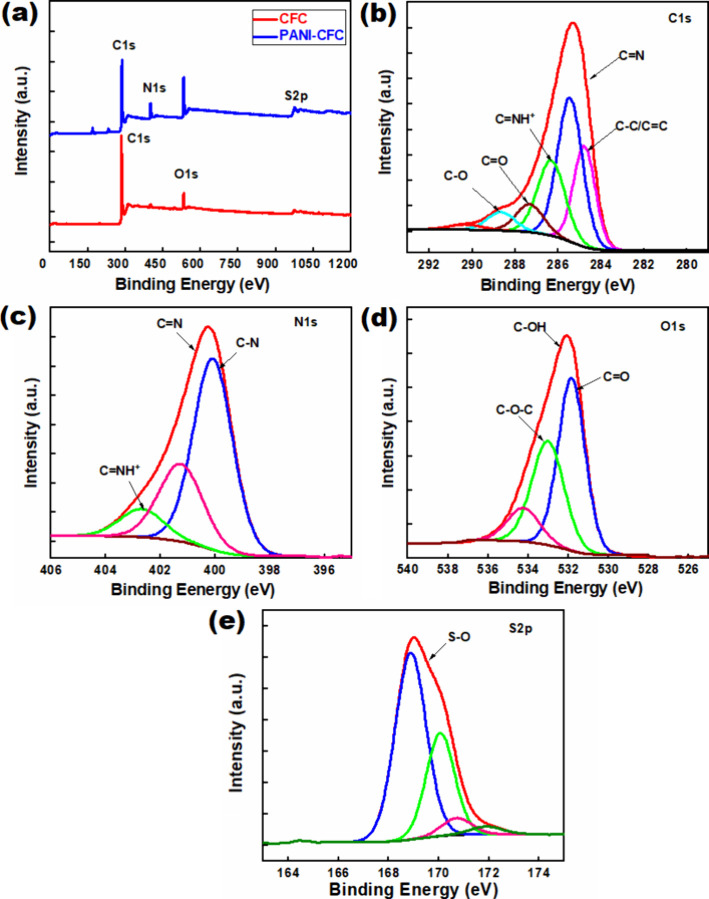
PANI-CFC and CFC materials: (a) survey spectrum; (b) C 1s spectra of PANI-CFC; (c) N 1s spectra of PANI-CFC; (d) O 1s spectra of PANI-CFC; and (e) S 2p spectra of PANI-CFC.
Figure 5
Figure 5
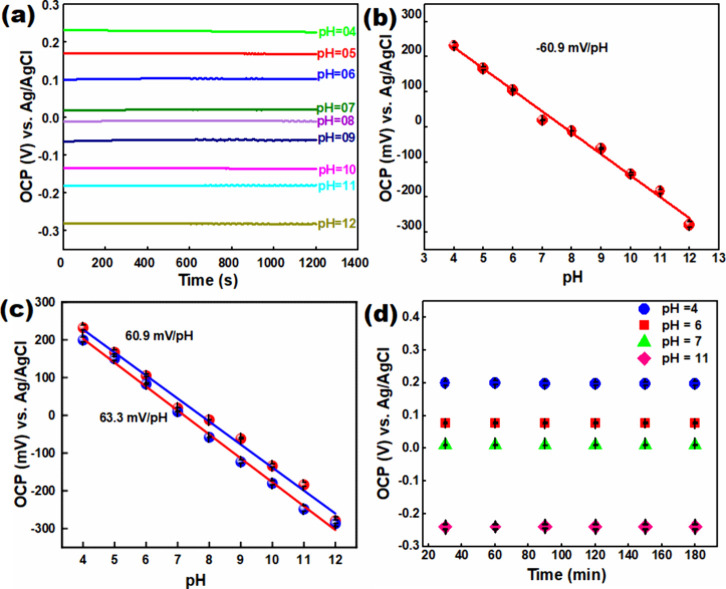
(a) Potential response of PANI-CFC at different pH (4–12) in 0.1 M buffer-solution; (b) the corresponding linear relation plot of pH (4–12); (c) reproducibility; and (d) potential drift test (electrode configuration: PANI-CFC working electrode, platinum wire counter electrode, and Ag/AgCl reference electrode).
Figure 6
Figure 6
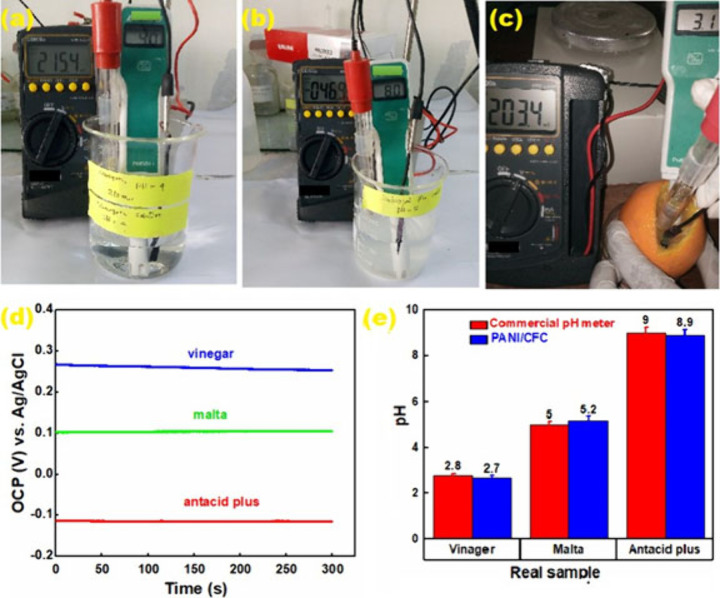
Real sample test images of (a) Vinegar solution; (b) the antacid plus; (c) Malta, (PANI-CFC working electrode and Ag/AgCl reference electrode); (d) OCP measurement of Malta, vinegar, and the antacid plus (conditions: PANI-CFC working electrode, platinum wire counter electrode, and Ag/AgCl reference electrode; 20 mL of each sample was taken for the measurement); and (e) Column representation of the comparison between PANI-CFC sensor and commercial pH meter.
Figure 7
Figure 7
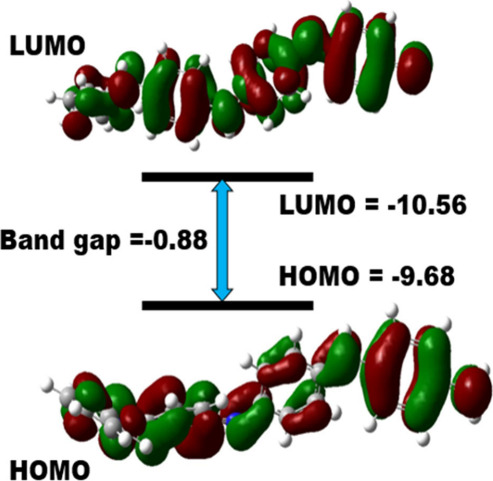
Frontier orbitals of protonated PANI and DFT B3LYP/6-311G+(d, p) level of theory.
Figure 8
Figure 8
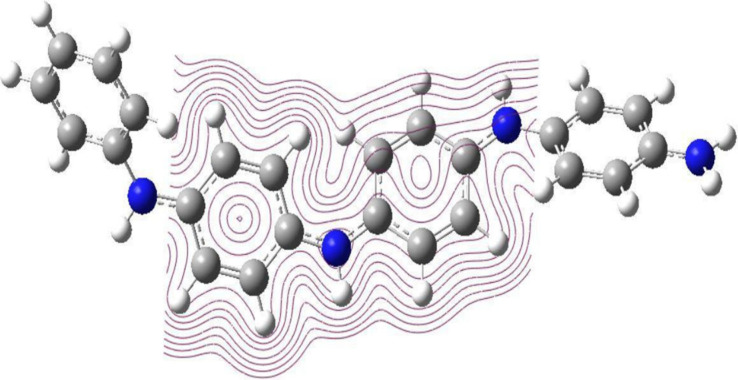
Contour structure of protonated PANI at the DFT B3LYP/6-311G+(2d,p) level of theory.

References

    1. Shi X. M.; Mei L. P.; Zhang N.; Zhao W. W.; Xu J. J.; Chen H. Y. A Polymer Dots-Based Photoelectrochemical PH Sensor: Simplicity, High Sensitivity, and Broad-Range PH Measurement. Anal. Chem. 2018, 90 (14), 8300–8303. 10.1021/acs.analchem.8b02291. - DOI - PubMed
    1. Li Y.; Mao Y.; Xiao C.; Xu X.; Li X. Flexible PH Sensor Based on a Conductive PANI Membrane for PH Monitoring. RSC Adv. 2020, 10 (1), 21–28. 10.1039/C9RA09188B. - DOI - PMC - PubMed
    1. Näreoja T.; Deguchi T.; Christ S.; Peltomaa R.; Prabhakar N.; Fazeli E.; Perälä N.; Rosenholm J. M.; Arppe R.; Soukka T.; et al. Ratiometric Sensing and Imaging of Intracellular PH Using Polyethylenimine-Coated Photon Upconversion Nanoprobes. Anal. Chem. 2017, 89 (3), 1501–1508. 10.1021/acs.analchem.6b03223. - DOI - PubMed
    1. Yue S.; Sun X.; Wang N.; Wang Y.; Wang Y.; Xu Z.; Chen M.; Wang J. SERS–Fluorescence Dual-Mode PH-Sensing Method Based on Janus Microparticles. ACS Appl. Mater. Interfaces 2017, 9 (45), 39699–39707. 10.1021/acsami.7b13321. - DOI - PubMed
    1. Shi X.-M.; Mei L.-P.; Zhang N.; Zhao W.-W.; Xu J.-J.; Chen H.-Y. A Polymer Dots-Based Photoelectrochemical PH Sensor: Simplicity, High Sensitivity, and Broad-Range PH Measurement. Anal. Chem. 2018, 90 (14), 8300–8303. 10.1021/acs.analchem.8b02291. - DOI - PubMed

LinkOut - more resources