. 2024 Jul 3;15(8):4453-4469.
doi: 10.1364/BOE.523716. eCollection 2024 Aug 1.

Probabilistic volumetric speckle suppression in OCT using deep learning

Affiliations

Probabilistic volumetric speckle suppression in OCT using deep learning

Bhaskara Rao Chintada et al. Biomed Opt Express. .

Abstract

We present a deep learning framework for volumetric speckle reduction in optical coherence tomography (OCT) based on a conditional generative adversarial network (cGAN) that leverages the volumetric nature of OCT data. In order to utilize the volumetric nature of OCT data, our network takes partial OCT volumes as input, resulting in artifact-free despeckled volumes that exhibit excellent speckle reduction and resolution preservation in all three dimensions. Furthermore, we address the ongoing challenge of generating ground truth data for supervised speckle suppression deep learning frameworks by using volumetric non-local means despeckling-TNode- to generate training data. We show that, while TNode processing is computationally demanding, it serves as a convenient, accessible gold-standard source for training data; our cGAN replicates efficient suppression of speckle while preserving tissue structures with dimensions approaching the system resolution of non-local means despeckling while being two orders of magnitude faster than TNode. We demonstrate fast, effective, and high-quality despeckling of the proposed network in different tissue types that are not part of the training. This was achieved with training data composed of just three OCT volumes and demonstrated in three different OCT systems. The open-source nature of our work facilitates re-training and deployment in any OCT system with an all-software implementation, working around the challenge of generating high-quality, speckle-free training data.


Conflict of interest statement

We have no conflicts of interest to disclose.

Figures
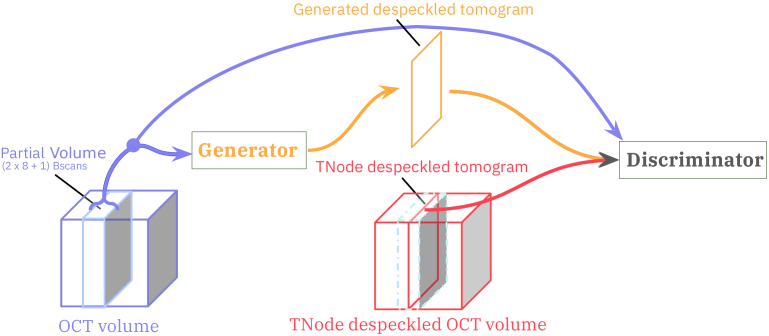
Fig. 1.
Fig. 1.
In DL-TNode-3D, a partial OCT volume is given as input to the generator to learn to despeckle tomograms with the help of a discriminator, making use of the given ground-truth speckle suppressed tomogram produced by TNode.
Fig. 2.
Fig. 2.
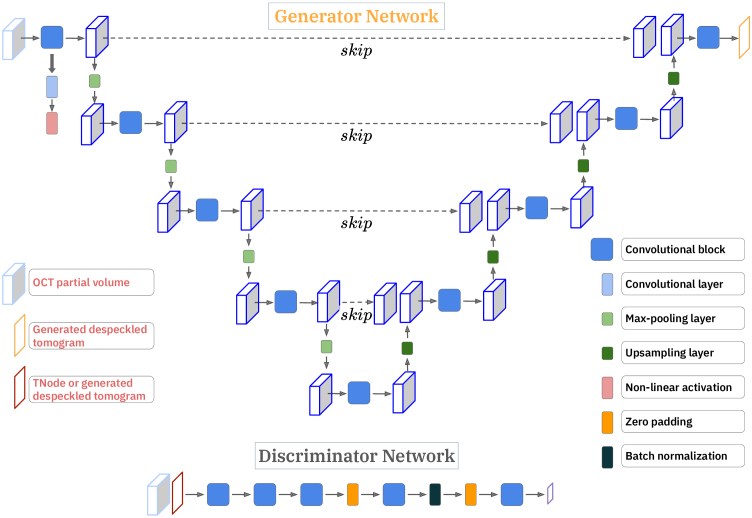
cGAN architecture of our volumetric speckle suppression network; U-Net as a Generator, convolutional patchGAN classifier as a Discriminator.
Fig. 3.
Fig. 3.
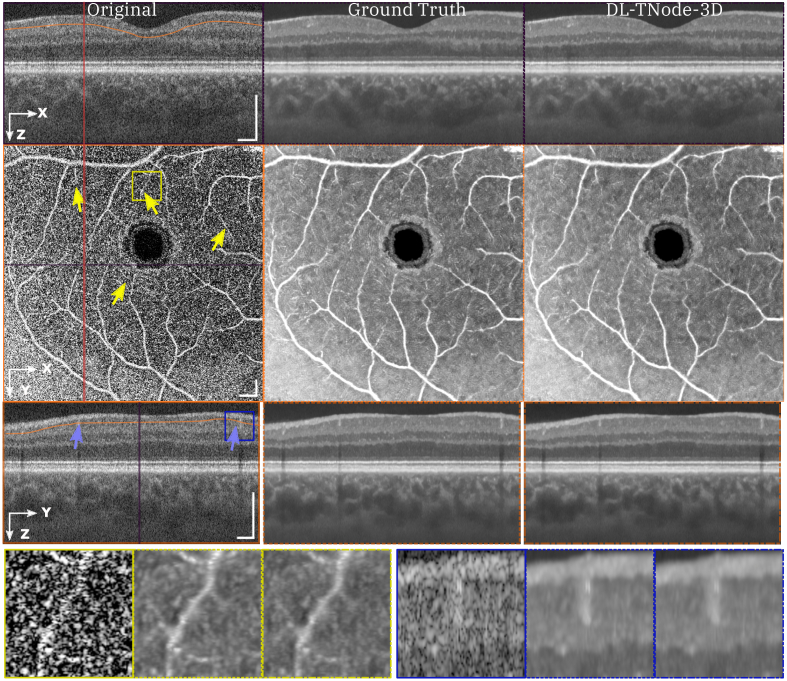
Orthogonal views of tomograms before and after despeckling using TNode (i.e. Ground Truth) and DL-TNode-3D. DL-TNode-3D produces OCT volumes close to the ground truth without any visible artifacts along the out-of-plane axis, y . z is the depth and x(y) is the fast- (slow-) scan axis direction. Yellow arrows indicate small capillaries that are preserved after despeckling with both TNode and DL-TNode-3D. Scale bars = 0.5 mm.
Fig. 4.
Fig. 4.
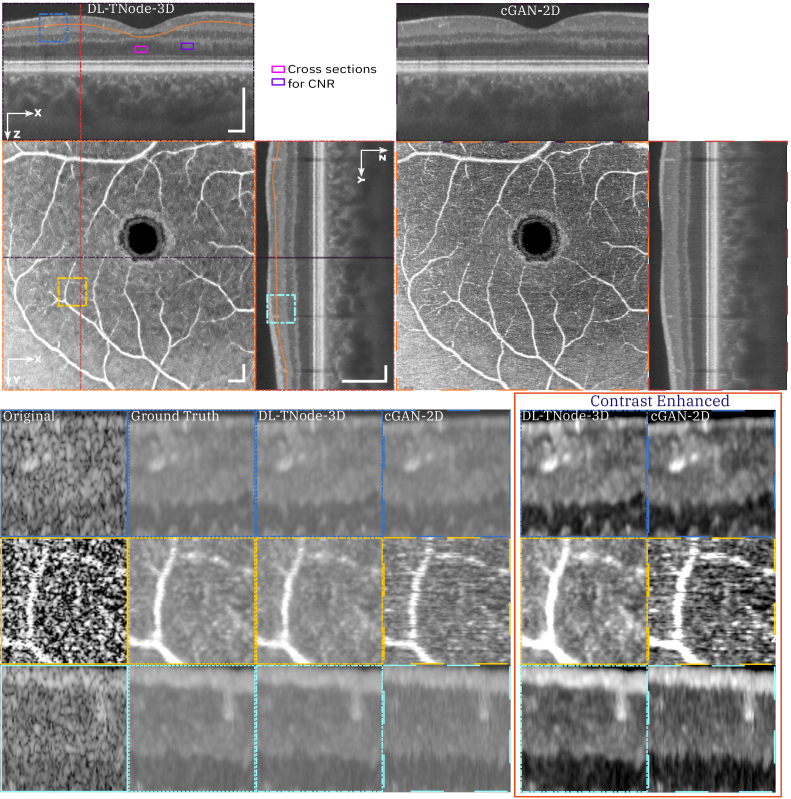
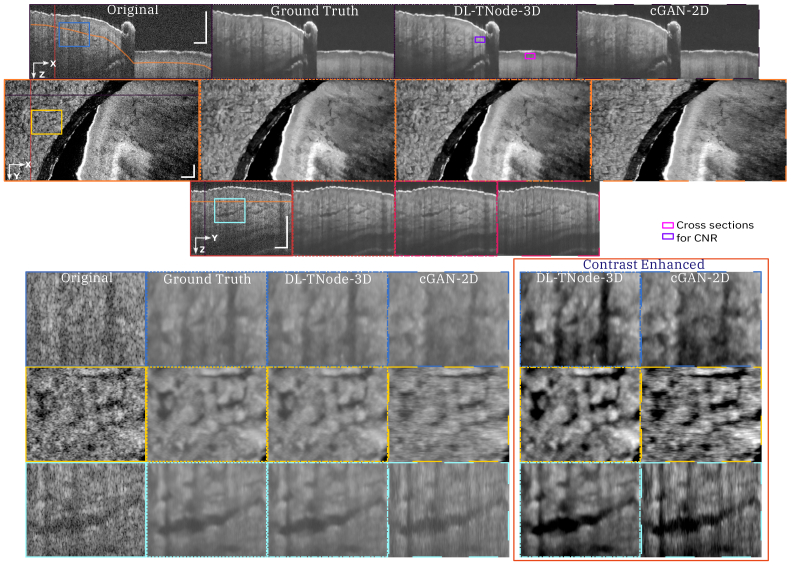
Comparison of speckle reduction using DL-TNode-3D and cGAN-2D for the retinal volume in Fig. 3. Orthogonal views where z is depth and x(y) is the fast- (slow-) scan axis direction. DL-TNode-3D produces OCT volumes close to the ground truth without any visible artifacts along the out-of-plane axis, y . Contrast-enhanced boxes show superior speckle suppression ability of DL-TNode-3D compared to cGAN-2D, which exhibits high-frequency artifacts along the slow-scan axis. Magenta and violet rectangles represent the two tissue types used for calculating CNR. Scale bars = 0.5 mm.
Fig. 5.
Fig. 5.
Comparison of speckle reduction using DL-TNode-3D and cGAN-2D for the ventral finger skin volume acquired using VCSEL system. Orthogonal views where z is depth and x(y) is the fast (slow) axis direction. DL-TNode-3D produces OCT volumes that match the ground truth without any visible artifacts along the out-of-plane axis, y . Purple arrow in the en face view indicates a motion artifact. Contrast-enhanced boxes show superior speckle suppression ability of DL-TNode-3D compared to cGAN-2D, which exhibits high-frequency artifacts along the slow-scan axis. Magenta and violet rectangles represent the two tissue types used for calculating CNR. Scale bars = 0.5 mm.
Fig. 6.
Fig. 6.
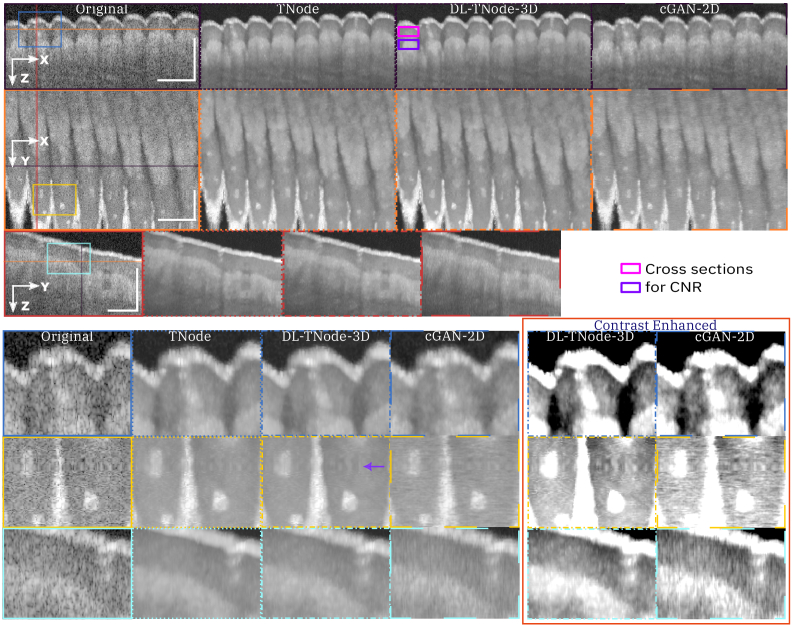
Comparison of speckle reduction using DL-TNode-3D and cGAN-2D for the ventral nail bed volume acquired using the polygon-based system. Orthogonal views where z is depth and x(y) is the fast (slow) axis direction. DL-TNode-3D produces OCT volumes close to the ground truth without any visible artifacts along the out-of-plane axis, y . Contrast-enhanced boxes show superior speckle suppression ability of DL-TNode-3D compared to cGAN-2D, which exhibits high-frequency artifacts along the slow-scan axis. Magenta and violet rectangles represent the two tissue types used for calculating CNR. Scale bars = 0.5 mm.

Update of

References

    1. Huang D., Swanson E. A., Lin C. P., et al. , “Optical coherence tomography,” Science 254(5035), 1178–1181 (1991). 10.1126/science.1957169 - DOI - PMC - PubMed
    1. Schmitt J. M., Xiang S., Yung K. M., “Speckle in optical coherence tomography,” J. Biomed. Opt. 4(1), 95–105 (1999). 10.1117/1.429925 - DOI - PubMed
    1. Bashkansky M., Reintjes J., “Statistics and reduction of speckle in optical coherence tomography,” Opt. Lett. 25(8), 545–547 (2000). 10.1364/OL.25.000545 - DOI - PubMed
    1. Karamata B., Hassler K., Laubscher M., et al. , “Speckle statistics in optical coherence tomography,” J. Opt. Soc. Am. A 22(4), 593–596 (2005). 10.1364/JOSAA.22.000593 - DOI - PubMed
    1. Goodman J. W., Speckle Phenomena in Optics: Theory and Applications (Roberts and Company Publishers, 2007).

LinkOut - more resources