


The ultrasonic vocalization (USV) syllable profile during neonatal opioid withdrawal and a kappa opioid receptor component to increased USV emissions in female mice
- PMID: 39348003
- PMCID: PMC11775077
- DOI: 10.1007/s00213-024-06694-7
The ultrasonic vocalization (USV) syllable profile during neonatal opioid withdrawal and a kappa opioid receptor component to increased USV emissions in female mice
Abstract
Rationale: Opioid use during pregnancy can lead to negative infant health outcomes, including neonatal opioid withdrawal syndrome (NOWS). NOWS comprises gastrointestinal, autonomic nervous system, and neurological dysfunction that manifest during spontaneous withdrawal. Variability in NOWS severity necessitates a more individualized treatment approach. Ultrasonic vocalizations (USVs) in neonatal mice are emitted in isolation as a stress response and are increased during opioid withdrawal, thus modeling a negative affective state that can be utilized to test new treatments.
Objectives: We sought to identify the behavioral and USV profile, brainstem transcriptomic adaptations, and role of kappa opioid receptors in USVs during neonatal opioid withdrawal.
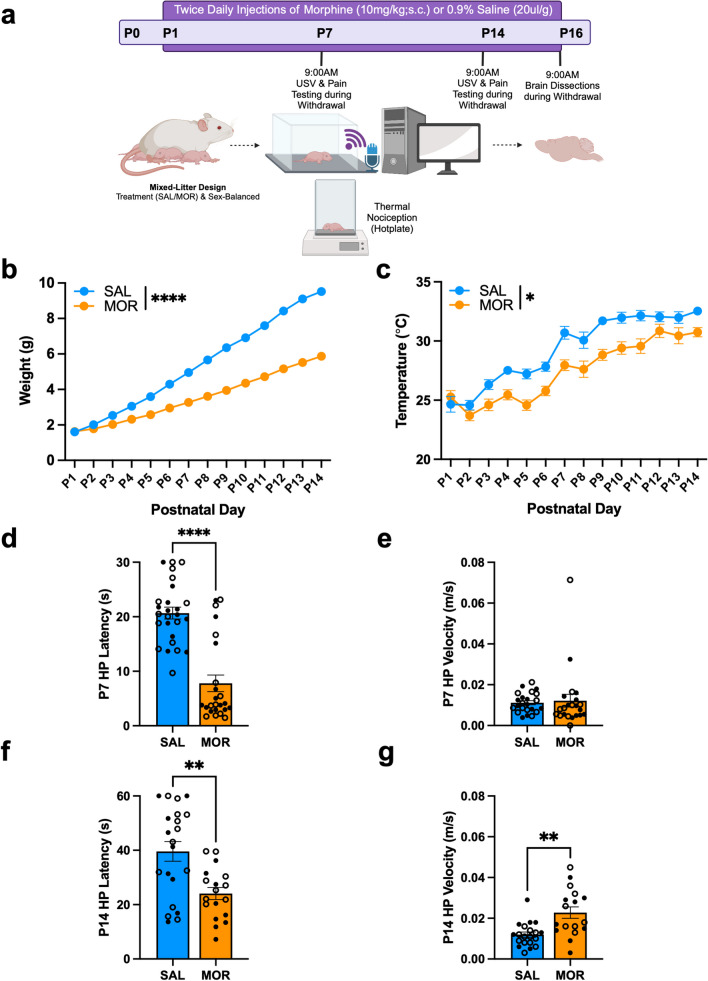
Methods: We employed a third trimester-approximate opioid exposure model, where neonatal inbred FVB/NJ pups were injected twice-daily with morphine (10mg/kg, s.c.) or saline (0.9%, 20 ul/g, s.c.) from postnatal day(P) 1 to P14. This protocol induces reduced weight gain, hypothermia, thermal hyperalgesia, and increased USVs during spontaneous morphine withdrawal.
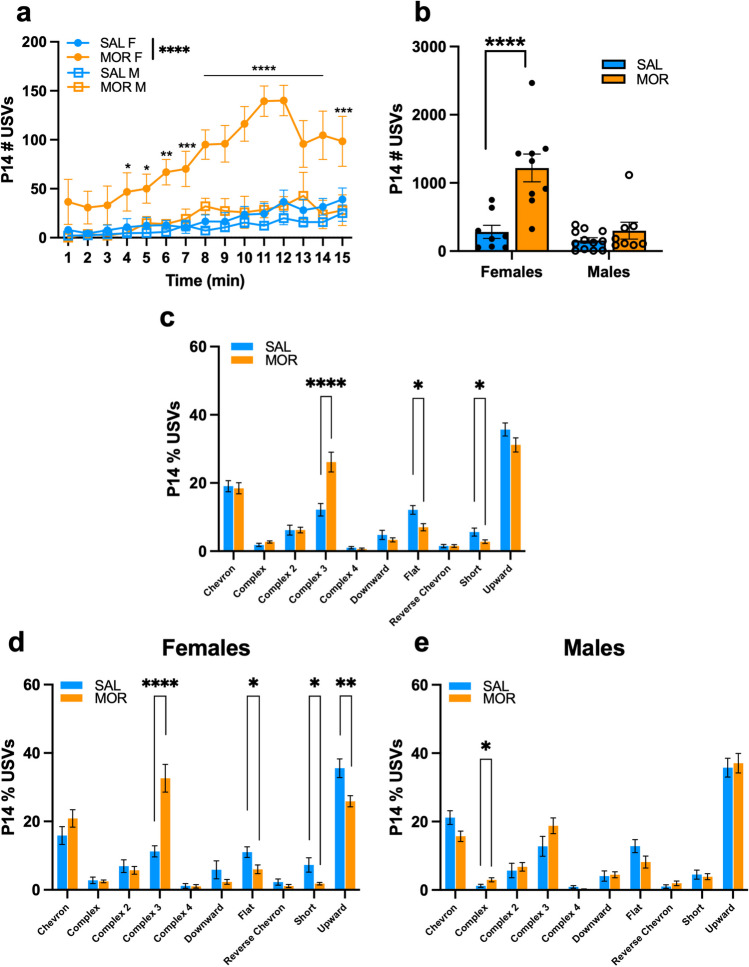
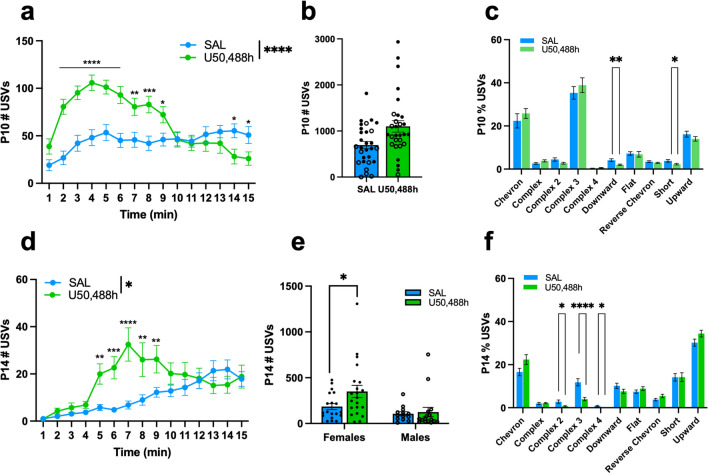
Results: On P14, there were increased USV emissions and altered USV syllables during withdrawal, including an increase in Complex 3 syllables in FVB/NJ females (but not males). Brainstem bulk mRNA sequencing revealed an upregulation of the kappa opioid receptor (Oprk1), which contributes to withdrawal-induced dysphoria. The kappa opioid receptor (KOR) antagonist, nor-BNI (30 mg/kg, s.c.), significantly reduced USVs in FVB/NJ females, but not males during spontaneous morphine withdrawal. Furthermore, the KOR agonist, U50,488h (0.625 mg/kg, s.c.), was sufficient to increase USVs on P10 (both sexes) and P14 (females only) in FVB/NJ mice.
Conclusions: We identified an elevated USV syllable, Complex 3, and a female-specific recruitment of the dynorphin/KOR system in increased USVs associated with neonatal opioid withdrawal severity.
Keywords: Brainstem; Emotional-affective withdrawal; Kappa opioid receptor; Morphine; Neonatal opioid withdrawal syndrome; RNA-seq; Sex differences; Spectrotemporal profile; Transcriptome; Ultrasonic vocalizations.
© 2024. The Author(s).
Conflict of interest statement
Declarations. Conflicts of interest: The authors have nothing to disclose.
Figures


Update of
-
The ultrasonic vocalization (USV) syllable profile during neonatal opioid withdrawal and a kappa opioid receptor component to increased USV emissions in female mice.bioRxiv [Preprint]. 2024 Sep 1:2024.07.02.601766. doi: 10.1101/2024.07.02.601766. bioRxiv. 2024. Update in: Psychopharmacology (Berl). 2025 Feb;242(2):427-447. doi: 10.1007/s00213-024-06694-7. PMID: 39005445 Free PMC article. Updated. Preprint.
References
-
- Abdel-Latif ME, Pinner J, Clews S, Cooke F, Lui K, Oei J (2006) Effects of Breast Milk on the Severity and Outcome of Neonatal Abstinence Syndrome Among Infants of Drug-Dependent Mothers. Pediatrics 117(6):e1163–e1169. 10.1542/peds.2005-1561 - PubMed
-
- Barr GA, Wang S (1992) Tolerance and withdrawal to chronic morphine treatment in the week-old rat pup. Eur J Pharmacol 215(1):35–42. 10.1016/0014-2999(92)90605-4 - PubMed
-
- Bartok RE, Craft RM (1997) Sex Differences in Opioid Antinociception. J Pharmacol Exp Ther 282(2):769–778 - PubMed
MeSH terms
Substances
Grants and funding
LinkOut - more resources
Full Text Sources
Molecular Biology Databases
Research Materials
