


Sputum culture conversion and its predictors among drug-resistant pulmonary tuberculosis patients in eastern Ethiopia
- PMID: 39348935
- PMCID: PMC12045090
- DOI: 10.1093/inthealth/ihae059
Sputum culture conversion and its predictors among drug-resistant pulmonary tuberculosis patients in eastern Ethiopia
Abstract
Background: Evidence of time to culture conversion is used to predict the time of cure from the disease and the overall drug-resistant tuberculosis (TB) treatment duration. Even though evidence about sputum culture conversion is enormous in TB treatment, no study has yet been done in our areas, where cases are common. The study aimed to assess the time to sputum conversion and its predictors among drug-resistant TB patients from October 2013 to September 2021 in eastern Ethiopia.
Methodology: A retrospective cohort study was conducted in eastern Ethiopia among 273 drug-resistant TB patients who were treated from October 2013 to September 2021 at Dire Dawa City and Harari regional treatment centres. The Kaplan-Meier method was used to estimate the median time of sputum culture conversion. Cox proportional hazards regression was employed to detect the predictors of sputum culture conversion. An adjusted hazard ratio (aHR) with 95% confidence interval (CI) was used to determine the strength and significance of the association.
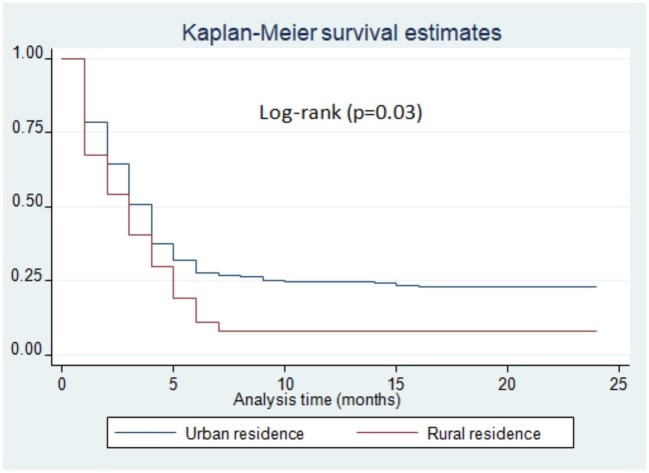
Results: Of the 273 drug-resistant TB patients, the sputum culture of 216 (79.12%) patients became negative in a median time of 3 months (interquartile range 2-7). The time to sputum culture conversion was negatively associated with underweight (aHR 0.65 [95% CI 0.49 to 0.90]) and poor adherence (aHR 0.41 [95% CI 0.24 to 0.69]). The time to sputum culture conversion was also positively associated with patients resistant to two or more drugs (aHR 1.58 [95% CI 1.07 to 2.32]) and patients receiving a short treatment regimen (aHR 2.24 [95% CI 1.10 to 2.55]).
Conclusions: A shorter culture conversion rate was observed compared with the median time recommended by the World Health Organization. Being underweight, poor adherence to treatment, resistance to two or more drugs and receiving a short treatment regimen were found to be predictors of time to sputum culture conversion. Implementing nutrition assessment, counselling and support of drug adherence may improve sputum culture conversion.
Keywords: Ethiopia; drug resistance; predictors; sputum culture conversion; tuberculosis.
© The Author(s) 2024. Published by Oxford University Press on behalf of Royal Society of Tropical Medicine and Hygiene.
Conflict of interest statement
None declared.
Figures



References
-
- World Health Organization . Global tuberculosis report 2023. Geneva: World Health Organization; 2023.
-
- World Health Organization . Definitions and reporting framework for tuberculosis – 2013 revision: updated December 2014 and January 2020. Geneva: World Health Organization; 2013.
-
- World Health Organization . Global tuberculosis report 2019. Geneva: World Health Organization; 2019.
-
- Ethiopia Ministry of Health . National guidelines for TB, DR-TB and leprosy in Ethiopia. Sixth edition. 2017. Available from: https://www.afro.who.int/publications/national-guidelines-tb-drug-resist...
-
- World Health Organization . Global tuberculosis report 2020. Geneva: World Health Organization; 2020.
Publication types
MeSH terms
Substances
Grants and funding
LinkOut - more resources
Full Text Sources
