


Different effects of migraine associated features on headache impact, pain intensity, and psychiatric conditions in patients with migraine
- PMID: 39349580
- PMCID: PMC11442628
- DOI: 10.1038/s41598-024-74253-3
Different effects of migraine associated features on headache impact, pain intensity, and psychiatric conditions in patients with migraine
Abstract
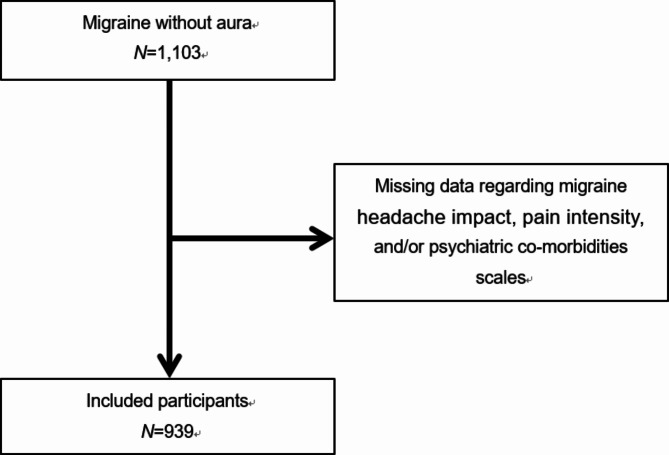
Migraine is a multifactorial brain disorder characterized by recurrent disabling headaches and their associated features. Several studies have suggested that these features are related to headache impact, pain intensity, and psychiatric conditions. However, differences in the relationship between each associated feature and headache impact, pain intensity, or psychiatric conditions remain unclear. This study aimed to assess the impact of migraine-associated features on headache impact, pain intensity, and psychiatric conditions in patients with migraine. In this two-centered study, patients with migraine without aura (MwoA) were enrolled to exclude those without headaches and avoid the influence of medication overuse, which is commonly associated with chronic migraine. We used multiple logistic regression to analyze the headache impact, pain intensity, and psychiatric conditions measured using the Headache Impact Test (HIT-6), Visual Analog Scale (VAS), Generalized Anxiety Disorder 7-item scale (GAD-7), and Patient Health Questionnaire-9 (PHQ-9). Patients' likelihood of experiencing symptoms such as nausea, vomiting, photophobia, phonophobia, osmophobia, and allodynia were also recorded. A total of 1103 patients with MwoA were enrolled in this study, and 164 patients were excluded from the study because of missing data. Finally, 939 patients with MwoAs were included. On multiple logistic regression analyses, nausea (odd ratios [OR] 1.87, confidence interval [CI]: 1.37-2.54), vomiting (OR 1.57, CI: 1.11-2.23), photophobia (OR 1.67, CI: 1.18-2.35), and allodynia (OR 1.56, CI: 1.06-2.28) were independent positive predictors of higher HIT-6 scores, and nausea (OR 1.72, CI: 1.22-2.43), vomiting (OR 1.84, CI: 1.29-2.63), phonophobia (OR 1.58, CI: 1.10-2.25), photophobia (OR 1.49, CI: 1.07-2.08), and allodynia (OR 1.81, CI: 1.24-2.66) were independent positive predictors of higher VAS score. Nausea (OR 1.49, CI: 1.09-2.02), phonophobia (OR 2.00, CI: 1.42-2.82), and allodynia (OR 1.81, CI: 1.24-2.63) were independent positive predictors of GAD-7 score. Nausea (OR 1.66, CI: 1.21-2.28), phonophobia (OR 1.49, CI: 1.05-2.11), and allodynia (OR 1.68, CI: 1.16-2.45) were independent positive predictors and vomiting (OR 0.54, CI: 0.37-0.78) was an independent negative predictor of PHQ-9 score. Our results suggest that nausea, vomiting, photophobia, phonophobia, and osmophobia have distinct effects on headache impact, pain intensity, and psychiatric conditions. Understanding these differences can aid in the personalized management of patients with MwoA.
Keywords: Allodynia; Associated features; Disability; Migraine; Psychiatric conditions.
© 2024. The Author(s).
Conflict of interest statement
The authors declare the following potential conflicts of interest with respect to the research, authorship, and/or publication of this article. NI reports being an advisor for Sawai and receiving speaker fees from Daiichi Sankyo, Eli Lilly, Otsuka, and Amgen; however, these companies were not related to the study. YM reports personal consultancy fees from Amgen Astellas BioPharma K.K., Daiichi Sankyo Company Limited, Eli Lilly Japan K.K., and Otsuka Pharmaceutical Co., Ltd. during the conduct of the study; however, no company had any relation to the study.
References
Publication types
MeSH terms
LinkOut - more resources
Full Text Sources
Medical
Miscellaneous
