


70-Gene signature-guided adjuvant systemic treatment adjustments in early-stage ER+ breast cancer patients: 7-year follow-up of a prospective multicenter cohort study
- PMID: 39349887
- PMCID: PMC11785635
- DOI: 10.1007/s10549-024-07496-3
70-Gene signature-guided adjuvant systemic treatment adjustments in early-stage ER+ breast cancer patients: 7-year follow-up of a prospective multicenter cohort study
Abstract
Background: A previous prospective multicenter study revealed the change of the oncologists' chemotherapy advice due to the 70-Gene signature (GS) test result in half of the estrogen receptor-positive (ER+) invasive early-stage breast cancer patients with disputable chemotherapy indication. This resulted in less patients receiving chemotherapy. This study aims to complement these results by the 7-year oncological outcomes according to the 70-GS test result and the oncologists' pre-test advice.
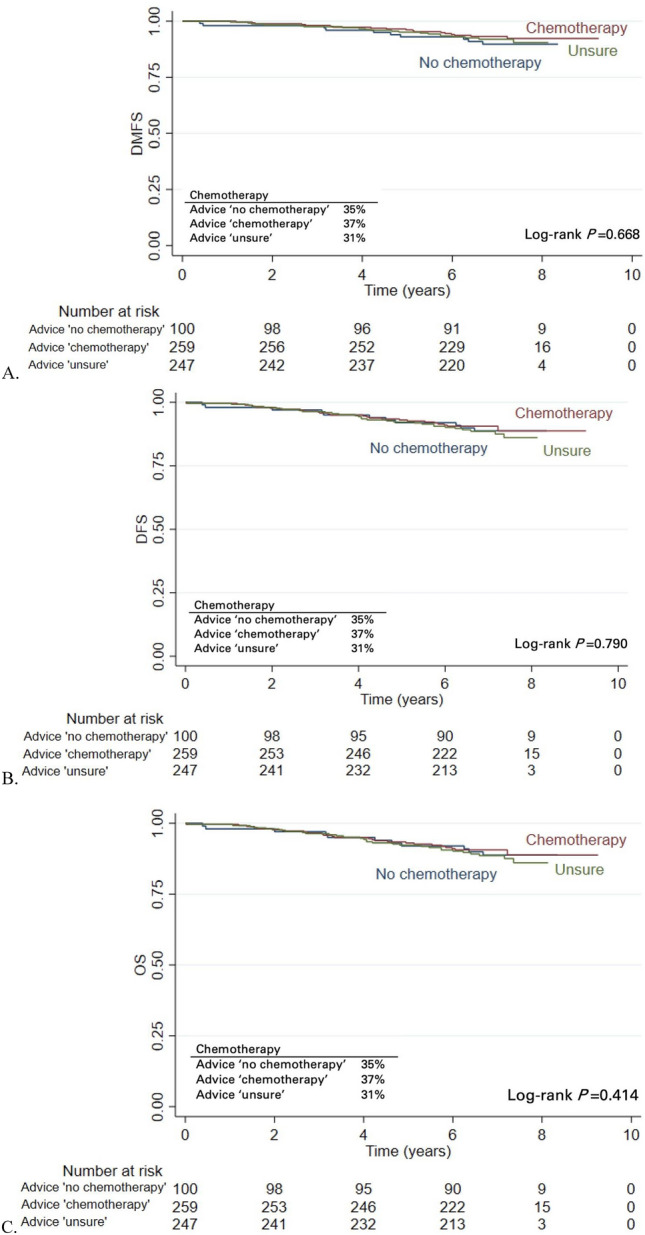
Methods: Patients operated for early-stage ER+ breast cancer with disputable chemotherapy indication, had been prospectively included between 2013 and 2015. Oncologists were asked whether they intended to administer adjuvant chemotherapy before deployment of the 70-GS test. Information on adjuvant systemic treatment and oncological outcome was obtained through active follow-up by data managers of the Netherlands Cancer Registry. The primary endpoint of this study was distant metastasis-free survival (DMFS) according to the genomic risk. Exploratory analyses were done to evaluate DMFS in relation to the oncologists' pre-test advice.
Results: After a median follow-up of 7 years, distant metastases were diagnosed in 23 of the 606 patients (3.8%) and 36 (5.9%) patients had died. The DMFS rate for the 357 70-GS genomic low-risk patients was 94.2% (95% CI 91.2-96.2) and 89.1% for the 249 genomic high-risk patients (95% CI 84.3-92.4). Of the low-risk patients 3% had received chemotherapy compared to 80% of the high-risk patients. For the subgroups based on the pre-test oncologists' advice (no chemotherapy/chemotherapy/unsure) there were no clinically relevant differences in DMFS (89.8, 93.2 and 92.0%, respectively), while comparable proportions of patients had received chemotherapy.
Conclusions: In patients with early-stage ER+ breast cancer with a disputable chemotherapy indication it is sensible to deploy the 70-GS to better select patients for adjuvant chemotherapy.
Keywords: 70-Gene Signature; Chemotherapy decision; Luminal breast cancer.
© 2024. The Author(s).
Conflict of interest statement
Declarations. Conflict of interest: The authors declare no competing interests.
Figures


References
-
- Mansour EG, Gray R, Shatila AH et al (1989) Efficacy of adjuvant chemotherapy in high-risk node-negative breast cancer: an intergroup study. N Engl J Med 320:485–490 - PubMed
-
- Mansour EG, Gray R, Shatila AH et al (1998) Survival advantage of adjuvant chemotherapy in high-risk node-negative breast cancer: ten-year analysis—an intergroup study. J Clin Oncol 16:3486–3492 - PubMed
-
- Fisher B, Dignam J, Wolmark N et al (1997) Tamoxifen and chemotherapy for lymph node-negative, estrogen receptor-positive breast cancer. J Natl Cancer Inst 89:1673–1682 - PubMed
-
- Nationaal Borstkanker Overleg Nederland (NABON) (2002) Richtlijn Behandeling van het Mammacarcinoom. https://www.nabon.nl/wp-content/uploads/2022/11/Richtlijn-Behandeling-Ma.... Accessed 2 Mar 2023
-
- Nationaal Borstkanker Overleg Nederland (NABON) (2004) Richtlijn Behandeling van het Mammacarcinoom. https://www.nabon.nl/wp-content/uploads/2022/11/Richtlijn-Behandeling-Ma.... Accessed 2 Mar 2023
Publication types
MeSH terms
Substances
LinkOut - more resources
Full Text Sources
Medical
