Prediction of Renal Graft Function 1 Year After Adult Deceased-Donor Kidney Transplantation Using Variables Available Prior to Transplantation
- PMID: 39350474
- PMCID: PMC11453122
- DOI: 10.12659/AOT.944603
Prediction of Renal Graft Function 1 Year After Adult Deceased-Donor Kidney Transplantation Using Variables Available Prior to Transplantation
Abstract
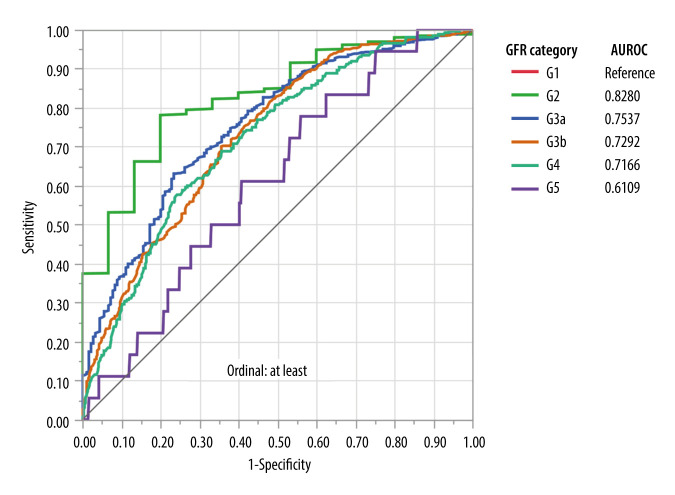
BACKGROUND Kidney transplantation is still the best therapy for patients with end-stage renal disease, but the demand for donor organs persistently surpasses the supply. A prognostic model using pre-transplant data for the prediction of renal graft function would be helpful to optimize organ allocation and avoid futile transplantations. MATERIAL AND METHODS Retrospective data of 2431 patients who underwent kidney transplantation between January 01, 2000, and December 31, 2012 with subsequent ten-year clinical follow-up in our transplant center were analyzed. Of these, 1172 patients met the inclusion criteria. Multivariable regression modelling was used to develop a prognostic model for the prediction of graft function after 1 year utilizing only pre-transplant data. The final model was assessed with the area under the receiver operating characteristic (AUROC) curve. RESULTS Donor age, donor serum creatinine, recipient body mass index, re-transplantations beyond the second kidney transplantation, and cold ischemia time had an independent, significant influence on graded renal graft function 1 year after kidney transplantation. AUROC analysis of the prognostic model was >0.700 for all GFR categories except KDIGO G5, indicating high sensitivity and specificity of prediction. CONCLUSIONS For improvement of renal graft function, organs from older donors or donors with high serum creatinine should not be used in obese recipients and for re-transplantations beyond the second one. Cold ischemia time should be as short as possible.
Conflict of interest statement
Figures

References
-
- Tonelli M, Wiebe N, Knoll G, et al. Systematic review: Kidney transplantation compared with dialysis in clinically relevant outcomes. Am J Transplant. 2011;11(10):2093–109. - PubMed
-
- Avramovic M, Stefanovic V. Health-related quality of life in different stages of renal failure. Artif Organs. 2012;36(7):581–89. - PubMed
-
- Merion RM, Ashby VB, Wolfe RA, et al. Deceased-donor characteristics and the survival benefit of kidney transplantation. JAMA. 2005;294(21):2726–33. - PubMed
MeSH terms
Substances
LinkOut - more resources
Full Text Sources
Medical
Miscellaneous