. 2024 Sep 30;10(5):00203-2024.
doi: 10.1183/23120541.00203-2024. eCollection 2024 Sep.

Muscle fibre satellite cells are located at a greater distance from capillaries in patients with COPD compared with healthy controls

Affiliations

Muscle fibre satellite cells are located at a greater distance from capillaries in patients with COPD compared with healthy controls

Milan W Betz et al. ERJ Open Res. .

Abstract

Background: COPD is a disease characterised by skeletal muscle dysfunction. A spatial relationship exists between satellite cells and muscle fibre capillaries, which has been suggested to be of major importance for satellite cell function. In the present study we compared the spatial relationship between satellite cells and capillaries in patients with COPD and age-matched healthy older adults.

Methods: Muscle biopsies were obtained from the vastus lateralis of n=18 patients with COPD (8 female, 10 male; age 66±5 years, mild-to-severe airflow obstruction) and n=18 age-, sex- and body mass index-matched healthy control adults (8 female, 10 male; age 68±5 years). Immunohistochemistry was used to assess type I/II muscle fibre size, distribution, myonuclear content, satellite cell number and fibre capillarisation. In addition, type I/II muscle fibre satellite cell distance to its nearest capillary was assessed.

Results: The percentage of type II muscle fibres was significantly greater in patients with COPD (62±10%) compared with controls (50±12%, p<0.05). Muscle fibre capillarisation was significantly lower in patients with COPD compared with controls (p<0.05). While satellite cell content was not different between groups, type I and type II satellite cell distance to its nearest capillary was significantly greater in patients with COPD (type I: 21.3±4.8 µm; type II: 26.7±9.3 µm) compared with controls (type I: 16.1±3.5 µm; type II: 22.7±5.8 µm; p<0.05).

Conclusion: Satellite cells are located at a greater distance from their nearest capillary in patients with COPD compared with age-matched controls. This increased distance could play a role in impaired satellite cell function in patients with COPD.


Conflict of interest statement

Conflict of interest: All authors report no conflict of interest.

Figures

FIGURE 1
FIGURE 1
Representative images for assessment of type I and type II skeletal muscle fibre distribution, fibre size, myonuclear content and capillarisation in a) patients with COPD and b) healthy older adults. Myosin heavy chain (MHC)-I (green) plus laminin (white) plus 4′,6-diamidino-2-phenylindole (DAPI) (blue) plus CD31 (red) staining. Type I and type II c) muscle fibre size and d) capillary-to-fibre ratio. Data are presented as mean±sd, as well as individual data points.
FIGURE 2
FIGURE 2
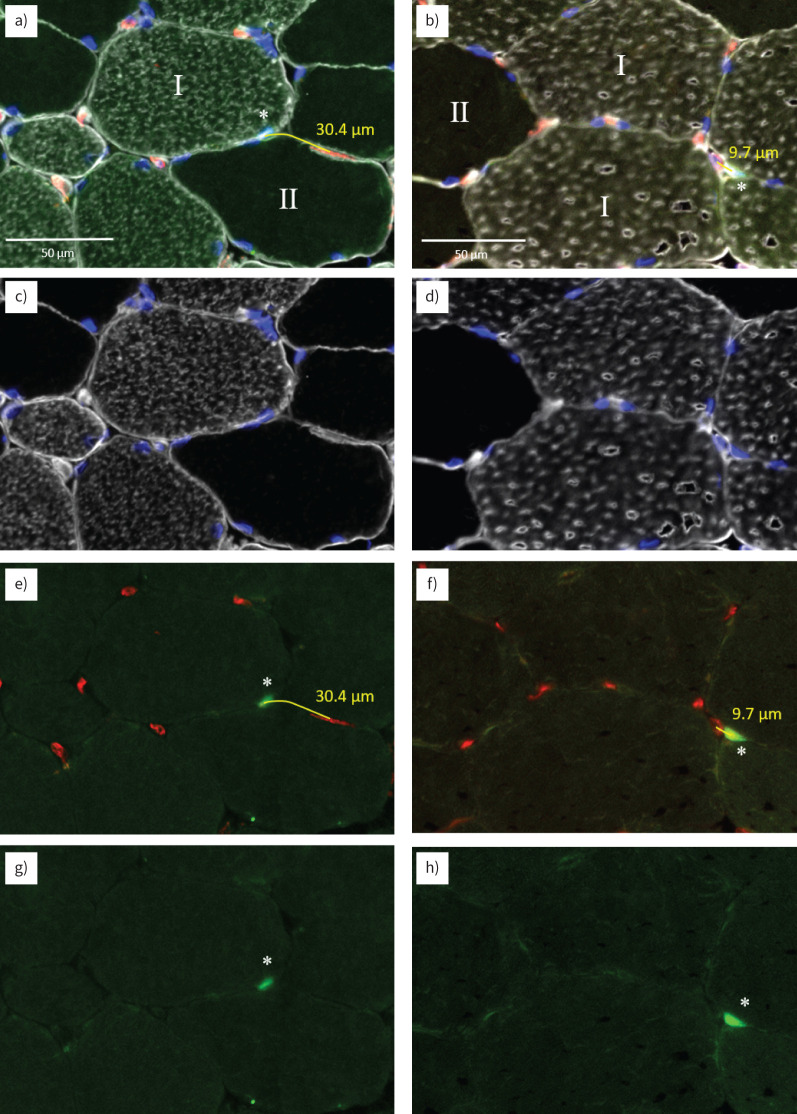
Representative images for assessment of type I and type II skeletal muscle satellite cell content and satellite cell distance to its nearest capillary in a,c,e,g) patients with COPD and b,d,f,h) age-matched controls. a,b) Myosin heavy chain (MHC)-I (white) plus laminin (white) plus 4′,6-diamidino-2-phenylindole (DAPI) (blue) plus Pax7 (green) plus CD31 (red) staining. c,d) MHC-I, laminin and DAPI. e,f) CD31 and Pax7. g,h) Pax7 only. Yellow line indicates the measurement of satellite cell distance to its nearest capillary. *: satellite cell.
FIGURE 3
FIGURE 3
Type I and type II muscle fibre satellite cell a) content and b) distance to nearest capillary in patients with COPD and age-matched healthy controls. Data are presented as mean±sd, as well as individual data points.

References

    1. Maltais F, Decramer M, Casaburi R, et al. . An official American Thoracic Society/European Respiratory Society statement: update on limb muscle dysfunction in chronic obstructive pulmonary disease. Am J Respir Crit Care Med 2014; 189: e15–e62. doi:10.1164/rccm.201402-0373ST - DOI - PMC - PubMed
    1. Engelen MP, Schols AM, Does JD, et al. . Skeletal muscle weakness is associated with wasting of extremity fat-free mass but not with airflow obstruction in patients with chronic obstructive pulmonary disease. Am J Clin Nutr 2000; 71: 733–738. doi:10.1093/ajcn/71.3.733 - DOI - PubMed
    1. Gosker HR, Engelen MP, van Mameren H, et al. . Muscle fiber type IIX atrophy is involved in the loss of fat-free mass in chronic obstructive pulmonary disease. Am J Clin Nutr 2002; 76: 113–119. doi:10.1093/ajcn/76.1.113 - DOI - PubMed
    1. Schols AM, Soeters PB, Dingemans AM, et al. . Prevalence and characteristics of nutritional depletion in patients with stable COPD eligible for pulmonary rehabilitation. Am Rev Respir Dis 1993; 147: 1151–1156. doi:10.1164/ajrccm/147.5.1151 - DOI - PubMed
    1. Evans RA, Kaplovitch E, Beauchamp MK, et al. . Is quadriceps endurance reduced in COPD? A systematic review. Chest 2015; 147: 673–684. doi:10.1378/chest.14-1079 - DOI - PubMed

LinkOut - more resources