. 2024 Dec;36(12):e13450.
doi: 10.1111/jne.13450. Epub 2024 Oct 1.

Rapid and local neuroestrogen synthesis supports long-term potentiation of hippocampal Schaffer collaterals-cornu ammonis 1 synapse in ovariectomized mice

Affiliations

Rapid and local neuroestrogen synthesis supports long-term potentiation of hippocampal Schaffer collaterals-cornu ammonis 1 synapse in ovariectomized mice

Matthieu J Maroteaux et al. J Neuroendocrinol. 2024 Dec.

Abstract

In aging women, cognitive decline and increased risk of dementia have been associated with the cessation of ovarian hormones production at menopause. In the brain, presence of the key enzyme aromatase required for the synthesis of 17-β-estradiol (E2) allows for local production of E2 in absence of functional ovaries. Understanding how aromatase activity is regulated could help alleviate the cognitive symptoms. In female rodents, genetic or pharmacological reduction of aromatase activity over extended periods of time impair memory formation, decreases spine density, and hinders long-term potentiation (LTP) in the hippocampus. Conversely, increased excitatory neurotransmission resulting in rapid N-methyl-d-aspartic acid (NMDA) receptor activation rapidly promotes neuroestrogen synthesis. This rapid modulation of aromatase activity led us to address the hypothesis that acute neuroestrogens synthesis is necessary for LTP at the Schaffer collateral-cornu ammonis 1 (CA1) synapse in absence of circulating ovarian estrogens. To test this hypothesis, we did electrophysiological recordings of field excitatory postsynaptic potential (fEPSPs) in hippocampal slices obtained from ovariectomized mice. To assess the impact of neuroestrogens synthesis on LTP, we applied the specific aromatase inhibitor, letrozole, before the induction of LTP with a theta burst stimulation protocol. We found that blocking aromatase activity prevented LTP. Interestingly, exogenous E2 application, while blocking aromatase activity, was not sufficient to recover LTP in our model. Our results indicate the critical importance of rapid, activity-dependent local neuroestrogens synthesis, independent of circulating hormones for hippocampal synaptic plasticity in female rodents.

Keywords: aromatase; electrophysiology; estrogen; hippocampus; synaptic plasticity.


Conflict of interest statement

The authors declare no conflicts of interest.

Figures
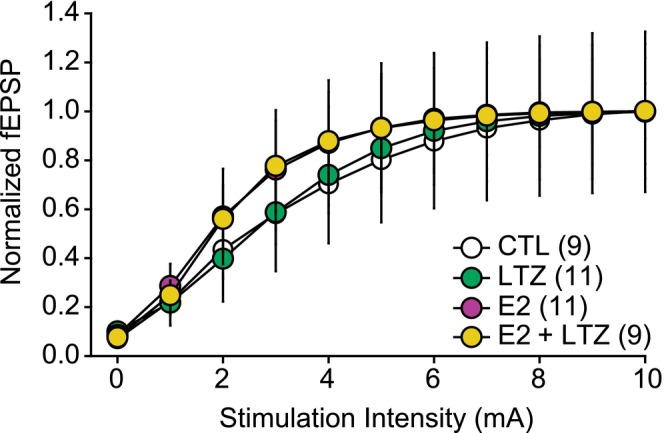
FIGURE 1
FIGURE 1
The input–output curves are not significantly different between control (CTL, n = 9), letrozole (LTZ, n = 11), 17‐β‐estradiol (E2, n = 11) and E2 + LTZ (n = 9) groups. Interaction: F(27,324) = 0.274, p = .897; Time: F(9,324) = 45.823, p < .001; Group: F(3,36) = 0.41, p > .05. Field excitatory postsynaptic potential (fEPSP) (y‐axis) are normalized to the maximum fEPSP.
FIGURE 2
FIGURE 2
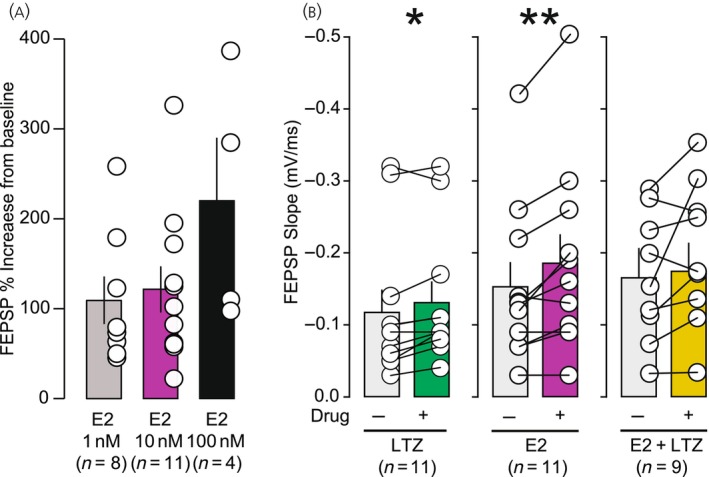
(A) Effect of 1, 10, 100 nM of 17‐β‐estradiol (E2) on basal field excitatory postsynaptic potential (fEPSP). Values are normalized to baseline. E2 1 nM: T(7) = 1.771, p = .120, n = 11; E2 10 nM: T(10) = 3.735, p = .004, n = 11; E2 100 nM: T(3) = 1.509, p = .120, n = 4. (B) Effect of letrozole (LTZ) (100 nM, n = 11), E2 (10 nM, 11), and LTZ + E2 (100/10 nM, n = 9) on basal fEPSP slope. Both LTZ (p < .05) and E2 (p < .01) significantly increased fEPSP slope. LTZ 100 nM: T(10) = 2.887, p = .016; E2 10 nM: T(10) = 3.735, p = .004; LTZ + E2 100/10 nM: T(8) = 1.840, p = .103.*p < .05, **p < .01, ***p < .001.
FIGURE 3
FIGURE 3
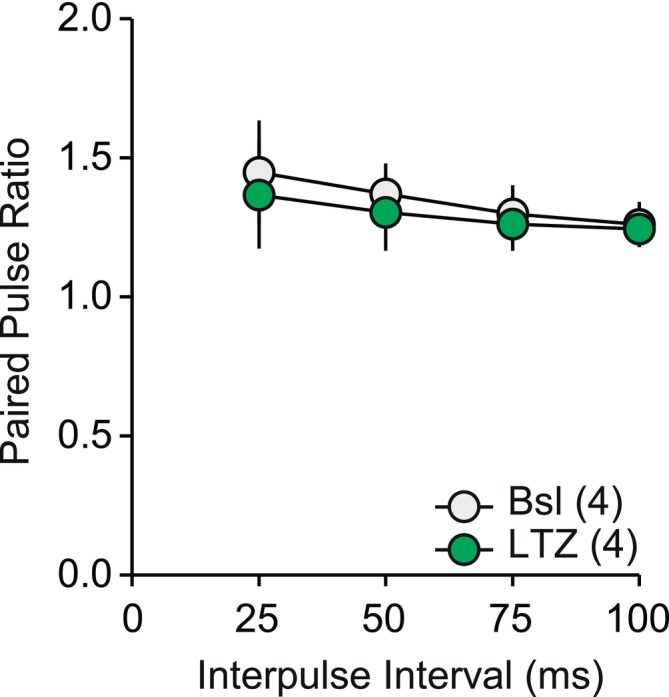
Thirty minutes application of letrozole (LTZ) did not significantly change the paired‐pulse ratio of Schaffer collateral to CA1 synapse in the hippocampus. Interaction: F(3,18) = 1.261, p = .317; Time: F(3,18) = 33.025, p < .001; Group: F(1,6) = 1.028, p = .350.
FIGURE 4
FIGURE 4
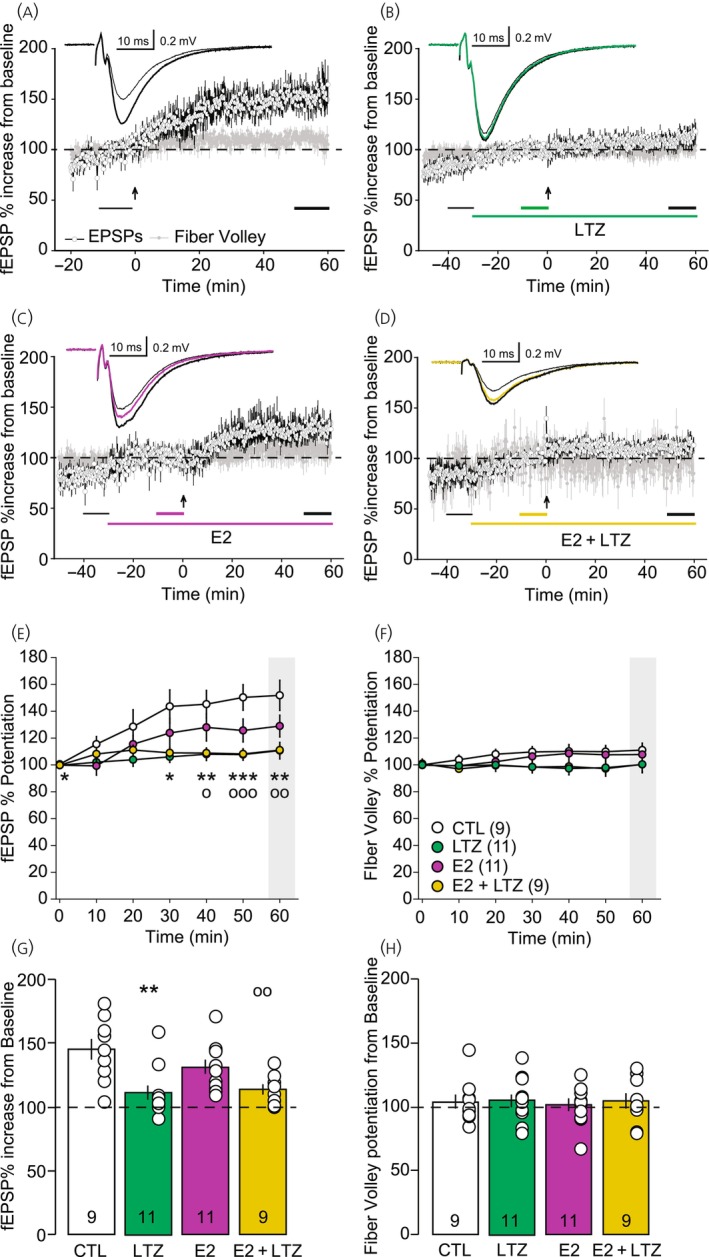
Time course and analysis of long‐term potentiation (LTP) of Schaffer collateral to CA1 synapse in the hippocampus. (A) Time course of slope of field excitatory postsynaptic potential (fEPSP) (open circles) and fiber volley (gray circles) in control condition (CTL, n = 9), in absence of any treatment sampled every 10 s; insert: Average traces 10 min before (thin gray trace) and 50 min after theta burst stimulation (TBS, black trace). (B) Time course of slope of fEPSP (open circles) and fiber volley (gray circles) in presence of letrozole (LTZ) (100 nM, n = 11) sampled every 10 s; insert: Average traces 10 min before LTZ application (thin black trace), 20 min after LTZ application (green trace) and 50 min after TBS (thick black trace). (C) Time course of slope of fEPSP (open circles) and fiber volley (gray circles) in presence of 17‐β‐estradiol (E2) (10 nM, n = 11) sampled every 10 s; insert: Average traces 10 min before E2 application (thin black trace), 20 min after LTZ application (purple trace) and 50 min after TBS (thick black trace). (D) Time course of fEPSP (open circles) and fiber volley (gray circles) in presence of E2 (1 nM) and LTZ (100 nM) sampled every 10 s (n = 9); insert: Average traces 10 min before E2 application (thin black trace), 20 min after drug application (yellow trace) and 50 min after TBS (thick black trace). In (A)–(D), the long‐colored line indicates when the drugs are applied; the arrow indicates the time at which the TBS was applied; the two or three short bottom lines indicate the periods over which the traces represented in the insert were averaged as well as the averaged values used in (G) and (H). (E) Development of the fEPSP after the LTP induction represented in 10‐min bin. Interaction: F(18,216) = 2.784, p < .004; Time: F(6,216) = 15.932, p < .001; Group: F(3,36) = 5.623, p = .003. (F) Development of the fiber volley after the LTP induction represented in 10 min bin. Interaction: F(18,216) = .955, p = .514; Time: F(6,216) = 1.788, p = .103; Group: F(3,36) = 1.529, p = .224. In (E) and (F), the time 0 min corresponds to the baseline before TBS to which the values have been normalized. (G) Bar graph representation of the last 10 min of fEPSP recordings relative to baseline (indicated by the short black line in A). F(3,39) = 6.527, F(3,39) = 6.527. (H) Bar graph representation of the last 10 min of fiber volley recordings relative to baseline (indicated by the short black line in C). F(3,39) = 0.078, p = .971. Post hoc statistics for (E) and (G): *p < .05, **p < .01, ***p < .001 CTL versus LTZ and ○p < .05, ○○p < .01, ○○○p < .001, CTL versus E2 + LTZ.

References

    1. Scheyer O, Rahman A, Hristov H, et al. Female sex and Alzheimer's risk: the menopause connection. J Prev Alzheimers Dis. 2018;5:225‐230. - PMC - PubMed
    1. Pines A. Alzheimer's disease, menopause and the impact of the estrogenic environment. Climacteric. 2016;19:430‐432. - PubMed
    1. Daniel JM, Hulst JL, Berbling JL. Estradiol replacement enhances working memory in middle‐aged rats when initiated immediately after Ovariectomy but not after a long‐term period of ovarian hormone deprivation. Endocrinology. 2006;147:607‐614. - PubMed
    1. Frick KM. Estrogens and age‐related memory decline in rodents: what have we learned and where do we go from here? Horm Behav. 2009;55:2‐23. - PMC - PubMed
    1. Luine VN. Estradiol and cognitive function: past, present and future. Horm Behav. 2014;66:602‐618. - PMC - PubMed

Publication types

MeSH terms

LinkOut - more resources