


Research Priorities in Pediatric Asthma Morbidity: Addressing the Impacts of Systemic Racism on Children with Asthma in the United States. An Official American Thoracic Society Workshop Report
- PMID: 39352175
- PMCID: PMC11451894
- DOI: 10.1513/AnnalsATS.202407-767ST
Research Priorities in Pediatric Asthma Morbidity: Addressing the Impacts of Systemic Racism on Children with Asthma in the United States. An Official American Thoracic Society Workshop Report
Abstract
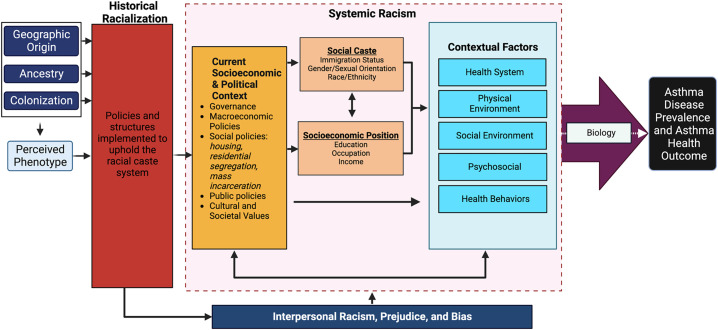
Background: In the United States, Black and Latino children with asthma are more likely than White children with asthma to require emergency department visits or hospitalizations because of an asthma exacerbation. Although many cite patient-level socioeconomic status and access to health care as primary drivers of disparities, there is an emerging focus on a major root cause of disparities-systemic racism. Current conceptual models of asthma disparities depict the historical and current effects of systemic racism as the foundation for unequal exposures to social determinants of health, environmental exposures, epigenetic factors, and differential healthcare access and quality. These ultimately lead to biologic changes over the life course resulting in asthma morbidity and mortality. Methods: At the 2022 American Thoracic Society International Conference, a diverse panel of experts was assembled to identify gaps and opportunities to address systemic racism in childhood asthma research. Panelists found that to examine and address the impacts of systemic racism on children with asthma, researchers and medical systems that support biomedical research will need to 1) address the current gaps in our understanding of how to conceptualize and characterize the impacts of systemic racism on child health, 2) design research studies that leverage diverse disciplines and engage the communities affected by systemic racism in identifying and designing studies to evaluate interventions that address the racialized system that contributes to disparities in asthma health outcomes, and 3) address funding mechanisms and institutional research practices that will be needed to promote antiracism practices in research and its dissemination. Results: A thorough literature review and expert opinion discussion demonstrated that there are few studies in childhood asthma that identify systemic racism as a root cause of many of the disparities seen in children with asthma. Community engagement and participation in research studies is essential to design interventions to address the racialized system in which patients and families live. Dissemination and implementation studies with an equity lens will provide the multilevel evaluations required to understand the impacts of interventions to address systemic racism and the downstream impacts. To address the impacts of systemic racism and childhood asthma, there needs to be increased training for research teams, funding for studies addressing research that evaluates the impacts of racism, funding for diverse and multidisciplinary research teams including community members, and institutional and financial support of advocating for policy changes based on study findings. Conclusions: Innovative study design, new tools to identify the impacts of systemic racism, community engagement, and improved infrastructure and funding are all needed to support research that will address impacts of systemic racism on childhood asthma outcomes.
Keywords: asthma; health disparities; minority and disadvantaged populations; racism; social determinants of health.
Figures
References
-
- U.S. Census Bureau. United States census definition of race. https://www.census.gov/quickfacts/fact/note/US/RHI625222#:~:text=OMB%20...
-
- Roberts D. Fatal invention: how science, politics, and big business re-create race in the twenty-first century. New York: New Press; 2011.
-
- Rothstein R. The color of law. New York: Liveright Publishing; 2017.
-
- Blatt LR, Sadler RC, Jones EJ, Miller P, Hunter-Rue DS, Votruba-Drzal E. Historical structural racism in the built environment and contemporary children’s opportunities. Pediatrics . 2024;153:e2023063230. - PubMed
