. 2024 Dec:50:102134.
doi: 10.1016/j.tranon.2024.102134. Epub 2024 Sep 30.

Bronchial washing fluid sequencing is useful in the diagnosis of lung cancer with necrotic tumor

Affiliations

Bronchial washing fluid sequencing is useful in the diagnosis of lung cancer with necrotic tumor

Jun Hyeok Lim et al. Transl Oncol. 2024 Dec.

Abstract

Background: Early-stage lung cancers detected by low-dose computed tomography (CT) often require confirmation through invasive procedures due to the absence of endobronchial lesions. This study assesses the diagnostic utility of bronchial washing fluid (BW) sequencing, a less invasive alternative, aiming to identify patient characteristics most suited for this approach.

Methods: From June 2017 to March 2018, we conducted a prospective cohort study by enrolling patients with incidental lung lesions suspected of early-stage lung cancer at two independent hospitals, and 114 were diagnosed with lung cancer while 50 were diagnosed with benign lesions. BW sequencing was performed using a targeted gene panel, and the clinical characteristics of patients detected with cancer through sequencing were identified.

Results: Malignant cells were detected in 33 patients (28.9 %) through BW cytology. By applying specificity-focused mutation criteria, BW sequencing classified 42 patients (36.8 %) as having cancer. Among the cancer patients who were BW sequencing positive and BW cytology negative, 15 patients (75.0 %) showed necrosis on CT. The sensitivity of BW sequencing was particularly enhanced in patients with necrotic tumors, reaching 75 %.

Conclusions: BW sequencing presents a viable, non-invasive diagnostic option for early-stage lung cancer, especially valuable in patients with necrotic lesions. By potentially reducing the reliance on more invasive diagnostic procedures, this method could streamline clinical workflows, decrease patient burden, and improve overall diagnostic efficiency.

Keywords: Bronchial washing; Early-stage lung cancer; Non-invasive diagnosis; Sequencing; Tumor necrosis.


Conflict of interest statement

Declaration of competing interest The authors declare that they have no known competing financial interests or personal relationships that could have appeared to influence the work reported in this paper.

Figures
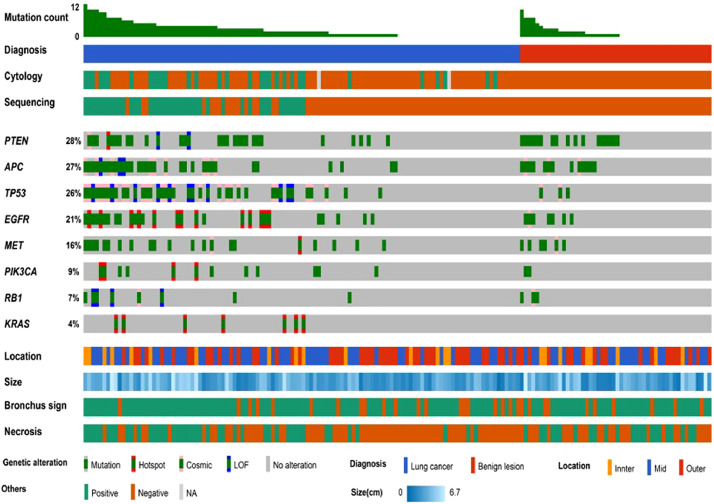
Fig. 1
Fig. 1
Results of BW sequencing with the panel sequencing by characteristics of lung lesions.
Fig. 2
Fig. 2
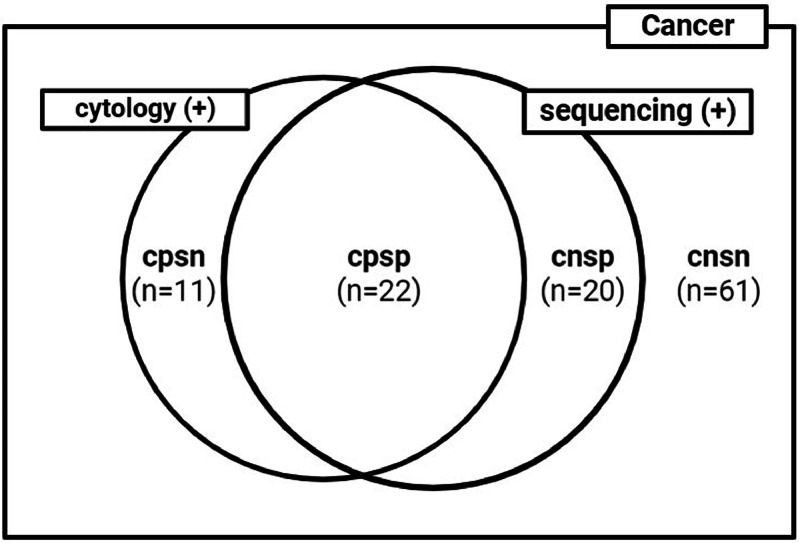
Venn diagram showing the positivity by BW cytology and by BW sequencing among lung cancer patients. cpsp = cytology positive/sequencing positive; cnsp = cytology negative/sequencing positive; cpsn = cytology positive/sequencing negative; cnsn = cytology negative/sequencing negative.
Fig. 3
Fig. 3
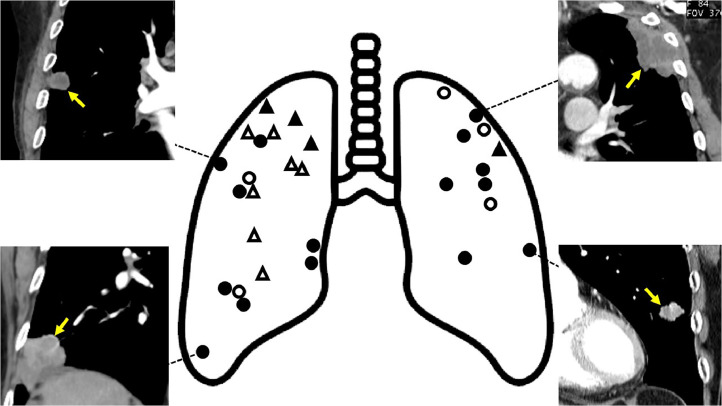
Location and necrosis of lung lesions in lung cancer patients whose BW were positive for sequencing only and those whose BW were positive for cytology only. Circles represent lesions with positive for BW sequencing only and triangles represent those with positive for BW cytology only. Filled shapes represent lung lesions with necrosis. Chest CT scan images show representative peripheral lung lesions (arrow) with necrosis and positive for BW sequencing only.
Fig. 4
Fig. 4
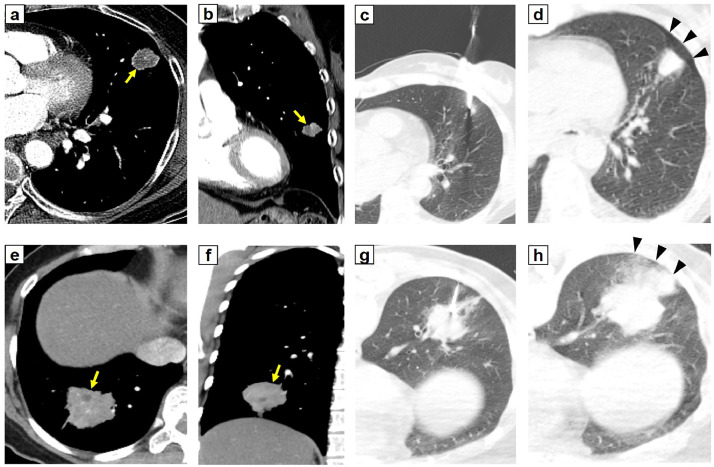
Two representative cases of patients with necrosis in a lung lesion, a positive sequencing only, and a complication of an invasive diagnostic test. (A-D) In a 78 years old woman, pneumothorax (arrowhead) occurred after percutaneous needle biopsy (PCNB) of a lung lesion (arrow) in outer location on lingula segment of the left upper lobe with necrosis. The patient was diagnosed with stage I lung adenocarcinoma and epidermal growth factor receptor (EGFR) exon 19 deletion was detected by EGFR PCR method. Result of BW sequencing also showed an EGFR exon 19 deletion mutation, E746_A750del. The patient underwent radiosurgery rather than surgical resection considering her old age and low performance status. (A) axial view (B) coronal view (C) PCNB (D) pneumothorax occurred after PCNB (E-H) In a 51 years old woman, pulmonary hemorrhage (arrowhead) with hemoptysis developed after PCNB of a lung lesion (arrow) in mid location on right lower lobe with necrosis. The patient was diagnosed with stage II lung adenocarcinoma and EGFR exon 20 insertion was detected by EGFR PCR method. Result of BW sequencing also showed an EGFR exon 20 insertion mutation, D770_N771insSVD. The patient underwent lobectomy. After 1 year, recurrence of lung cancer was observed and the patient received amivantamab, a target agent for EGFR exon 20 insertion mutation, and the partial response of lung lesions was observed thereafter. (E) axial view (F) coronal view (G) PCNB (H) pulmonary hemorrhage developed after PCNB.

References

    1. Wiener R.S., Schwartz L.M., Woloshin S., Welch H.G. Population-based risk for complications after transthoracic needle lung biopsy of a pulmonary nodule: an analysis of discharge records. Ann. Intern. Med. 2011;155:137–144. - PMC - PubMed
    1. Folch E.E., Bowling M.R., Pritchett M.A., Murgu S.D., Nead M.A., Flandes J., et al. NAVIGATE 24-month results: electromagnetic navigation bronchoscopy for pulmonary lesions at 37 centers in Europe and the United States. J. Thoracic Oncol. 2022;17:519–531. - PubMed
    1. Robin M., Mhanna L., Chaltiel L., Plat G., Héluain V., Basset C., et al. Feasibility of comprehensive genotyping specimens from radial endobronchial ultrasonography and electromagnetic navigation bronchoscopy. ERJ. Open. Res. 2021;7 - PMC - PubMed
    1. Solomon D.A., Solliday N.H., Gracey D.R. Cytology in fiberoptic bronchoscopy. Comparison of bronchial brushing, washing and post-bronchoscopy sputum. Chest. 1974;65:616–619. - PubMed
    1. Cohen J.D., Li L., Wang Y., Thoburn C., Afsari B., Danilova L., et al. Detection and localization of surgically resectable cancers with a multi-analyte blood test. Science (1979) 2018;359:926–930. - PMC - PubMed

LinkOut - more resources