Review
. 2024 Oct 2;9(1):262.
doi: 10.1038/s41392-024-01951-9.

Type 2 diabetes mellitus in adults: pathogenesis, prevention and therapy

Affiliations
Review

Type 2 diabetes mellitus in adults: pathogenesis, prevention and therapy

Xi Lu et al. Signal Transduct Target Ther. .

Abstract

Type 2 diabetes (T2D) is a disease characterized by heterogeneously progressive loss of islet β cell insulin secretion usually occurring after the presence of insulin resistance (IR) and it is one component of metabolic syndrome (MS), and we named it metabolic dysfunction syndrome (MDS). The pathogenesis of T2D is not fully understood, with IR and β cell dysfunction playing central roles in its pathophysiology. Dyslipidemia, hyperglycemia, along with other metabolic disorders, results in IR and/or islet β cell dysfunction via some shared pathways, such as inflammation, endoplasmic reticulum stress (ERS), oxidative stress, and ectopic lipid deposition. There is currently no cure for T2D, but it can be prevented or in remission by lifestyle intervention and/or some medication. If prevention fails, holistic and personalized management should be taken as soon as possible through timely detection and diagnosis, considering target organ protection, comorbidities, treatment goals, and other factors in reality. T2D is often accompanied by other components of MDS, such as preobesity/obesity, metabolic dysfunction associated steatotic liver disease, dyslipidemia, which usually occurs before it, and they are considered as the upstream diseases of T2D. It is more appropriate to call "diabetic complications" as "MDS-related target organ damage (TOD)", since their development involves not only hyperglycemia but also other metabolic disorders of MDS, promoting an up-to-date management philosophy. In this review, we aim to summarize the underlying mechanism, screening, diagnosis, prevention, and treatment of T2D, especially regarding the personalized selection of hypoglycemic agents and holistic management based on the concept of "MDS-related TOD".


Conflict of interest statement

The authors declare no competing interests.

Figures
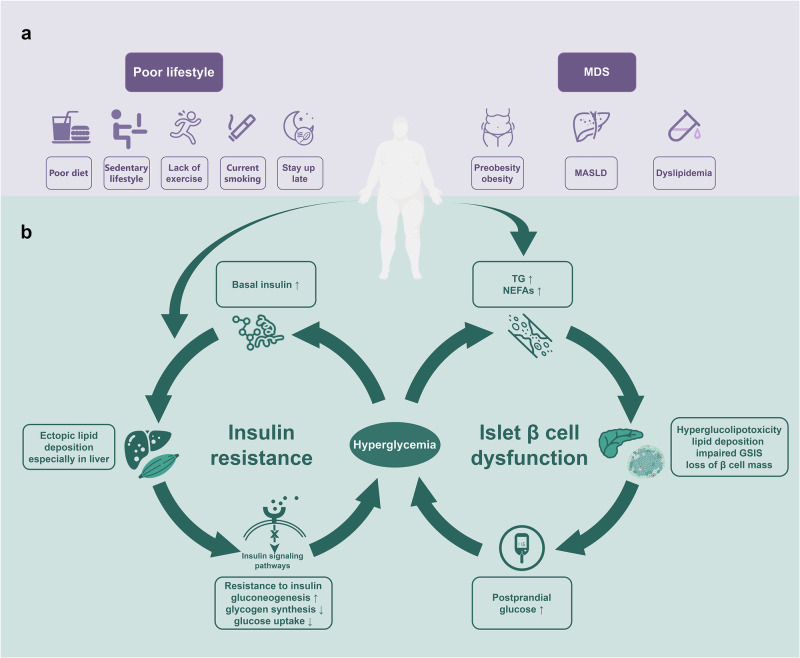
Fig. 1
Fig. 1
Vicious cycle of hyperglycemia. Poor lifestyle and/or metabolic dysfunction syndrome leads to elevated triglycerides, non-esterified fatty acids (a). Excessive lipids is deposited in non-adipose tissue, blocking the insulin signaling pathways, then resulting in insulin resistance, especially in the liver which increase the liver’s glucose production and weakens uptake of glucose, thereby increasing blood glucose and basal insulin levels, and the elevated insulin promotes lipid deposition, further aggravating insulin resistance and forming a vicious circle; elevated glucose and lipids produce hyperglucolipotoxicity to islet β cells and lipid deposition in islets, damaging the secretion function and number of pancreatic β cells, and further increasing blood glucose (b). MDS metabolic dysfunction syndrome, MASLD metabolic associated steatotic liver disease, TG triglycerides, NEFAs non-esterified fatty acids, GSIS glucose-stimulated insulin secretion
Fig. 2
Fig. 2
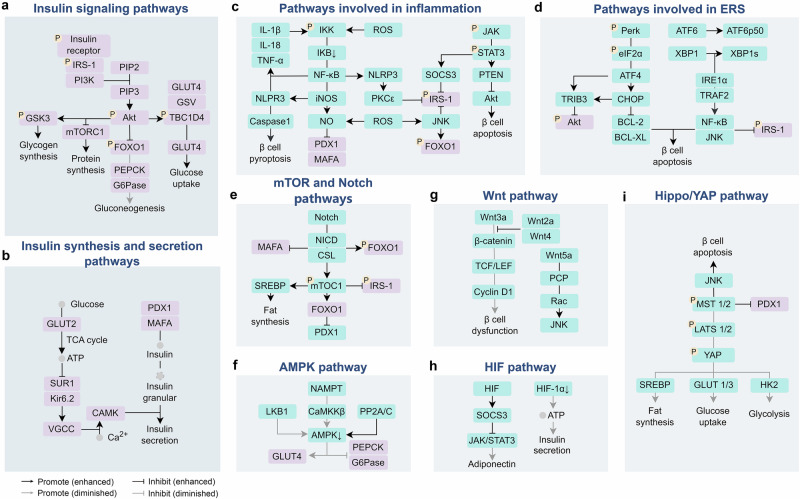
Signaling pathways involved in T2D. In T2D, insulin signaling pathways (a) and insulin synthesis and secretion pathways (b) are affected by inflammatory pathways (c), ERS (d), and other pathways such as mTOR and notch pathways (e), AMPK pathway (f), Wnt pathway (g), HIF pathway (h), Hippo/YAP pathway (i)
Fig. 3
Fig. 3
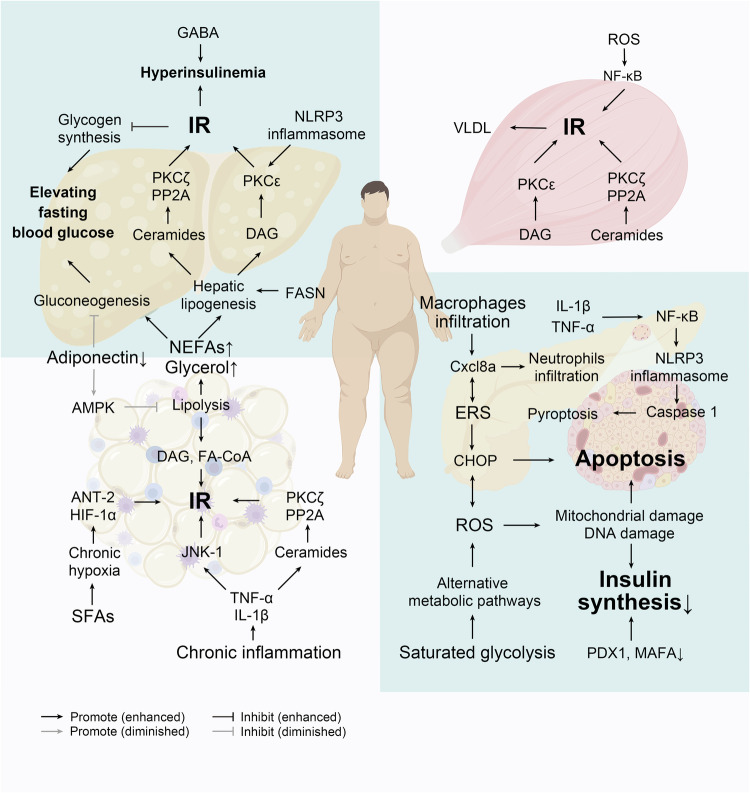
A sketch of pathogenesis of T2D. Briefly, Under the stimulation of SFAs, hypoxia in adipocytes due to enhanced SFAs metabolism, and the release of inflammatory factors from macrophage infiltration cause chronic inflammation in adipose tissues, leading to adipocyte IR and increased lipolysis. NEFAs and glycerol from lipolysis causes increased lipid synthesis, gluconeogenesis, and ectopic fat deposition in the liver, which affects IRS-1/PI3K/Akt2 phosphorylation on the one hand, and increases hepatic release of glucose on the other. At the same time, ectopic fat deposition also occurs in the muscle and leads to elevated circulating VLDL, further exacerbating lipid metabolism disorders and IR in the liver. Persistent hyperglycemia and excess fatty acids in the circulation due to overnutrition and IR further damage β-cell function and mass by some shared pathways, involving inflammation, ERS, and oxidative stress. IR insulin resistance, SFAs saturated fatty acid, NEFAs non-esterified fatty acids, TNF-α tumor necrosis factor α, IL-1β interleukin-1β, JNK c-Jun N-terminal kinase, FASN fatty acid synthase, DAG diacylglycerol, FA-CoA Fatty acyl-coenzyme A, ANT-2 adenine nucleotide translocase 2, HIF-1α hypoxia-inducible factor 1 alpha, NLRP3 NOD-like receptor family pyrin domain-containing 3, GABA γ-aminobutyric acid, PP2A protein phosphatase 2A, PKC protein kinase C, AMPK adenosine 5’-monophosphate-activated protein kinase, VLDL very-low-density lipoprotein, ROS reactive oxygen species, NF-κB nuclear factor-kappa B, Cxcl8a neutrophil chemokine (C-X-C motif) ligand 8a, ERS endoplasmic reticulum stress, CHOP C/EBP homologous protein, PDX1 pancreatic and duodenal homeobox factor-1, MAFA MAF bZIP transcription factor A
Fig. 4
Fig. 4
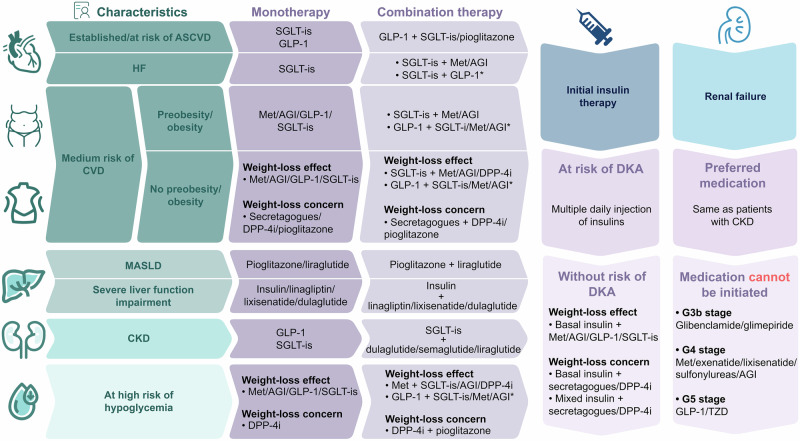
Personalized choice of hypoglycemic agents for patients with newly diagnosed T2D. This figure is modified according to Zhang et al. T2D type 2 diabetes, MASLD metabolic associated steatotic liver disease, ASCVD atherosclerotic coronary heart disease, HF heart failure, CKD chronic kidney disease, CVD cardiovascular disease, DKA diabetic ketoacidosis, Met metformin, AGI α-glucosidase inhibitors, GLP-1 glucagon-like peptide-1, SGLT-is sodium-glucose cotransporter inhibitors, DPP-4i dipeptidyl peptidase-4 inhibitors, TZD thiazolidinediones. *These regimens are considered in patients with affordability and willingness for injection therapy

References

    1. American Diabetes Association Professional Practice Committee. Standards of Care in Diabetes-2024. Diabetes Care47 (2024).
    1. Lonardo, A., Nascimbeni, F., Mantovani, A. & Targher, G. Hypertension, diabetes, atherosclerosis and NASH: Cause or consequence. J. Hepatol.68, 335–352 (2018). - DOI - PubMed
    1. GBD 2021 Diabetes Collaborators. Global, regional, and national burden of diabetes from 1990 to 2021, with projections of prevalence to 2050: a systematic analysis for the Global Burden of Disease Study 2021. Lancet402, 203–234 (2023). - DOI - PMC - PubMed
    1. GBD 2019 Diseases and Injuries Collaborators. Global burden of 369 diseases and injuries in 204 countries and territories, 1990-2019: a systematic analysis for the Global Burden of Disease Study 2019. Lancet396, 1204–1222 (2020). - DOI - PMC - PubMed
    1. Sun, H. et al. IDF Diabetes Atlas: Global, regional and country-level diabetes prevalence estimates for 2021 and projections for 2045. Diabetes Res. Clin. Pr.183, 109119 (2022). - DOI - PMC - PubMed

Publication types

MeSH terms