


Screen time, sleep duration, leisure physical activity, obesity, and cardiometabolic risk in children and adolescents: a cross-lagged 2-year study
- PMID: 39354336
- PMCID: PMC11443718
- DOI: 10.1186/s12872-024-04089-2
Screen time, sleep duration, leisure physical activity, obesity, and cardiometabolic risk in children and adolescents: a cross-lagged 2-year study
Abstract
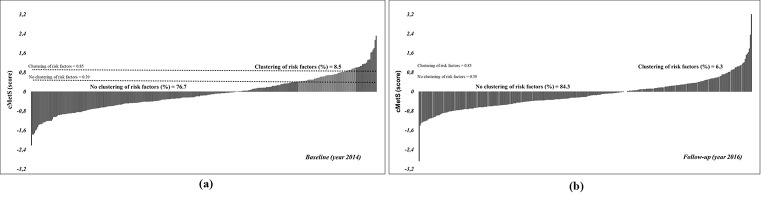
Background: Considering the previous research that suggested that screen time (ST), sleep duration, physical activity (PA), obesity and cardiometabolic risk factors are related, it is essential to identify how these variables are associated over time, to provide knowledge for the development of intervention strategies to promote health in pediatric populations. Also, there is a lack of studies examining these associations longitudinally. The aims of the present study were: (1) to investigate the longitudinal relationships between ST, sleep duration, leisure PA, body mass index (BMI), and cardiometabolic risk score (cMetS) in children and adolescents; and (2) to verify scores and prevalence of cMetS risk zones at baseline and follow-up.
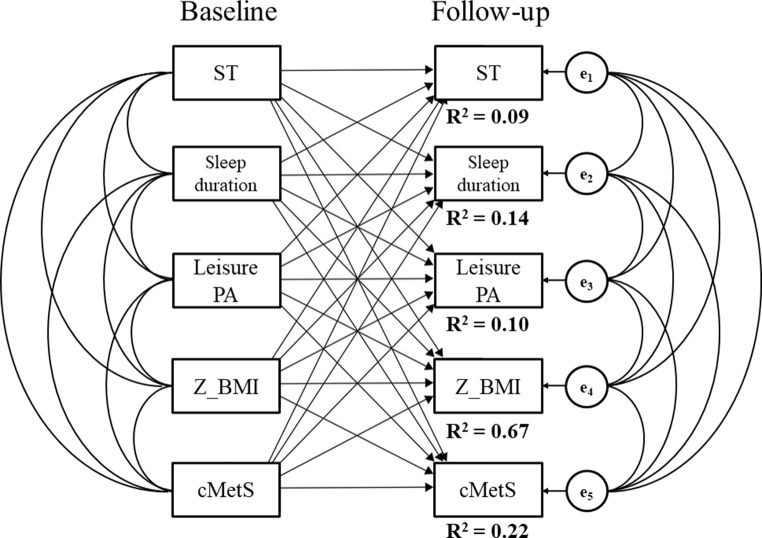
Methods: This observational longitudinal study included 331 children and adolescents (aged six to 17 years; girls = 57.7%) from schools in a southern city in Brazil. ST, sleep duration, and leisure PA were evaluated by a self-reported questionnaire. BMI was evaluated using the BMI z-scores (Z_BMI). The cMetS was determined by summing sex- and age-specific z-scores of total cholesterol/high-density lipoprotein cholesterol (HDL-C) ratio, triglycerides, glucose, and systolic blood pressure and dividing it by four. A two-wave cross-lagged model was implemented.
Results: ST, sleep duration, and leisure PA were not associated with cMetS after 2-years. However, it was observed that higher ST at baseline was associated with shorter sleep duration at follow-up (B=-0.074; 95%IC=-0.130; -0.012), while higher Z_BMI from baseline associated with higher cMetS of follow-up (B = 0.154; 95%CI = 0.083;0.226). The reciprocal model of relationships indicated that the variance of ST, sleep time, leisure PA, Z_BMI, and cMetS explained approximately 9%, 14%, 10%, 67% and 22%, respectively, of the model. Individual change scores and prevalence indicated that cMetS had individual changes from 2014 to 2016.
Conclusion: Sleep duration, ST and leisure PA were not associated with cMetS after 2 years. ST showed an inverse association with sleep duration, and Z_BMI was positively associated with cMetS after a 2-year follow-up. Finally, the prevalence of no clustering of risk factors increased after two years. These findings suggest the need to promote healthy lifestyle habits from childhood and considering individual factors that can influence cardiometabolic health in children and adolescents.
Keywords: Metabolic syndrome; Obesity; Physical activity; Schoolchildren; Sedentary behavior; Sleep duration.
© 2024. The Author(s).
Conflict of interest statement
The authors declare no competing interests.
Figures

References
-
- Bussler S, Penke M, Flemming G, Elhassan YS, Kratzsch J, Sergeyev E, et al. Novel insights in the metabolic syndrome in Childhood and Adolescence. Horm Res Paediatr. 2017;88:181–93. - PubMed
-
- Noubiap JJ, Nansseu JR, Lontchi-Yimagou E, Nkeck JR, Nyaga UF, Ngouo AT, et al. Global, regional, and country estimates of metabolic syndrome burden in children and adolescents in 2020: a systematic review and modelling analysis. Lancet Child Adolesc Health. 2022;6:158–70. - PubMed
Publication types
MeSH terms
LinkOut - more resources
Full Text Sources
Medical
