


Feasibility of a digital palliative care intervention (Convoy-Pal) for older adults with heart failure and multiple chronic conditions and their caregivers: a waitlist randomized control trial
- PMID: 39354453
- PMCID: PMC11446009
- DOI: 10.1186/s12904-024-01561-w
Feasibility of a digital palliative care intervention (Convoy-Pal) for older adults with heart failure and multiple chronic conditions and their caregivers: a waitlist randomized control trial
Abstract
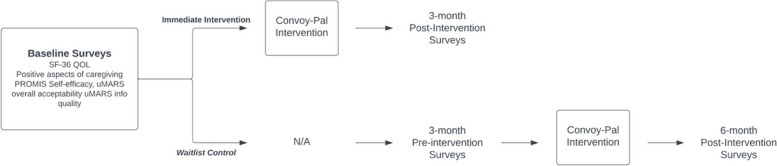
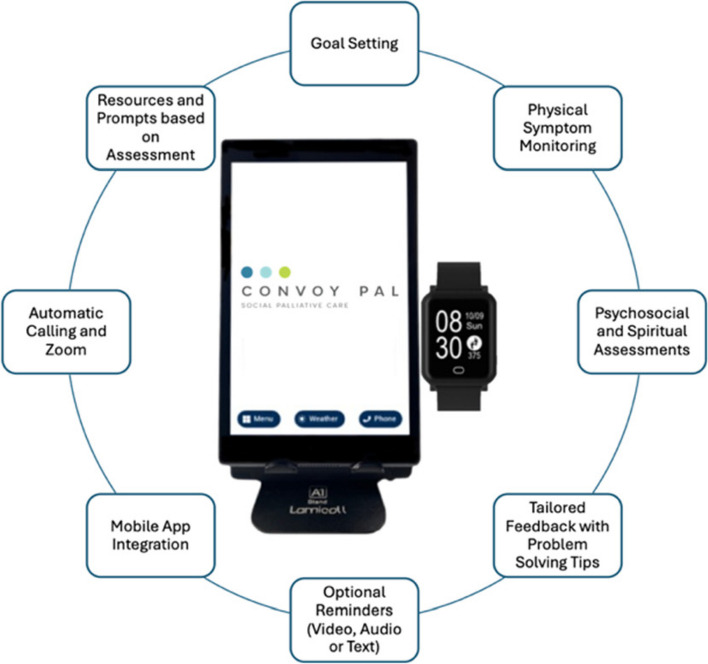
Background: Although older adults with heart failure (HF) and multiple chronic conditions (MCC) frequently rely on caregivers for health management, digital health systems, such as patient portals and mobile apps, are designed for individual patients and often exclude caregivers. There is a need to develop approaches that integrate caregivers into care. This study tested the feasibility of the Social Convoy Palliative Care intervention (Convoy-Pal), a 12-week digital self-management program that includes assessment tools and resources for clinical palliative care, designed for both patients and their caregivers.
Methods: A randomized waitlist control feasibility trial involving patients over 65 years old with MCC who had been hospitalized two or more times for HF in the past 12 months and their caregivers. Descriptive statistics were used to evaluate recruitment, retention, missing data, self-reported social functioning, positive aspects of caregiving, and the acceptability of the intervention.
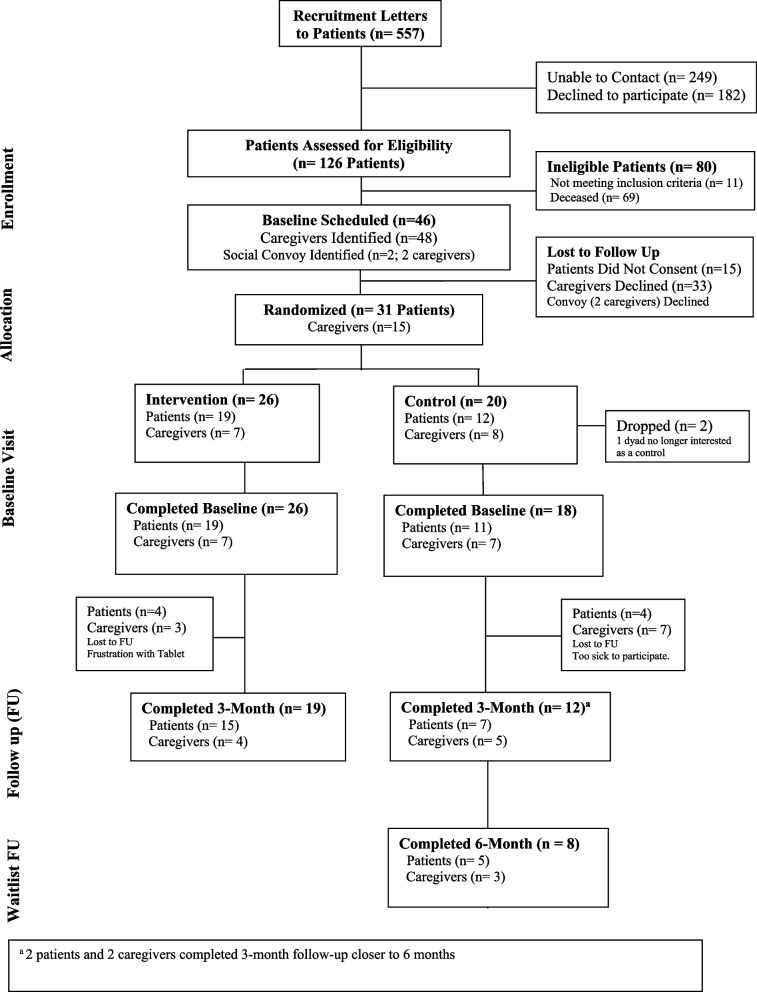
Results: Of 126 potentially eligible patients, 11 were ineligible and 69 were deceased. Of the 46 eligible patients, 31 enrolled in the trial. Although 48 caregivers were identified, only 15 enrolled. The average age was 76.3 years for patients and 71.6 years for caregivers, with most participants being non-Hispanic White. Notably, 4% did not have access to a personal mobile device or computer. Retention rates were 79% for intervention patients, 57% for intervention caregivers, and 60% for control participants. Only 4.6% of survey subscales were missing, aided by robust technical support. Intervention patients reported improved social functioning (SF-36: 64.6 ± 25.8 to 73.2 ± 31.3) compared to controls (64.6 ± 27.1 to 67.5 ± 24.4). Intervention caregivers also reported increased positive perceptions of caregiving (29.5 ± 5.28 to 35.0 ± 5.35) versus control caregivers (29.4 ± 8.7 to 28.0 ± 4.4). Waitlist control participants who later joined the Convoy-Pal program showed similar improvements. The intervention was well-rated for acceptability, especially regarding the information provided (3.96 ± .57 out of 5).
Conclusions: Recruiting informal caregivers proved challenging. Nonetheless, Convoy-Pal retained patients and collected meaningful self-reported outcomes, showing potential benefits for both patients and caregivers. Given the importance of a patient and caregiver approach in palliative care, further research is needed to design digital tools that cater to multiple simultaneous users.
Trial registration: ClinicalTrials.gov Identifier NCT04779931. Date of registration: March 3, 2021.
Keywords: Aging; Digital health; Heart failure; Palliative care.
© 2024. The Author(s).
Conflict of interest statement
The authors declare no competing interests.
Figures
References
-
- Kahn RS, Antonucci TC. Convoys over the life course: attachment, roles, and social support. In: Baltes PB, Brim O, editors. Life-span development and behavior. New York: Acadmic Press; 1980. p. 254–83.
-
- Antonucci TC, Fiori KL, Birditt K, Jackey LMH. Convoys of Social Relations: Integrating Life-Span and Life-Course Perspectives. In: Lerner RM, Lamb ME, Freund AM, editors. The Handbook of Life-Span Development. Hoboken, NJ, USA: John Wiley & Sons, Inc.; 2010 . Available from: http://doi.wiley.com/10.1002/9780470880166.hlsd002012 . Cited 2017 Aug 16. - DOI
Publication types
MeSH terms
Associated data
Grants and funding
LinkOut - more resources
Full Text Sources
Medical
Research Materials
Miscellaneous
