The 2023 European Task Force Criteria for Diagnosis of Arrhythmogenic Cardiomyopathy: Historical Background and Review of Main Changes
- PMID: 39355594
- PMCID: PMC11440389
- DOI: 10.31083/j.rcm2509348
The 2023 European Task Force Criteria for Diagnosis of Arrhythmogenic Cardiomyopathy: Historical Background and Review of Main Changes
Abstract
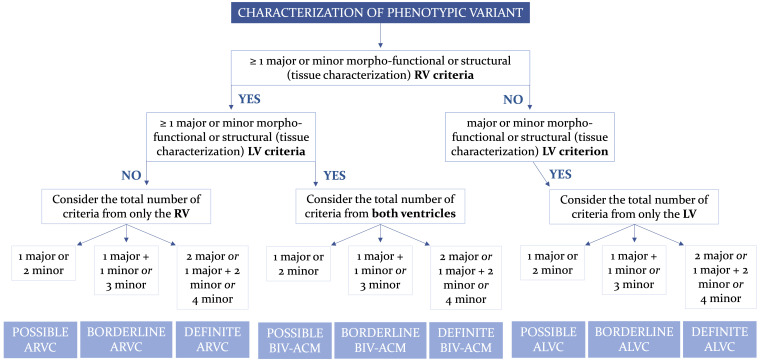
Arrhythmogenic cardiomyopathy (ACM) is a cardiac disease featured by non-ischemic myocardial scarring linked to ventricular electrical instability. As there is no single gold-standard test, diagnosing ACM remains challenging and a combination of specific criteria is needed. The diagnostic criteria were first defined and widespread in 1994 and then revised in 2010, approaching and focusing primarily on right ventricular involvement without considering any kind of left ventricular variant or phenotype. Years later, in 2020, with the purpose of overcoming previous limitations, the Padua Criteria were introduced by an international expert report. The main novel elements were the introduction of specific criteria for left ventricular variants as well as the use of cardiac magnetic resonance for tissue characterization and scar detection. The last modifications and refinement of these criteria were published at the end of 2023 as the European Task Force criteria, by a "head-quarter" of ACM international experts, proving the emerging relevance of this condition besides its difficult diagnosis. In this review, emphasizing the progress in understanding the aetiology of the cardiomyopathy, an analysis of the new criteria is presented. The introduction of the term "scarring/arrhythmogenic cardiomyopathy" sets an important milestone in this field, underlying how non-ischemic myocardial scarring-typical of ACM-and arrhythmic susceptibility could be the main pillars of numerous different phenotypic variants regardless of etiology.
Keywords: arrhythmogenic cardiomyopathy; cardiac magnetic resonance; diagnosis; sudden death; ventricular arrhythmia.
Copyright: © 2024 The Author(s). Published by IMR Press.
Conflict of interest statement
The authors declare no conflict of interest. Alessandro Zorzi, Barbara Bauce, and Domenico Corrado are serving as Guest Editor of this journal, and Alessandro Zorzi is also serving as one of the Editorial Board members of this journal. We declare that Alessandro Zorzi, Barbara Bauce, and Domenico Corrado had no involvement in the peer review of this article and have no access to information regarding its peer review. Full responsibility for the editorial process for this article was delegated to John Lynn Jefferies.
Figures
References
-
- Corrado D, Link MS, Calkins H. Arrhythmogenic Right Ventricular Cardiomyopathy. The New England Journal of Medicine . 2017;376:61–72. - PubMed
-
- Maron BJ. Right ventricular cardiomyopathy: another cause of sudden death in the young. The New England Journal of Medicine . 1988;318:178–180. - PubMed
-
- Lancisi GM. Demotucordisetaneurysmatibus. Opus posthumu, in duas partes divisum. Giovanni Maria Salvioni: Rome. 1728. [(Accessed: 27 March 2024)]. Available at: https://www.milestone-books.de/pages/books/003141/giovanni-maria-lancisi... .
-
- Marcus FI, Fontaine GH, Guiraudon G, Frank R, Laurenceau JL, Malergue C, et al. Right ventricular dysplasia: a report of 24 adult cases. Circulation . 1982;65:384–398. - PubMed
-
- Thiene G, Nava A, Corrado D, Rossi L, Pennelli N. Right ventricular cardiomyopathy and sudden death in young people. The New England Journal of Medicine . 1988;318:129–133. - PubMed
Publication types
LinkOut - more resources
Full Text Sources
Research Materials