. 2024 Oct 1;4(10):2835-2845.
doi: 10.1158/2767-9764.CRC-24-0312.

USP36 SUMOylates Las1L and Promotes Its Function in Pre-Ribosomal RNA ITS2 Processing

Affiliations

USP36 SUMOylates Las1L and Promotes Its Function in Pre-Ribosomal RNA ITS2 Processing

Yanping Li et al. Cancer Res Commun. .

Abstract

Ribosome biogenesis is a highly regulated cellular process requiring a large cohort of accessory factors to ensure the accurate production of ribosomes. Dysregulation of ribosome biogenesis is associated with the development of various human diseases, including cancer. The Las1L-Nol9 endonuclease-kinase complex is essential for the cleavage of the rRNA internal transcribed spacer 2 (ITS2), the phosphorylation of the 5'-hydroxyl end of the resulting precursor, and, thus, the maturation of the 60S ribosome. However, how the Las1L-Nol9 complex is regulated in cells is unclear. In this study, we report that the nucleolar ubiquitin-specific protease USP36 is a novel regulator of the Las1L-Nol9 complex. USP36 interacts with both Las1L and Nol9 and regulates their stability via deubiquitination. Intriguingly, USP36 also mediates the SUMOylation of Las1L, mainly at lysine (K) 565. Mutating K565 to arginine (R) does not affect the levels of Las1L and the formation of the Las1L-Nol9 complex, but abolishes its function in ITS2 processing, as unlike wild-type Las1L, the K565R mutant failed to rescue the defects in the ITS2 processing induced by the knockdown of endogenous Las1L. These results suggest that USP36-mediated Las1L SUMOylation is critical for ITS2 processing and that USP36 plays a critical role in ribosome biogenesis by regulating the Las1L-Nol9 complex.

Significance: This study identifies USP36 as a deubiquitinating and small ubiquitin-like modifier ligase dual-function enzyme to mediate Las1L deubiquitination and SUMOylation. Las1L SUMOylation at K565 plays a critical role in pre-rRNA ITS2 processing. Thus, our study reveals a novel downstream pathway for USP36-regulated ribosome biogenesis.


Conflict of interest statement

R.C. Sears reports personal fees from Rappta Therapeutics and grants from AstraZeneca outside the submitted work. M.-S. Dai reports grants from NIH during the conduct of the study. No disclosures were reported by the other authors.

Figures
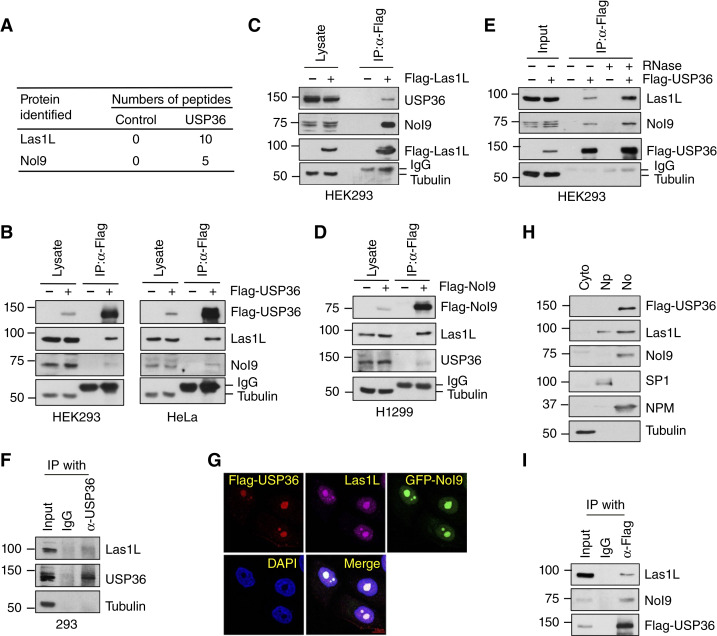
Figure 1
Figure 1
USP36 interacts with the Las1L–Nol9 complex. A, Number of Las1L and Nol9 peptides detected by mass spectrometry analysis of immunoprecipitates from control 293 and 293-Flag-USP36 cells by anti-Flag antibody. B, USP36 interacts with Las1L and Nol9. The HEK293 and HeLa cells transfected with Flag-USP36 were subjected to Co-IP with anti-Flag antibody, followed by IB. C, Co-IP of Las1L with USP36. The HEK293 cells transfected with Flag-Las1L were assayed by Co-IP using anti-Flag antibody, followed by IB. D, Co-IP of Nol9 with USP36. H1299 cells were transfected with Flag-Nol9 and assayed by Co-IP using anti-Flag antibody, followed by IB. E, The interaction of USP36 with Las1L–Nol9 is independent of RNA. The HEK293 cells transfected with Flag-USP36 were subjected to Co-IP with anti-Flag antibody in the presence or absence of 100 μg/mL RNase A and 100 U/mL RNase T1 treatment, followed by IB. F, Co-IP between endogenous USP36 and Las1L. 293 cell lysates were immunoprecipitated with anti-USP36, followed by IB with anti-Las1L antibody. G, Co-localization of Flag-USP36 with Las1L and Nol9. HeLa cells co-transfected with Flag-USP36 and GFP-Nol9 were immunostained with anti-Flag (Red) and anti-Las1L (far red), followed by 4′,6-diamidino-2-phenylindole (DAPI) staining for DNA (blue). H, Cell fractionation assays. HeLa cells stably expressing Flag-USP36 were fractionated into cytoplasmic (Cyto), nucleoplasmic (Np), and nucleolar fractions (No), followed by IB. Tubulin, SP1, and nucleophosmin (NPM) were used as cytoplasmic, nucleoplasmic, and nucleolar markers, respectively. I, Co-IP of USP36 with Las1L–Nol9 in the nucleolar fraction. Lysates from the nucleolar fraction shown in H were immunoprecipitated with anti-Flag antibody followed by IB.
Figure 2
Figure 2
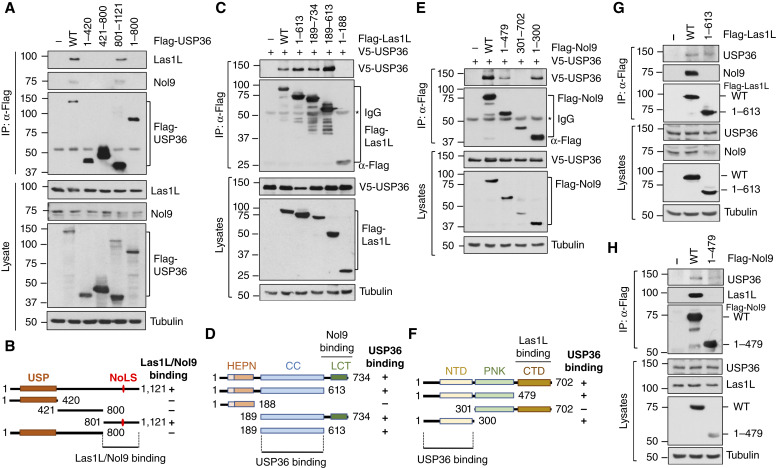
Mapping the interaction of USP36 with the Las1L–Nol9 complex. A and B, The C-terminal domain of USP36 binds to Las1L and Nol9. H1299 cells transfected with Flag-USP36 or its deletion mutants were assayed by Co-IP with anti-Flag antibody, followed by IB (A). Diagram of USP36 indicating the C-terminal Las1L–Nol9–binding domain is shown in B. USP, ubiquitin-specific protease. C and D, USP36 binds to the CC domain of Las1L. H1299 cells transfected with Flag-Las1L or its deletion mutants together with V5-USP36 were subjected to Co-IP with anti-Flag antibody, followed by IB (C). The diagram of Las1L domains is shown in D. HEPN, higher eukaryotes and prokaryotes nucleotide-binding domain; LCT, Las1L C-terminal tail; CC, coiled-coil. E and F, USP36 binds to the NTD domain of Nol9. H1299 cells transfected with Flag-Nol9 or its deletion mutants together with V5-USP36 were subjected to Co-IP with anti-Flag antibody, followed by IB (E). The diagram of Nol9 domains is shown in F. NTD, N-terminal domain; PNK, polynucleotide kinase; CTD, C-terminal domain. G and H, USP36 binds to Las1L and Nol9 independently. H1299 cells transfected with WT Flag-Las1L or the Nol9-binding defective mutant (G) or Flag-Nol9 or its Las1L-binding defective mutant (H) were subjected to Co-IP with anti-Flag antibody, followed by IB.
Figure 3
Figure 3
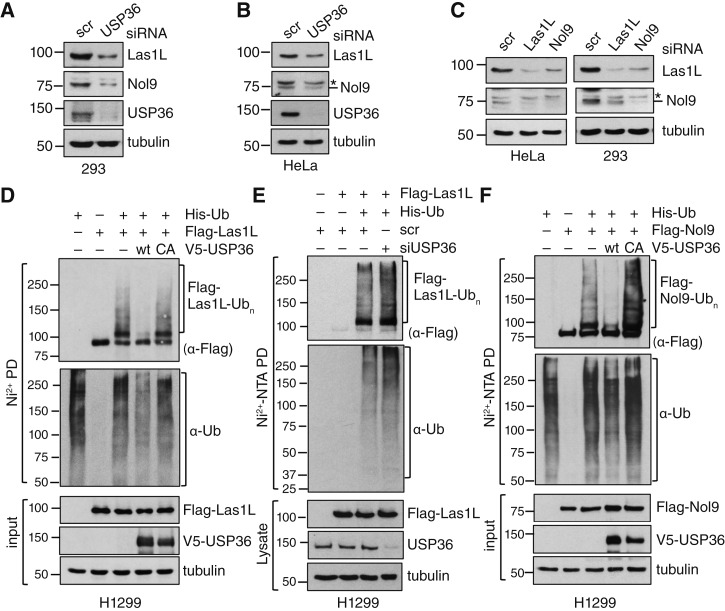
USP36 deubiquitinates Las1L and Nol9 and regulates their levels. A and B, Knockdown of USP36 reduces the levels of Las1L and Nol9. The HEK293 (A) and HeLa (B) cells transfected with scrambled (scr) or USP36 siRNA were assayed by IB. C, The stability of Las1L and Nol9 is dependent on each other. HeLa and HEK293 cells transfected with scr, Las1L, or Nol9 siRNA were assayed by IB. D, USP36 deubiquitinates Las1L. H1299 cells transfected with the indicated plasmids were subjected to Ni2+-NTA PD under denaturing conditions, followed by IB to detect the ubiquitinated species of Las1L. The protein expression is shown in the bottom panels. E, Knockdown of endogenous USP36 increases the ubiquitinated species of Las1L. H1299 cells transfected with the indicated plasmids together with scr or USP36 siRNA were subjected to Ni2+-NTA PD under denaturing conditions, followed by IB to detect the ubiquitinated species of Las1L. The protein expression is shown in the bottom panels. F, USP36 deubiquitinates Nol9. H1299 cells transfected with the indicated plasmids were subjected to Ni2+-NTA PD under denaturing conditions, followed by IB to detect the ubiquitinated species of Nol9. The protein expression is shown in the bottom panels.
Figure 4
Figure 4
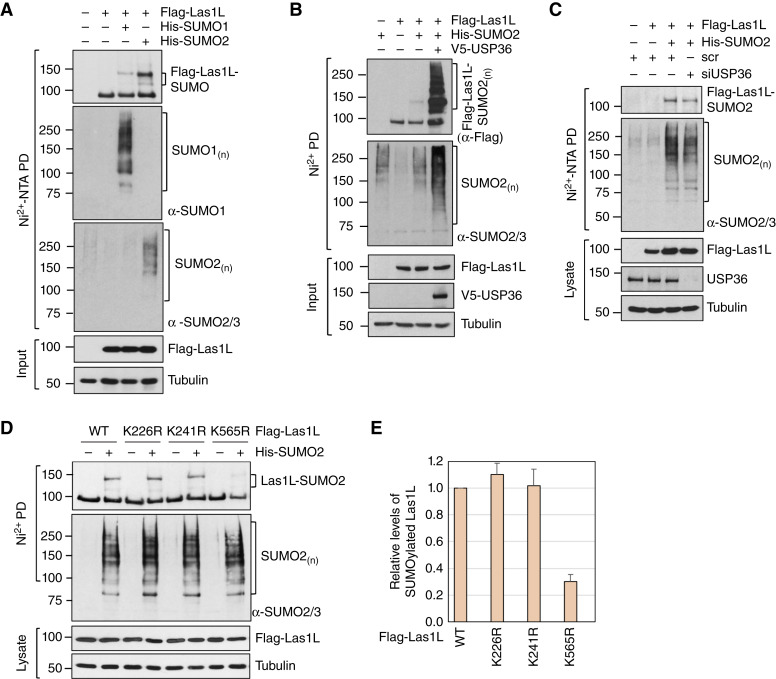
USP36 SUMOylates Las1L. A, Las1L is SUMOylated in cells. H1299 cells transfected with Flag-Las1L in the absence or presence of His-SUMO1 or His-SUMO2 were subjected to Ni2+-NTA PD under denaturing conditions, followed by IB with anti-Flag, anti-SUMO1, and anti-SUMO2/3 antibodies. B, USP36 promotes Las1L SUMOylation. H1299 cells transfected with the indicated plasmids were subjected to Ni2+-NTA PD, followed by IB to detect Las1L SUMOylation. The SUMOylated Las1L and total SUMOylated proteins are indicated. The protein expression is shown in the bottom panels. C, Knockdown of endogenous USP36 reduces Las1L SUMOylation. H1299 cells transfected with the indicated plasmids together with scr or USP36 siRNA were subjected to Ni2+-NTA PD, followed by IB to detect Las1L SUMOylation. The protein expression is shown in the bottom panels. D and E, Las1L is SUMOylated at K565. H1299 cells transfected with WT Las1L or the indicated lysine mutant plasmids were subjected to Ni2+-NTA beads PD under denaturing conditions, followed by IB. The SUMOylated Las1L and total SUMOylated proteins are indicated. The protein expression is shown in the bottom panels. The relative ratio of SUMOylated Las1L to native Las1L normalized to WT Las1L from the four individual experiments are shown in E.
Figure 5
Figure 5
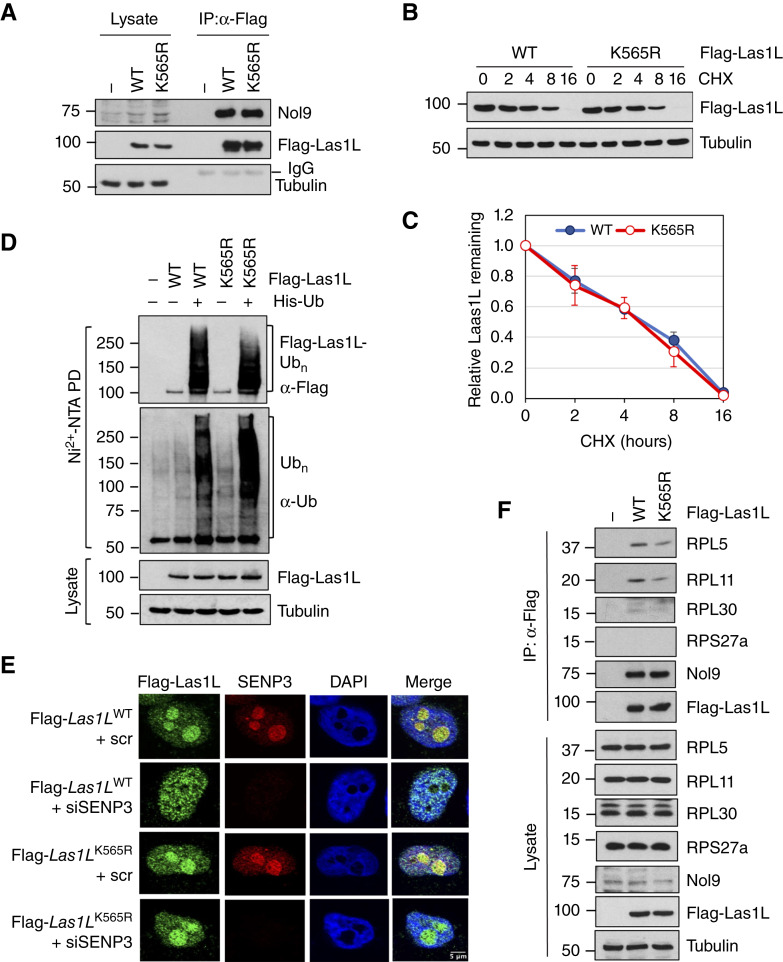
SUMOylation of Las1L regulates its cellular localization and association with the pre-60S ribosome. A, Las1L SUMOylation does not affect its interaction with Nol9. The HEK293 cells transfected with WT Las1L, the K565R mutant, or control vector were assayed by Co-IP with anti-Flag antibody, followed by IB. B and C, Mutating K565 does not affect the half-life of Las1L. HeLa cells transfected with WT Las1L or the K565R mutant were treated with 100 μg/mL cycloheximide (CHX) and harvested at different time points, followed by IB. A representative experiment is shown in B, and the quantification from the three independent experiments is shown in C. D, Mutating K565 does not affect Las1L ubiquitination determined by Ni2+-NTA beads PD under denaturing conditions. The ubiquitinated Las1L and total protein ubiquitination are indicated. The protein expression is shown in the bottom panels. E, Las1L SUMOylation at K565 affects its nucleoplasmic translocation. HeLa cells transfected with Flag-Las1L (WT or the K565R mutant) together with scr or SENP3 siRNA were immunostained with anti-Flag (green) and anti-SENP3 (red), followed by 4′,6-diamidino-2-phenylindole (DAPI) staining for DNA (blue). F, Mutating K565 attenuates the interaction of Las1L with the pre-60S ribosome. The HEK293 cells transfected with WT Flag-Las1L, the K565R mutant, or control vector were assayed by Co-IP with anti-Flag antibody, followed by IB to detect the indicated ribosomal proteins.
Figure 6
Figure 6
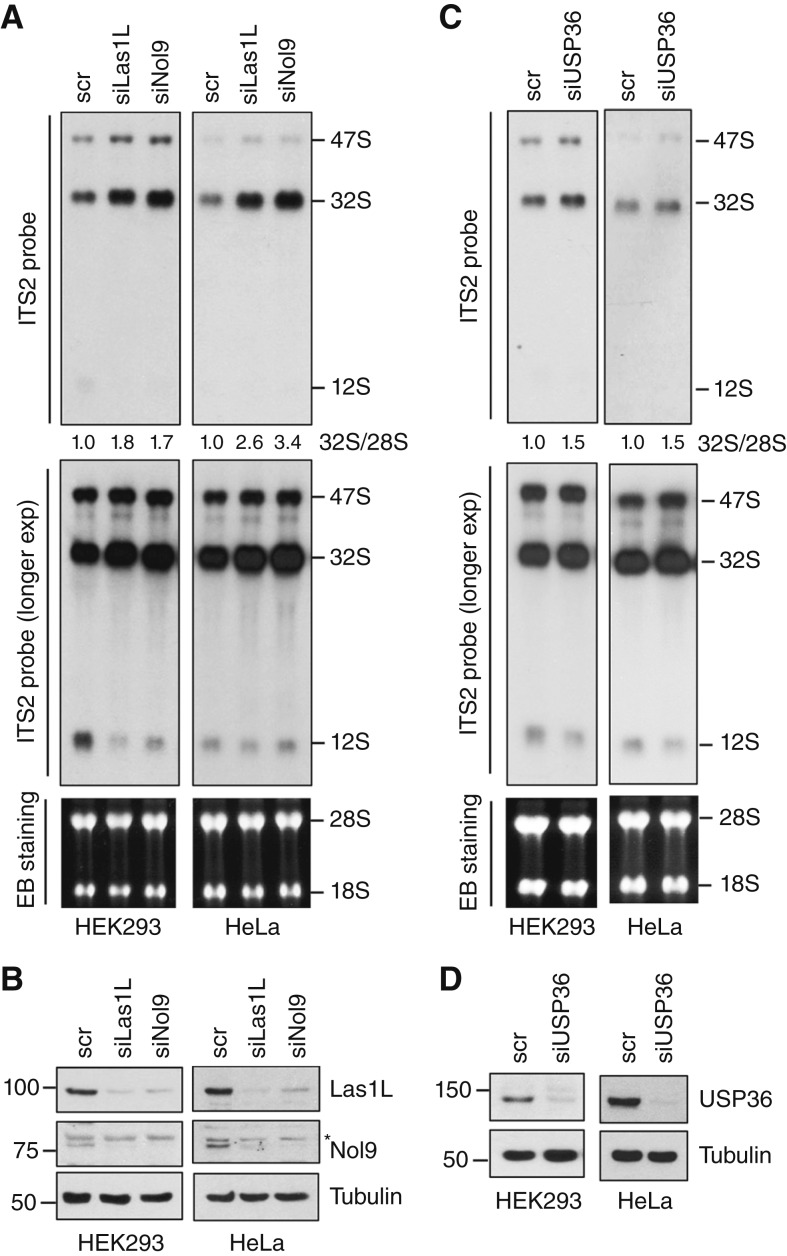
The Las1L–Nol9 complex and USP36 play a role in rRNA ITS2 processing. The HEK293 and HeLa cells transfected with scr, Las1L, Nol9 siRNA (A and B), or USP36 siRNA (C and D) were assayed for rRNA processing by Northern blot analysis using probe hybridizing to the ITS2 (A and C). The 47S pre-rRNA, 32S rRNA, 12S rRNA, and the relative ratios of 32S to 28S rRNA normalized to the scr control are shown in the top panels. Ethidium bromide (EB) staining of the RNA gels to indicate 28S and 18S rRNAs is shown in the bottom panels (A and C). The protein expression is shown by IB (B and D).
Figure 7
Figure 7
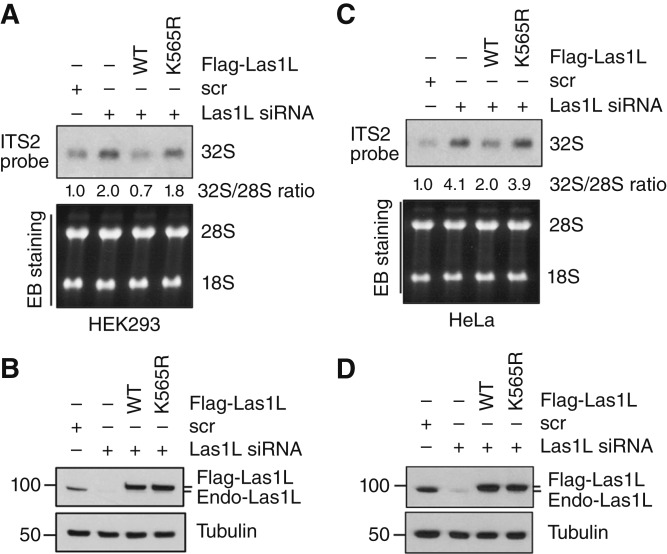
Las1L SUMOylation at K565 is critical for its function in rRNA ITS2 processing. The HEK293 (A and B) and HeLa (C and D) cells transfected with scr or Las1L siRNA together with siRNA-resistant WT Flag-Las1L or its K565R mutant were assayed for rRNA ITS2 processing by Northern blot analysis using the ITS2 probe. The 32S rRNA precursor and the relative ratios of 32S to 28S rRNA normalized to the scr control are indicated in the top panels. Ethidium bromide (EB) staining of the RNA agarose gel is shown in the bottom panels (A and C). One representative experiment from three independent experiments is shown. The expression of the endogenous Las1L and exogenous Flag-Las1L is shown by IB (B and D).

References

    1. Baßler J, Hurt E. Eukaryotic ribosome assembly. Annu Rev Biochem 2019;88:281–306. - PubMed
    1. Bohnsack KE, Bohnsack MT. Uncovering the assembly pathway of human ribosomes and its emerging links to disease. EMBO J 2019;38:e100278. - PMC - PubMed
    1. Dorner K, Ruggeri C, Zemp I, Kutay U. Ribosome biogenesis factors-from names to functions. EMBO J 2023;42:e112699. - PMC - PubMed
    1. Castle CD, Cassimere EK, Denicourt C. LAS1L interacts with the mammalian Rix1 complex to regulate ribosome biogenesis. Mol Biol Cell 2012;23:716–28. - PMC - PubMed
    1. Castle CD, Sardana R, Dandekar V, Borgianini V, Johnson AW, Denicourt C. Las1 interacts with Grc3 polynucleotide kinase and is required for ribosome synthesis in Saccharomyces cerevisiae. Nucleic Acids Res 2013;41:1135–50. - PMC - PubMed

Publication types

LinkOut - more resources