Eight-Week Supplementation With Bifidobacterium lactis HN019 and Functional Constipation: A Randomized Clinical Trial
- PMID: 39356506
- PMCID: PMC11447574
- DOI: 10.1001/jamanetworkopen.2024.36888
Eight-Week Supplementation With Bifidobacterium lactis HN019 and Functional Constipation: A Randomized Clinical Trial
Abstract
Importance: Probiotic supplementation may improve bowel movements. However, large, properly designed studies are lacking.
Objective: To evaluate the potential benefit of Bifidobacterium animalis subsp lactis HN019 on constipation, expressed as complete spontaneous bowel movements (CSBMs).
Design, setting, and participants: This randomized triple-blind placebo-controlled clinical trial with 2 weeks of run-in and 8 weeks of intervention was conducted from December 25, 2020, to February 28, 2022, at 5 hospitals in Shanghai, China. Participants included healthy volunteers with functional constipation according to Rome III criteria, 18 to 70 years of age, and a body mass index (calculated as the weight in kilograms divided by the height in meters squared) of less than 30.0. Eligibility after the run-in phase required the randomized participants to have 3 or fewer CSBMs/wk. Data were analyzed from September 29, 2022, to March 23, 2023, and reported as intention to treat.
Intervention: Participants were randomized to receive probiotic (B lactis HN019, 7.0 × 10⁹ colony forming units (CFU)/d in maltodextrin at the start of the study and 4.69 × 10⁹ CFU/d at the end of the study or maltodextrin placebo once a day for 8 weeks.
Main outcomes and measures: Primary outcome was change in CSBMs. Secondary outcomes included use of rescue medication, stool consistency, degree of straining for each bowel movement, abdominal pain, and bloating. Further, dietary habits and physical activity were recorded. Fecal samples were analyzed for moisture content, short-chain fatty acids, branched-chain fatty acids, microbiota composition, and calprotectin.
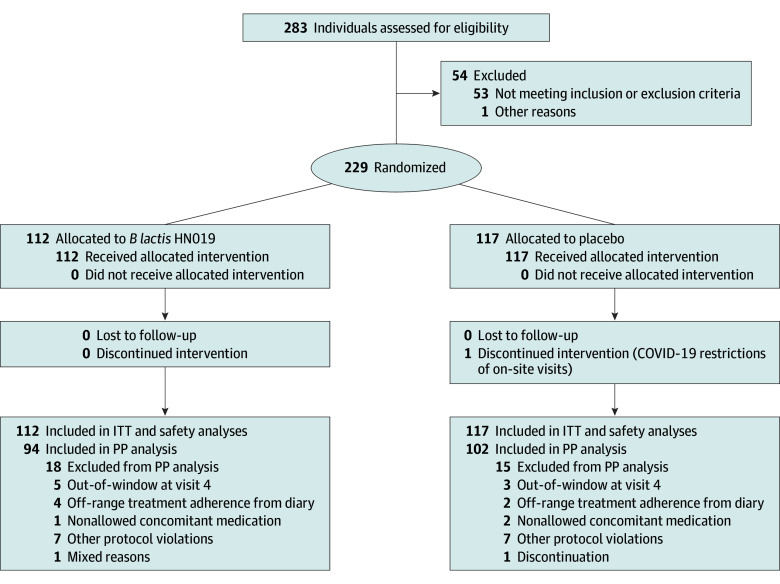
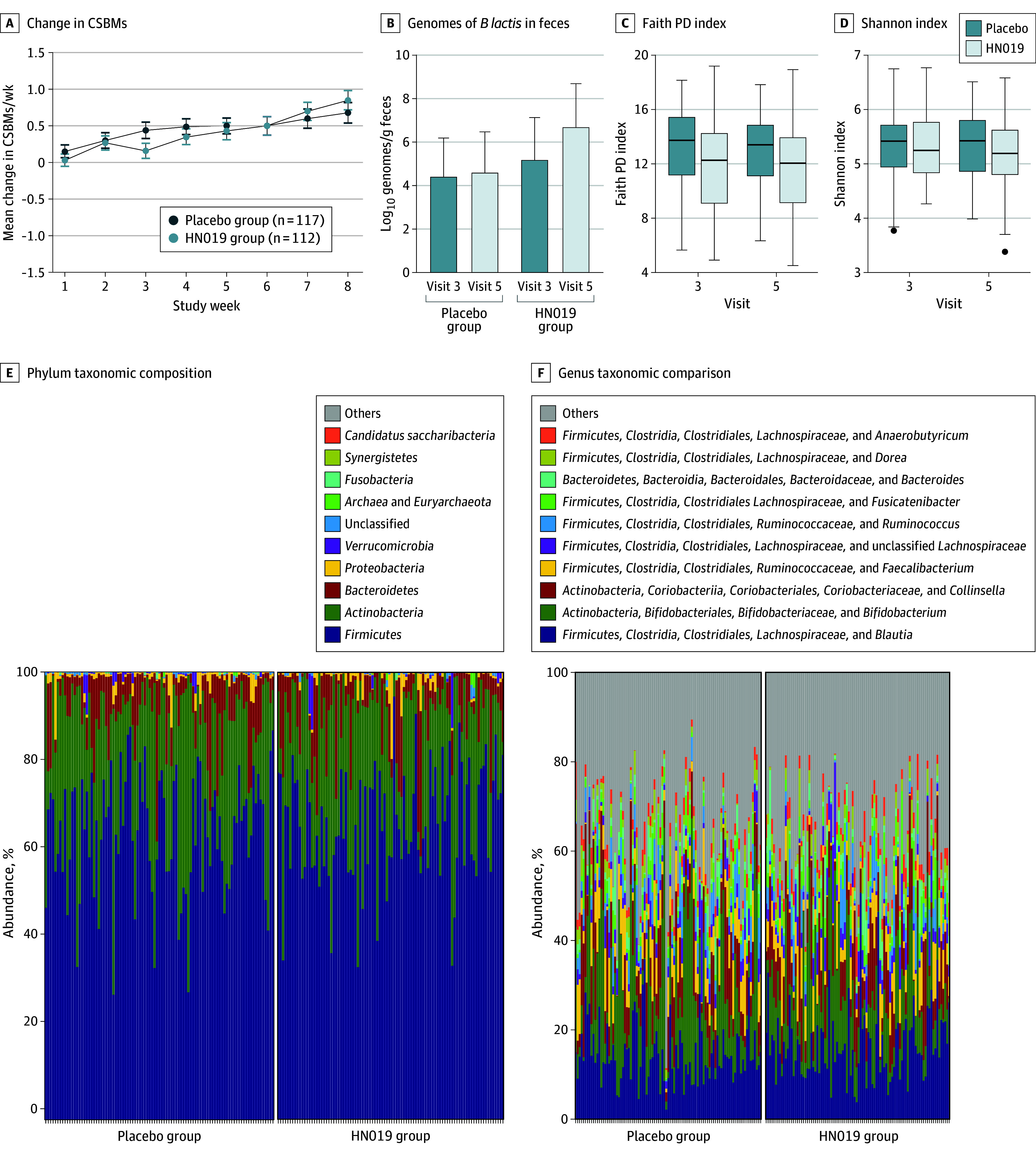
Results: Of the 283 individuals assessed for eligibility, 229 were randomized to either the placebo (n = 117) or the HN019 (n = 112) group. One participant in the placebo group discontinued due to COVID-19 restrictions. The 229 participants (194 [84.7% female) had a median age of 45 (38-52) years, mean (SD) BMI of 22.8 (2.5), and a mean (SD) of 0.77 (1.0) CSBM/wk. There was no difference in the change of weekly CSBMs from baseline to the end of study between the HN019 (least-square mean change, 0.80 [95% CI, 0.54-1.05]) and placebo (least-square mean change, 0.66 [95% CI, 0.41-0.90]) groups.
Conclusions and relevance: Although probiotics have been reported to improve bowel function, this large, well-conducted randomized clinical trial did not confirm such results. Daily consumption of B lactis HN019 at the tested dose of 4.69 × 10⁹ CFU did not outperform placebo to increase CSBMs.
Trial registration: Chinese Clinical Trial Registry Identifier: ChiCTR2000029215.
Conflict of interest statement
Figures
References
-
- Chen MH, Hou XH. Comittee NaM. Chinese expert consensus on chronic constipation (2019, GuangZhou). Chin J Digestion. 2019;39(9):22.
-
- Harris MS, Daniels OT. Core aspects of clinical development and trials in chronic idiopathic constipation. In: Catto-Smith AG, ed. Constipation—Causes, Diagnosis and Treatment. InTech; 2012:147-172.
-
- Ibarra A, Latreille-Barbier M, Donazzolo Y, Pelletier X, Ouwehand AC. Effects of 28-day Bifidobacterium animalis subsp. lactis HN019 supplementation on colonic transit time and gastrointestinal symptoms in adults with functional constipation: a double-blind, randomized, placebo-controlled, and dose-ranging trial. Gut Microbes. 2018;9(3):236-251. doi:10.1080/19490976.2017.1412908 - DOI - PMC - PubMed
Publication types
MeSH terms
Associated data
LinkOut - more resources
Full Text Sources
Medical