


CRISPR/Cas9 in the treatment of sickle cell disease (SCD) and its comparison with traditional treatment approaches: a review
- PMID: 39359808
- PMCID: PMC11444630
- DOI: 10.1097/MS9.0000000000002478
CRISPR/Cas9 in the treatment of sickle cell disease (SCD) and its comparison with traditional treatment approaches: a review
Abstract
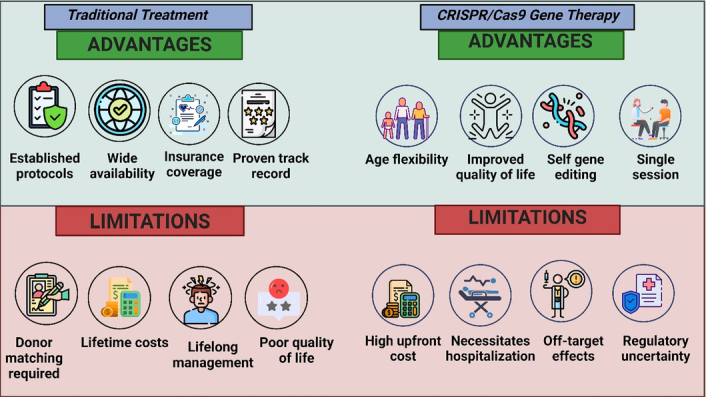
Sickle cell disease (SCD) is a common hereditary blood disorder that profoundly impacts individuals' health, causing chronic pain, anemia, organ damage, increased susceptibility to infections, and social and psychological effects. Over the years, advances in treatment have improved the long-term outcomes of SCD patients. However, problems such as limited access to hematopoietic stem cell transplantation (HSCT) and potential complications associated with the available therapies underscore the importance of continued research and development. The recent FDA approval of Casgevy (Exagamglogene autotemcel), a genetic therapy based on CRISPR/Cas9 technology, demonstrates a comprehensive effort to address the complexity of SCD using new technologies. This review explores the potential of CRISPR/Cas9 for treating SCD and evaluates its efficacy, safety, and long-term outcomes compared to traditional treatment approaches. Long-term research is needed to comprehensively assess the safety, effectiveness, and inclusion of CRISPR/Cas9, ensuring its overall efficacy.
Keywords: CRISPR/Cas9; casgevy; gene editing; hematopoietic stem cell therapy; sickle cell disease.
Copyright © 2024 The Author(s). Published by Wolters Kluwer Health, Inc.
Conflict of interest statement
The authors declare no conflicts of interest.
Figures
References
-
- Sedrak A, Kondamudi NP. Sickle Cell Disease. StatPearls StatPearls Publishing Copyright © 2023. StatPearls Publishing LLC; 2023.
-
- Kavanagh PL, Fasipe TA, Wun T. Sickle cell disease: a review. JAMA 2022;328:57–68. - PubMed
-
- Prevention CDC. Sickle Cell Disease (SCD). Centers for Disease Control and Prevention. 2023. https://www.cdc.gov/sickle-cell/about/
-
- Mangla A, Ehsan M, Agarwal N, et al. Sickle Cell Anemia. StatPearls StatPearls Publishing Copyright © 2023. StatPearls Publishing LLC; 2023.
Publication types
LinkOut - more resources
Full Text Sources