


Chiari malformation and its influence on trigeminal neuralgia: a systematic review
- PMID: 39359841
- PMCID: PMC11444572
- DOI: 10.1097/MS9.0000000000002527
Chiari malformation and its influence on trigeminal neuralgia: a systematic review
Abstract
Objective: In order to properly understand the correlation between TN and Chiari malformation type I (CMI), it is imperative to delve into the underlying processes and develop efficacious treatment strategies.
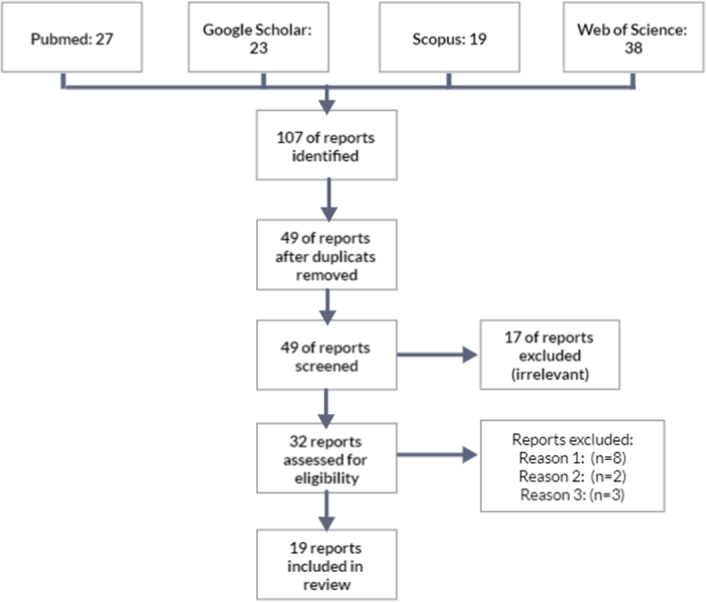
Methods: A comprehensive search was performed regarding trigeminal neuralgia (TN) in individuals diagnosed with CMI. A total of 19 cases were identified in the existing literature.
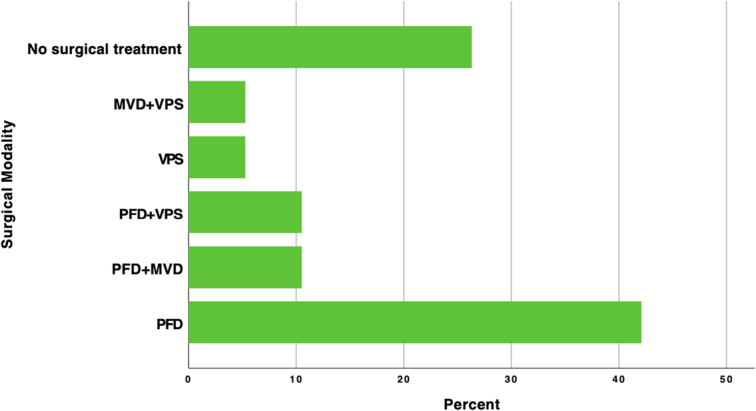
Results: The review of 19 studies showed that the most commonly affected division was V2 (31.6%), followed by V3 (10.5%) and V1 (5.3%). Radiological findings were variable. The medulla oblongata was compressed in 6 patients (31.6%), the cervical spinal cord showed abnormalities in 3 patients (15.8%) abnormalities; one cervical myelocele (5.26%), two cervical syringomyelia (10.53%) while 5 patients (26.3%) showed normal findings. The skull bones in 4 patients (21,1%) showed deformity in the form of small posterior fossa or platybasia. The surgical treatment was conducted in 14 patients (73.7%). The study suggested that posterior fossa decompression (PFD) plus microvascular decompression (MVD) dual surgical modality yielded the best results for V2 distribution (P=0.017).
Conclusion: Chiari malformation type I can directly influence the occurrence and severity of trigeminal neuralgia. Therefore, an effective management of this malformation, like neurovascular decompression, PFD or ventriculoperitoneal shunt, can act as a potential treatment for trigeminal neuralgia. While the PFD alone was effective in the V3 and V1 distribution of trigeminal neuralgia, PFD plus microvascularplus plus microvascular decompression (MVD) as a dual surgical modality yielded the best results for V2 distribution.
Keywords: Chiari malformation; microvascular decompression; posterior fossa decompression; trigeminal neuralgia.
Copyright © 2024 The Author(s). Published by Wolters Kluwer Health, Inc.
Conflict of interest statement
The authors have no relevant financial or non-financial interests to disclose.
Figures

References
-
- da Silva JA, da Silva EB. Basilar impression as a cause of trigeminal neuralgia: report of a case. Arq Neuropsiquiatr 1982;40:165–169. - PubMed
-
- Ayuso-Peralta L, Jiménez-Jiménez FJ, Tejeiro J, et al. . Trigeminal neuralgia associated with Arnold Chiari malformation. Rev Neurol, 29:1345. - PubMed
-
- Iváñez V, Moreno M. Trigeminal neuralgia in children as the only manifestation of Chiari I malformation. Rev Neurol, 28:485–487. - PubMed
-
- Rosetti P, Oulad Ben Taib N, Brotchi J, et al. . Arnold Chiari Type I malformation presenting as a trigeminal neuralgia: case report. Neurosurgery 1999;44:1122–1124. - PubMed
-
- Chakraborty A, Bavetta S, Leach J, et al. . Trigeminal neuralgia presenting as Chiari I malformation. Minim Invasive Neurosurg 2003;46:47–49. - PubMed
Publication types
LinkOut - more resources
Full Text Sources