. 2024;2(1):26.
doi: 10.1038/s44259-024-00043-6. Epub 2024 Sep 30.

Genomic epidemiology describes introduction and outbreaks of antifungal drug-resistant Candida auris

Affiliations

Genomic epidemiology describes introduction and outbreaks of antifungal drug-resistant Candida auris

Dana Kappel et al. NPJ Antimicrob Resist. 2024.

Abstract

Candida auris is a globally emerged fungal pathogen causing nosocomial invasive infections. Here, we use cutting-edge genomic approaches to elucidate the temporal and geographic epidemiology of drug-resistant C. auris within the UK. We analysed a representative sample of over 200 isolates from multiple UK hospitals to assess the number and timings of C. auris introductions and infer subsequent patterns of inter- and intra-hospital transmission of azole drug-resistant isolates. We identify at least one introduction from Clade I and two from Clade III into the UK, and observe temporal and geographical evidence for multiple transmission events of antifungal drug resistant isolates between hospitals and identified local within-hospital patient-to-patient transmission events. Our study confirms outbreaks of drug-resistant C. auris are linked and that transmission amongst patients occurs, explaining local hospital outbreaks, and demonstrating a need for improved epidemiological surveillance of C. auris to protect patients and healthcare services.

Keywords: Eukaryote; Evolutionary ecology; Evolutionary genetics; Fungal evolution; Fungal genomics.


Conflict of interest statement

Competing interestsJ.R. and A.A. have received honoraria from Gilead Sciences.

Figures

Fig. 1
Fig. 1. Dating the introduction of C. auris into the United Kingdom.
ERG11 mutations are shown for each isolate. a Maximum clade credibility phylogeny using the posterior tree distributions of UK Clade I isolates showing a TMRCA as 2008 (CI: 1989–2015). b Maximum clade credibility phylogeny using the posterior tree distributions of UK Clade III isolates showing a TMRCA as 2004 (CI: 1972–2015). Subclades A and B are denoted and posterior distributions are shown. Isolates with raised MICs to 5-FC are depicted with a purple star, and ERG11 mutations are shown as blue for Y132F, red for K143R, and green for F126L. Mutations associated with fluconazole resistance, according to previous studies, are also shown, namely Ala224Ala in B9J08_001302 and His283His in B9J08_001303.
Fig. 2
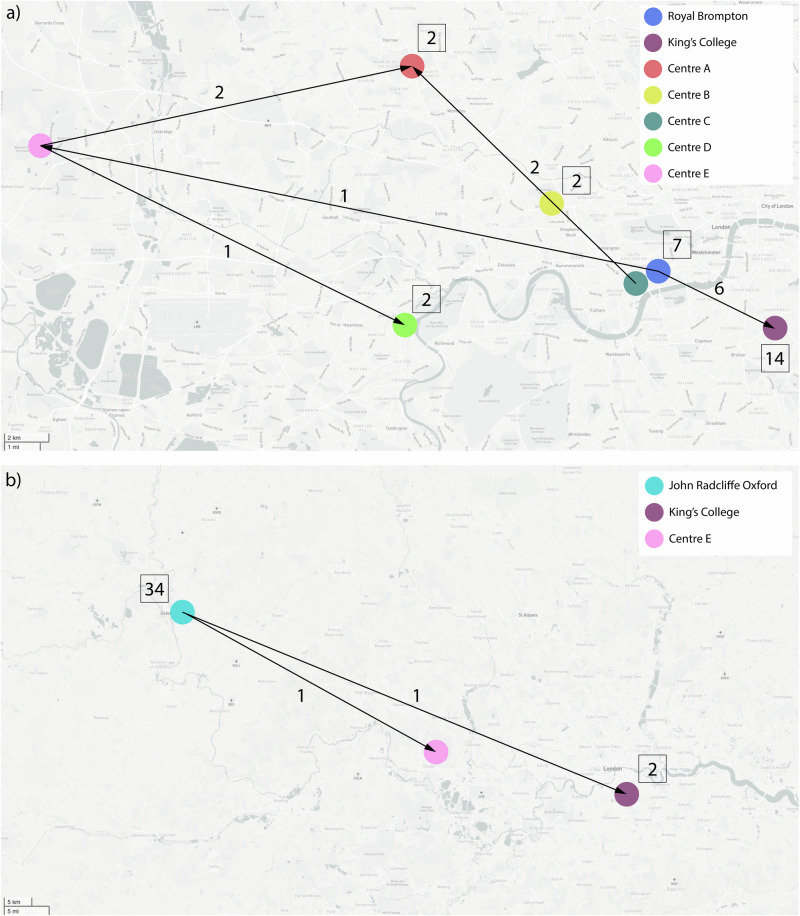
Fig. 2. Intra- and Inter-hospital transmission events identified by TransPhylo.
a Clade I direct transmission directionality according to the analysis in TransPhylo of within hospitals between patients or environmental surfaces and between hospitals. b Clade III direct transmission directionality according to the analysis in TransPhylo of within hospitals between patients or environmental surfaces and between hospitals. In both, the numbers above arrows indicate the number of identified inter-hospital transmissions, whilst numbers within squares indicate the number of identified intra-hospital transmissions.
Fig. 3
Fig. 3. Microevolution of sequential isolates.
a Timelines of six patients in four London hospitals with sampling dates, location of sample and unique SNPs accumulated. b Unrooted, ordered, maximum likelihood phylogenetic tree constructed in RAxML using whole-genome SNPs for sequential isolates taken from six patients in four London hospitals. Branch lengths represent the average number of SNPs.

References

    1. Satoh, K. et al. Candida auris sp. nov., a novel ascomycetous yeast isolated from the external ear canal of an inpatient in a Japanese hospital. Microbiol. Immunol.53, 41–44 (2009). - DOI - PubMed
    1. Worku, M. & Girma, F. Candida auris: from multidrug resistance to pan-resistant strains. Infect. Drug Resist.13, 1287–1294 (2020). - DOI - PMC - PubMed
    1. Gifford, H., Rhodes, J. & Farrer, R. A. The diverse genomes of Candida auris. Lancet Microbe 100903 10.1016/S2666-5247(24)00135-6 (2024). - PubMed
    1. UK Health Security Agency. Candida auris: a Review of Recent Literature (UK Health Security Agency, 2023).
    1. Lockhart, S. R. et al. Simultaneous emergence of multidrug resistant Candida auris on three continents confirmed by whole genome sequencing and epidemiological analyses. Clin. Infect. Dis.64, 134–140 (2017). - DOI - PMC - PubMed

LinkOut - more resources